
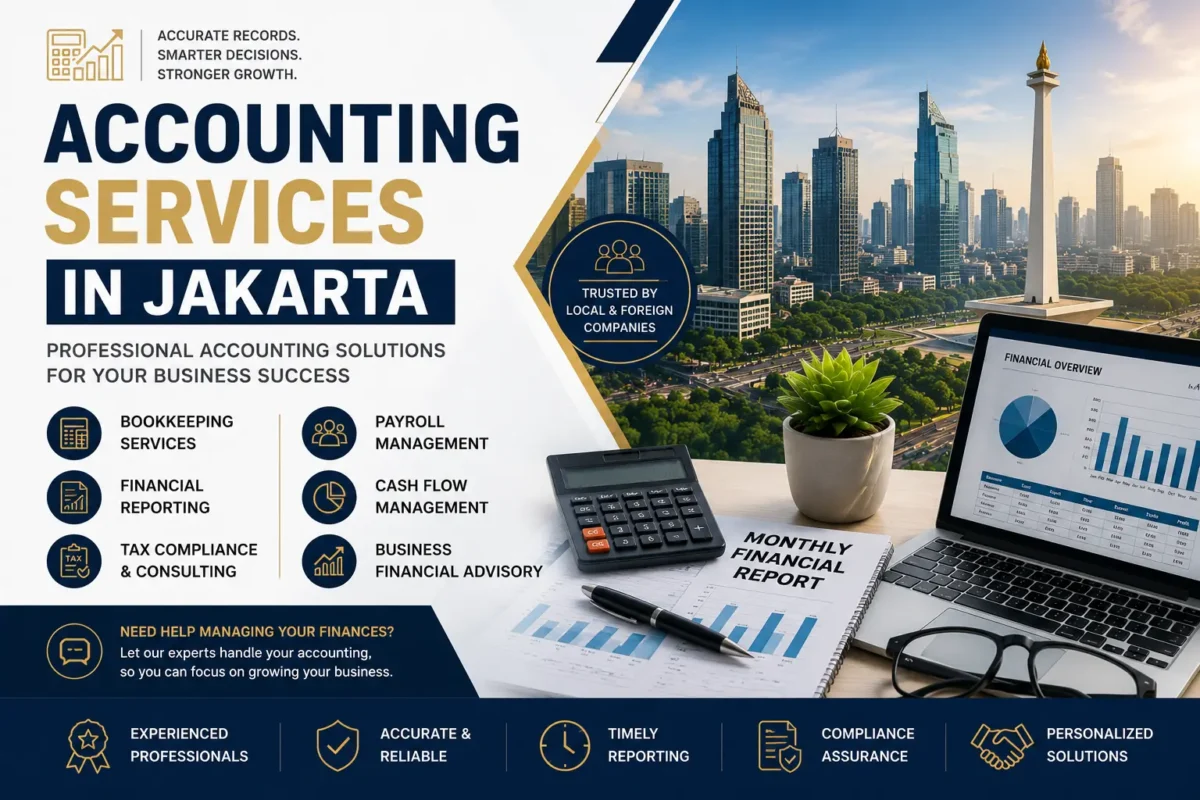
Accounting services in Jakarta help companies turn daily transaction documents into organized ledgers, reconciliations and management reports. The scope should be defined carefully: bookkeeping and report preparation are different from an independent audit, and preparing tax data is different from acting as a formal taxpayer representative.
This page focuses on outsourced accounting support for companies operating in Jakarta. For a broader explanation of tax obligations, see Tax Compliance Indonesia.
Regulatory references checked on 7 September 2026. The appropriate process depends on the company’s legal form, transactions, reporting framework and taxpayer profile.
What accounting services in Jakarta may include
| Workstream | Typical deliverable | Important boundary |
|---|---|---|
| Bookkeeping | Transaction journals, general ledger and supporting-document index | Source documents and management explanations remain the company’s responsibility |
| Bank reconciliation | Reconciliation of bank balances to the ledger with an exception list | Unexplained items require management investigation and approval |
| Receivables and payables | Customer and vendor schedules, ageing and balance checks | Collection, payment approval and commercial decisions remain with management |
| Fixed assets | Asset register and depreciation workpapers | Classification, useful life and tax treatment must follow the applicable basis |
| Payroll data support | Payroll schedules and supporting data for withholding calculations | Employment terms and employee data must be confirmed by the company |
| Management reporting | Draft balance sheet, profit-and-loss, cash-flow and selected schedules | These are not audited statements unless a licensed Public Accountant performs an assurance engagement |
| Tax-data preparation | Reconciled ledger data and draft calculation workpapers | Filing and representation must follow current tax-authorization rules |
Why a clear monthly close matters
A monthly close creates a repeatable point at which the company checks whether transactions have been recorded completely and consistently. It does not guarantee that every estimate or tax position is correct, but it helps management identify missing documents and unusual balances before year-end.
A practical close commonly includes:
- collecting sales, purchase, expense, payroll and bank records;
- posting transactions to the agreed chart of accounts;
- reconciling bank, cash, receivables, payables and selected control accounts;
- reviewing cut-off, accruals, prepayments and fixed assets;
- preparing an exception list for management clarification;
- closing the approved adjustments; and
- issuing the agreed management-reporting package.
Company records and management responsibility
Article 28 of Indonesia’s General Provisions and Tax Procedures Law requires corporate taxpayers to maintain books. The Directorate General of Taxes explains that the books must be prepared in good faith, reflect actual business activities and support the financial statements attached to the annual corporate tax return.
The accounting provider works from information supplied or approved by the company. Directors and management remain responsible for transaction authorization, completeness of source documents, accounting estimates, selected policies and the use of the reports.
An accounting engagement should therefore specify:
- the accounting period and reporting currency;
- the applicable chart of accounts and reporting framework;
- the document cut-off date;
- who approves journal adjustments;
- which reconciliations and schedules are included;
- the delivery date and review process; and
- items expressly excluded from the engagement.
Management reports are not an audit opinion
Bookkeeping staff may compile ledgers and prepare financial-statement drafts. That work does not provide independent assurance.
Under Law No. 5 of 2011 on Public Accountants, assurance services—including audits and reviews of historical financial information—may only be provided by a licensed Public Accountant. When assurance is required, the accounting provider can prepare schedules and coordinate with a separately engaged Public Accountant or public accounting firm (KAP).
Accounting support and tax work
Accounting records provide inputs for tax analysis, but they do not determine by themselves which taxes apply. VAT depends, among other things, on PKP status and taxable supplies. Withholding obligations depend on the type of payment and recipient. Payroll-related obligations depend on the workforce and remuneration.
An accounting engagement may include organizing tax documents, reconciling relevant accounts and preparing workpapers for review. Formal exercise of a taxpayer’s rights or obligations by another person is subject to the representative requirements in PMK 44/2026 and the professional rules in PMK 55/2026.
Documents commonly needed at onboarding
- deed, NIB, NPWP and current corporate data;
- opening trial balance and latest financial statements;
- chart of accounts and accounting-policy information;
- bank statements and payment records;
- sales, purchase and expense documents;
- customer, vendor, payroll and fixed-asset data;
- previous tax returns and payment receipts; and
- contracts supporting material or unusual transactions.
Choosing an accounting-service scope
Compare providers using a written scope rather than broad promises. Useful questions include:
- Which ledgers and reconciliations are delivered every month?
- Who reviews exception items and approves adjustments?
- What is the cut-off for receiving documents?
- How are confidential records transferred and retained?
- Which tax tasks are data preparation, which are filing, and which require a qualified representative?
- Who performs an audit if independent assurance is required?
Outsourcing may change staffing and workflow costs, but cost savings or improved profitability cannot be guaranteed. The result depends on transaction volume, document quality, internal controls and the scope purchased.
How Jakarta Legal ID can support companies in Jakarta
Jakarta Legal ID can support transaction recording, ledger maintenance, reconciliations, management-report preparation and tax-data organization. When regulated tax representation or independent assurance is required, the company should appoint a professional who holds the necessary authority or licence for that engagement.
See the service overview at Financial & Tax Consulting and the topic pillar at Financial Consultant Indonesia.
Frequently asked questions
Do accounting services include an audit?
No, not automatically. Bookkeeping and management-report preparation do not provide assurance. An audit or review must be separately performed by a licensed Public Accountant.
Does every business need monthly bookkeeping?
The law requires corporate taxpayers to maintain books, but the operational frequency and service package should match transaction volume, reporting needs and filing obligations. Monthly processing is a common control practice, not a universal statutory service format.
Is VAT reporting included for every company?
No. VAT work is relevant when the company’s status and transactions create the obligation. The scope must be confirmed from actual facts.
Who is responsible for the final financial information?
Management remains responsible for the company’s records, judgments, approvals and use of the reports.
Official references
- Directorate General of Taxes: corporate bookkeeping and financial statements
- Law No. 5 of 2011 on Public Accountants
- PMK 44/2026: taxpayer representatives
- PMK 55/2026: tax consultants and other representatives
Need a defined monthly accounting scope? Contact Jakarta Legal ID with the company’s entity type, transaction volume, current records and required reporting package for an initial scope review.