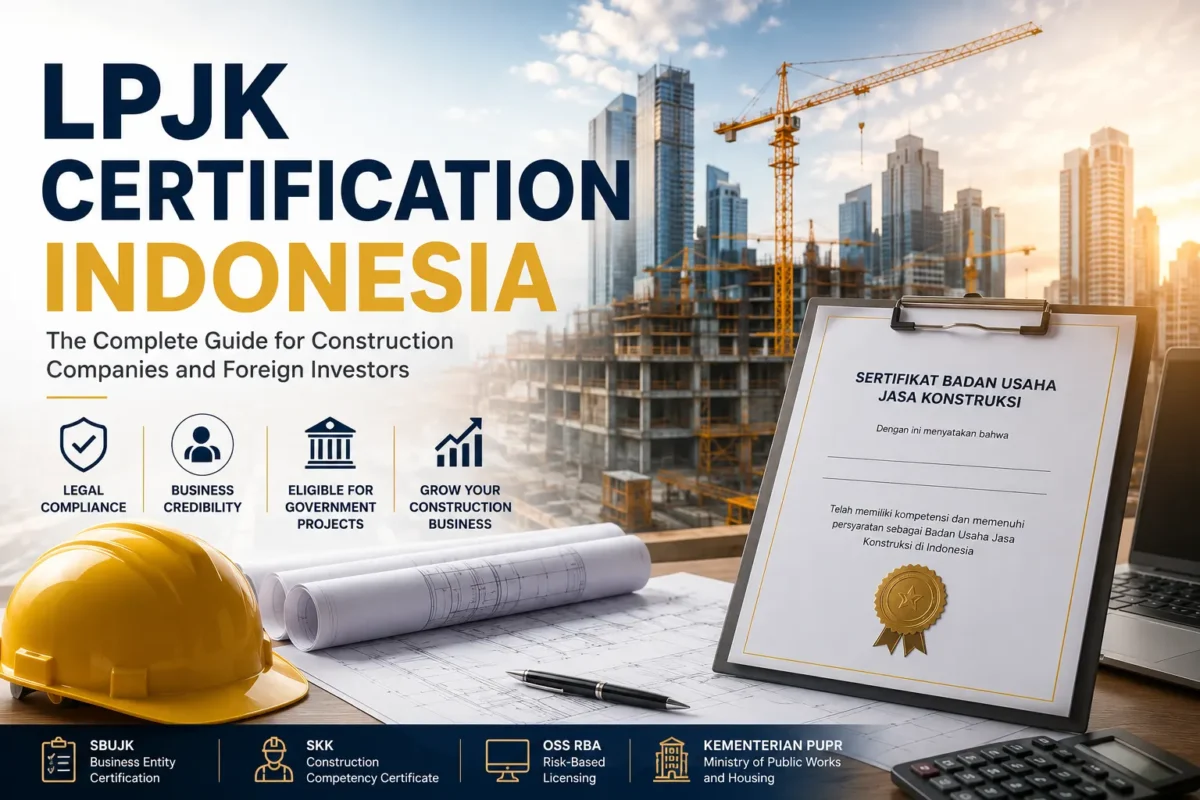
Companies operating in Indonesia’s construction sector must comply with national licensing and certification requirements. One of the most important requirements is obtaining LPJK Certification Indonesia, which demonstrates that a construction business meets the standards established under Indonesian construction regulations.
Whether you are an Indonesian contractor or a foreign investor planning to establish a construction company in Indonesia, understanding the LPJK certification process is essential for legal compliance and business growth.
This guide explains everything you need to know, including the certification requirements, application process, legal framework, benefits, estimated timeline, and common questions.
What Is LPJK Certification Indonesia?
LPJK Certification Indonesia refers to the certification system for construction service providers that ensures companies comply with Indonesia’s construction regulations, professional standards, and competency requirements.
Following regulatory reforms, the certification process is administered under the supervision of the Ministry of Public Works and Housing (PUPR), while LPJK continues to play an important role in maintaining standards within Indonesia’s construction industry.
Today, LPJK certification is closely connected with:
- Business Entity Certification (SBU)
- Construction Workforce Certification (SKK)
- OSS Risk-Based Licensing (OSS RBA)
- Construction Business Licensing
These certifications verify that a construction company possesses the qualifications necessary to undertake construction projects legally.
Why LPJK Certification Matters
Obtaining LPJK Certification provides several important advantages.
Legal Compliance
Construction companies must satisfy licensing requirements before participating in many public and private projects.
Business Credibility
Certification demonstrates that a company meets national competency standards, increasing trust among project owners and business partners.
Government Tender Eligibility
Many government procurement projects require certified construction companies.
Competitive Advantage
Certified businesses are generally viewed as more reliable and capable when bidding for projects.
Business Expansion
Certification enables companies to pursue larger and more complex construction opportunities across Indonesia.
Who Needs LPJK Certification?
LPJK Certification is generally required for:
- Construction contractors
- Construction consultants
- Engineering service providers
- Infrastructure companies
- EPC contractors
- Mechanical and electrical contractors
- Foreign construction companies operating through Indonesian entities
- Joint venture construction companies
Businesses involved in planning, supervision, or execution of construction work should verify the certification requirements applicable to their activities.
Main Requirements for LPJK Certification Indonesia
Although specific requirements may vary depending on business classification, companies generally need to prepare:
Company Documents
- Company Deed of Establishment
- Business Identification Number (NIB)
- Tax Identification Number (NPWP)
- OSS Registration
- Company domicile information
Technical Personnel
Construction companies must employ certified professionals holding the appropriate SKK (Construction Competency Certificate).
Business Classification
The company must determine the correct business classification based on:
- Construction specialization
- Business scale
- Project category
- Technical capability
Administrative Compliance
Applicants must complete all administrative documentation before certification can proceed.
Read More: Business Certification Indonesia: Complete Guide to SBU, LPJK, and Business Certification Services
LPJK Certification Process
The certification process typically involves several stages.
1. Company Assessment
Business activities and qualifications are reviewed to determine the appropriate certification category.
2. Document Preparation
Legal, technical, and administrative documents are compiled.
3. Technical Verification
The submitted documents undergo verification to ensure compliance with Indonesian construction regulations.
4. Certification Submission
Applications are submitted through the designated certification system.
5. Evaluation
Authorities review documentation and may request additional information if necessary.
6. Certificate Issuance
Upon approval, the company receives the relevant certification, allowing it to operate within its approved business classification.
Estimated Processing Time
Processing times vary depending on:
- Completeness of documentation
- Company classification
- Technical personnel availability
- Verification requirements
- Government processing schedules
Preparing accurate documentation from the beginning can significantly reduce delays.
Common Challenges During Certification
Many companies encounter issues such as:
Incomplete Documentation
Missing corporate documents often delay the application.
Incorrect Business Classification
Selecting an inappropriate construction classification may result in rejection or additional review.
Insufficient Certified Personnel
Construction companies must have qualified technical personnel with valid competency certifications.
Regulatory Changes
Indonesia periodically updates construction regulations. Businesses should verify the latest requirements before applying.
LPJK Certification for Foreign Companies
Foreign investors interested in Indonesia’s construction industry must comply with additional legal requirements.
Depending on the business model, foreign companies may need to:
- Establish an Indonesian company
- Form a joint venture
- Obtain investment approvals
- Register through OSS
- Fulfill construction licensing requirements
- Obtain the appropriate business certifications
Professional legal guidance can simplify these procedures and reduce compliance risks.
Benefits of Working with a Professional Consultant
Although companies may complete the process independently, many choose professional consultants because they can assist with:
- Initial eligibility assessment
- Business classification
- Documentation review
- Government submissions
- Regulatory compliance
- Communication with relevant authorities
- Faster application preparation
Professional assistance often minimizes administrative errors that could delay certification.
How LPJK Certification Supports Business Growth
Certification is more than a regulatory requirement.
It helps businesses:
- Build stronger market credibility
- Increase client confidence
- Access larger projects
- Participate in government procurement
- Improve corporate reputation
- Demonstrate compliance with Indonesian construction standards
For companies planning long-term operations in Indonesia, certification forms an important foundation for sustainable growth.
Frequently Asked Questions
What is LPJK Certification Indonesia?
It is a certification system for construction businesses that verifies compliance with Indonesia’s construction regulations and competency standards.
Is LPJK Certification mandatory?
Many construction activities require certification under applicable Indonesian regulations. Businesses should confirm the latest requirements based on their specific activities.
Who can apply?
Construction contractors, consultants, engineering firms, and eligible construction service providers.
Can foreign companies obtain LPJK Certification?
Yes. Foreign investors can obtain the required certifications by complying with Indonesian investment and construction regulations.
What documents are required?
Typical documents include company registration documents, OSS registration, tax documents, technical personnel certifications, and supporting administrative records.
How long does the certification process take?
The timeline depends on document readiness, company classification, and regulatory review.
What is the difference between LPJK and SBU?
LPJK establishes and maintains standards within the construction sector, while the Business Entity Certificate (SBU) confirms that a company meets the required qualifications for specific construction services.
Does certification need renewal?
Yes. Companies should monitor certificate validity and complete renewal procedures before expiration.
Can consultants help with the process?
Yes. Professional consultants can assist with documentation, compliance, submissions, and regulatory coordination.
Where can businesses obtain professional assistance?
Companies seeking guidance can work with experienced legal and business consultants specializing in Indonesian construction licensing.
Conclusion
LPJK Certification Indonesia is an essential requirement for companies operating within Indonesia’s construction industry. Beyond regulatory compliance, certification strengthens business credibility, improves competitiveness, and creates opportunities to participate in larger public and private projects.
Because construction regulations may change, businesses should always verify the latest requirements before submitting an application. Preparing complete documentation and understanding the applicable business classifications can significantly improve the efficiency of the certification process.
If your company plans to establish or expand construction operations in Indonesia, obtaining the appropriate certifications is a critical step toward long-term success.
Need assistance with LPJK Certification Indonesia, business licensing, or construction compliance?
The legal and licensing specialists at Jakarta Legal ID can assist with document preparation, regulatory compliance, business licensing, and certification processes for both Indonesian and foreign companies.
Contact Jakarta Legal ID to discuss your construction licensing requirements with experienced professionals.
Suggested References
- Ministry of Public Works and Housing (PUPR)
- OSS Risk-Based Licensing (OSS RBA)
- Indonesian Construction Services Law (Law No. 2 of 2017, as amended)
- Relevant implementing regulations issued by the Government of Indonesia