
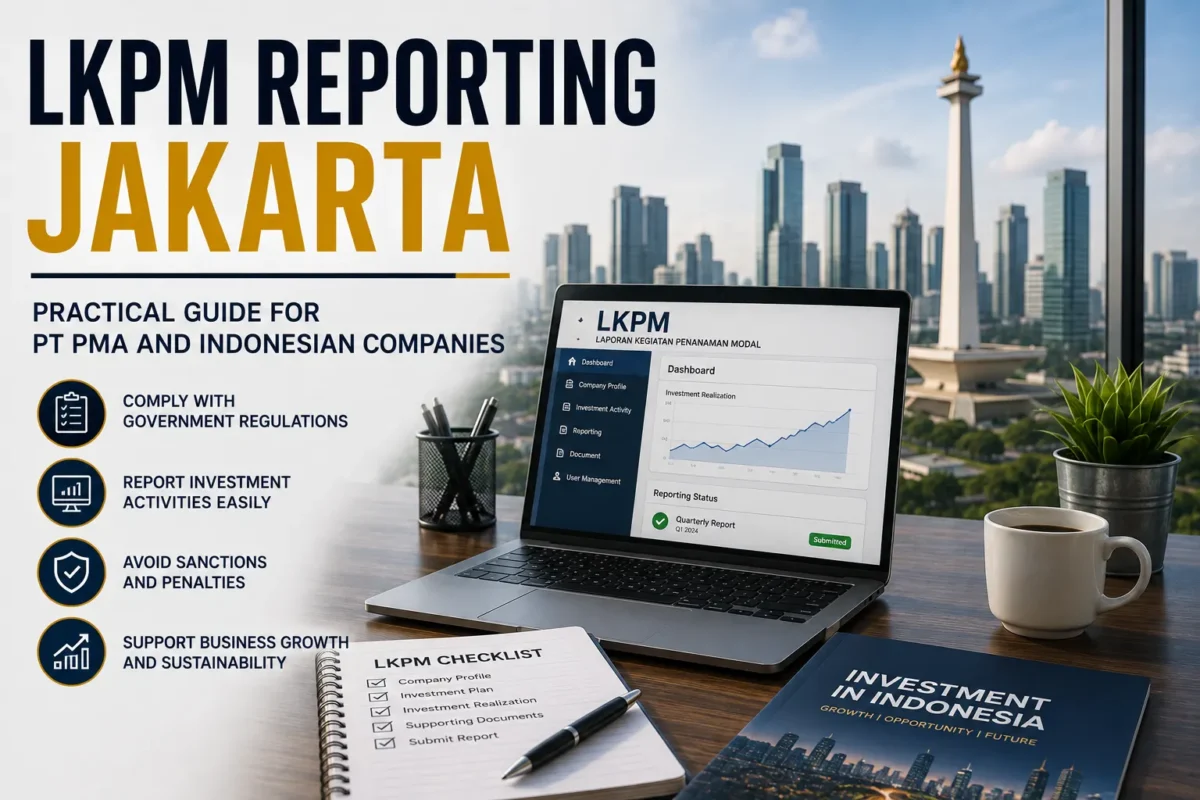
LKPM, or Laporan Kegiatan Penanaman Modal, is Indonesia’s Investment Activity Report. It is used to report investment realization and the fulfillment of investment obligations through the Online Single Submission system.
For companies handling LKPM reporting Jakarta, the first step is to determine the company’s business scale, project status, registered activities, and applicable reporting period. LKPM should not be confused with a corporate annual report or tax return. It is a separate investment-supervision report linked to the company’s projects and OSS records.
The current framework is contained in Minister of Investment and Downstreaming/Head of BKPM Regulation No. 5 of 2025, which is listed by BKPM JDIH as in force.
LKPM Reporting Jakarta: What Is the Obligation?
Under the current regulation, business actors submit LKPM through OSS to report the development of investment realization and fulfillment of investment obligations.
The report can include information relating to:
- Investment realization
- Indonesian workforce realization
- Production of goods or services
- Fulfillment of basic requirements and business licensing
- Investment obligations and responsibilities
- Obstacles encountered by the business
The reporting obligation is tied to each business activity and project location after the business actor obtains an NIB. This makes project-level consistency important, particularly for companies with several KBLI activities or several operating locations.
Which Companies Must Submit LKPM?
Article 286 of the current regulation distinguishes reporting frequency according to business scale.
Business actors with a small-business scale report every six months, while medium and large businesses report every three months.
The same provision states that LKPM is not required for:
- Micro-scale businesses
- Business activities financed from the national budget or regional budget
The company’s reporting cycle should therefore be determined from its actual OSS business scale rather than assumptions based on turnover, shareholder nationality, or the company’s commercial profile alone.
PT PMA Is Generally on the Quarterly Reporting Cycle
For foreign-investment companies, the rule is clearer. Article 26 of Regulation No. 5 of 2025 provides that a business entity categorized as PMA is a large business, unless another applicable regulation provides otherwise.
Because medium and large businesses submit LKPM every three months under Article 286, PT PMA companies generally follow the quarterly LKPM schedule.
This is why a foreign-owned company should not rely on older website content that links LKPM frequency to paid-up capital alone. Under the current framework, the reporting frequency is expressly tied to business scale.
Jakarta Legal ID’s verified Financial & Tax Consulting service includes LKPM reporting support within its financial compliance services.
Small Businesses Report Every Semester
Small-scale businesses subject to LKPM submit reports every six months.
The current periods are:
- Semester I covering January through June, due no later than 15 July of the same year
- Semester II covering July through December, due no later than 15 January of the following year
The regulation’s official LKPM format for small businesses also follows these semester periods.
Current LKPM Reporting Deadlines
For medium and large businesses, including PT PMA under the general rule, LKPM is submitted quarterly.
The current statutory deadlines are:
Reporting period | Reporting deadline | Quarter I: January–March | No later than 15 April | | Quarter II: April–June | No later than 15 July | | Quarter III: July–September | No later than 15 October | | Quarter IV: October–December | No later than 15 January of the following year
These deadlines are stated in Article 286 of Regulation No. 5 of 2025.
If a reporting date coincides with a national holiday, the regulation provides that the reporting period may be adjusted through an official notification to business actors.
Companies should therefore rely on the current OSS notice and regulation rather than reusing a filing calendar from a previous year.
Preparation Stage vs Operational and Commercial Stage
Medium and large businesses do not necessarily use one identical LKPM form throughout the life of a project.
The current regulation distinguishes between:
- Preparation-stage LKPM for a business activity that has not yet become operational or entered commercial transactions
- Operational and/or commercial LKPM for an activity that is ready for or has entered operation or commercial transactions
For operational or commercial reporting, the current regulation provides that the business actor submits the relevant LKPM after completing the declaration of readiness for operational and/or commercial activity in OSS.
Data Should Match the Company’s Actual Project Status
A company should not change its reporting stage simply because construction appears substantially complete or because management informally considers the business operational.
The reporting status should be reconciled with the information actually recorded in OSS, including the relevant activity and project status.
This becomes particularly important where the company has:
- Several KBLI activities
- More than one project location
- A mixture of preparation-stage and operational projects
- Recent amendments to business activities
- Changes in investment plans
Each material project should be reviewed individually before the LKPM is prepared.
What Information Is Reported in LKPM?
Under the current regulation, LKPM reporting can cover investment and compliance information beyond a single investment number.
For medium and large businesses, the official forms and regulation include information relating to company identity, NIB, business activity, project location, investment realization, workforce, production, licensing obligations, and operational issues.
For example, the operational/commercial reporting format includes investment realization data and draws several company and project fields automatically from OSS.
Businesses should therefore reconcile LKPM with internal records before submission, rather than entering estimates solely to complete the form.
Useful supporting records may include:
- Fixed-asset acquisition records
- Construction and equipment expenditures
- Project-location records
- Employment data
- Production or service realization data
- OSS business activity information
- Applicable licenses and approvals
- Investment realization schedules
Accounting records can help support investment figures, but LKPM figures should still be reviewed under the definitions and reporting instructions applicable to LKPM rather than copied automatically from the financial statements.
LKPM Reporting Jakarta Pre-Filing Checklist
Before submitting LKPM reporting Jakarta, review:
- The company’s current business scale in OSS
- Whether the relevant activity is subject to LKPM
- The correct reporting period
- Each KBLI activity being reported
- Each project location
- Preparation versus operational/commercial status
- Investment realization for the reporting period
- Cumulative investment realization where required
- Workforce realization
- Production or service information where applicable
- Business licensing and supporting obligations
- Any obstacle that should be reported
- Consistency between internal records and OSS information
- Whether previous LKPM reports have received approval or requests for correction
After submission, the current regulation provides for verification and evaluation through OSS. The result can be an approval notification or a request for correction.
Common LKPM Reporting Problems
Using the Wrong Reporting Frequency
A common error is assuming every company reports quarterly or that the schedule is determined solely by paid-up capital. Under the current regulation, small businesses report every semester, while medium and large businesses report quarterly.
Treating LKPM as a Tax Report
LKPM reports investment activity and compliance information. It is separate from monthly tax returns, annual corporate income tax reporting, and the company’s financial statements.
For broader accounting and tax preparation, Jakarta Legal ID’s existing Tax Compliance Indonesia guide provides a separate tax-focused framework.
Reporting One Combined Figure for Different Projects
LKPM is linked to activities and locations. Companies with several projects should check the relevant project and business activity before entering realization data.
Failing to Reconcile OSS Data
Incorrect address, KBLI, investment plan, project stage, or company information in OSS can complicate the reporting process. Corporate or OSS data changes should be handled through the relevant amendment workflow instead of being concealed within the LKPM report.
Ignoring a Request for Correction
Under the current regulation, LKPM submissions are verified through OSS and can result in a request for correction. A company should monitor the submission status rather than assuming that receiving an initial submission receipt means the reporting process is fully complete.
Conclusion
LKPM is an ongoing investment-reporting obligation that should be managed separately from tax, accounting, and corporate annual reporting. Under the current framework, small businesses report every semester, medium and large businesses report quarterly, and micro businesses and qualifying APBN or APBD-funded activities are exempt from this particular LKPM obligation.
For Jakarta companies, especially PT PMA, the most reliable approach is to maintain project-level records throughout the year, reconcile them with OSS before every reporting period, use the correct preparation or operational form, and monitor the submission until the OSS verification process is complete.
Prepare and Review Your LKPM Before the Reporting Deadline
LKPM errors can arise when investment figures, project locations, KBLI activities, workforce data, or OSS project status do not match the company’s actual records. Preparing the report from reconciled project and financial information makes the filing process easier to manage and reduces the need for avoidable corrections.
Jakarta Legal ID can assist businesses and investors with reviewing LKPM data and coordinating the reporting process. Its verified provides a relevant starting point for consultation on investment reporting, accounting, and related corporate compliance.
FAQ – LKPM reporting Jakarta
What is LKPM in Indonesia?
LKPM stands for Laporan Kegiatan Penanaman Modal, or Investment Activity Report. It is submitted through OSS to report investment realization and fulfillment of applicable investment obligations.
Who must submit LKPM?
Under Minister of Investment and Downstreaming/Head of BKPM Regulation No. 5 of 2025, small, medium, and large businesses generally submit LKPM for applicable business activities and project locations after obtaining an NIB. Micro businesses and activities financed from APBN or APBD are exempt from this LKPM requirement.
How often must a PT PMA submit LKPM?
PT PMA is categorized as a large business under the current general investment rule. Large businesses submit LKPM every three months, so a PT PMA generally follows the quarterly reporting cycle unless another applicable regulation provides otherwise.
What are the quarterly LKPM deadlines?
For medium and large businesses, Quarter I is due no later than 15 April, Quarter II by 15 July, Quarter III by 15 October, and Quarter IV by 15 January of the following year. Official notices should still be checked where a deadline coincides with a national holiday.
How often does a small business submit LKPM?
A small-scale business subject to LKPM reports every six months. Semester I is due no later than 15 July and Semester II no later than 15 January of the following year.
Does every Indonesian company have to file LKPM?
No. The current regulation expressly exempts micro businesses and business activities financed from APBN or APBD from the general LKPM investment-realization reporting requirement. Applicability should be checked against the company’s actual OSS profile and activities.
What is the difference between preparation-stage and operational LKPM?
For medium and large businesses, preparation-stage LKPM applies to activities that have not yet become operational or entered commercial transactions. Operational or commercial LKPM applies to activities that are ready for or have begun operation or commercial transactions, subject to the applicable OSS status and declaration.
What information is commonly included in LKPM?
The current framework includes investment realization, workforce realization, production information, fulfillment of licensing and investment obligations, and obstacles encountered by the business. The exact form depends on the reporting category and project stage.
Is LKPM the same as an annual corporate tax return?
No. LKPM is investment-activity reporting through OSS, while the annual corporate tax return is a separate tax obligation. Accounting records may support both processes, but the purpose, definitions, forms, and filing systems are different.
What happens after an LKPM is submitted through OSS?
The current regulation provides for verification and evaluation through OSS. The business may receive an approval notification or a request for correction, so the submission status should be monitored until the reporting process is resolved.
References & Sources
- BKPM JDIH — Minister of Investment and Downstreaming/Head of BKPM Regulation No. 5 of 2025
- OSS Indonesia — LKPM Non-UMK Preparation or Construction Stage Guide
- OSS Indonesia — LKPM Non-UMK Operational or Commercial Stage Guide
- LKPM — Laporan Kegiatan Penanaman Modal (LKPM)