
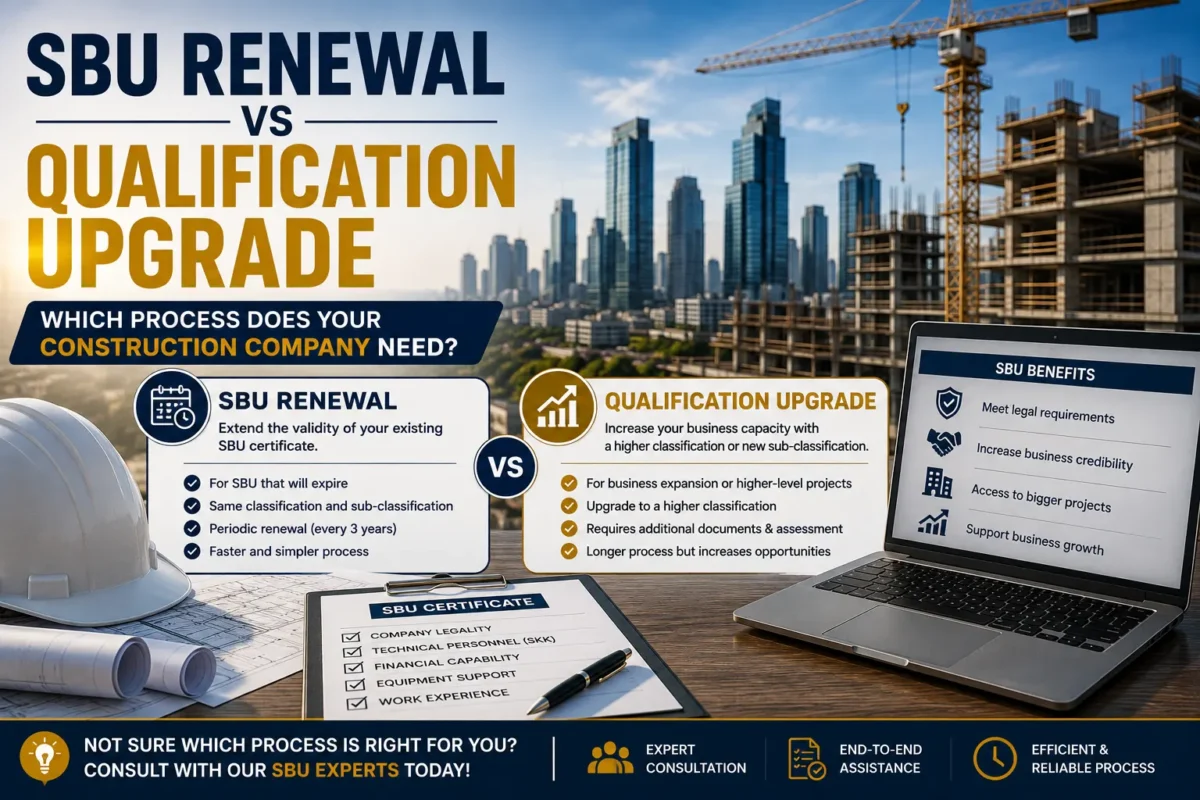
A construction company with an existing SBU does not always need the same application when its certificate approaches expiry. Some businesses only need to maintain their current certification, while others want to move into a higher business qualification because their financial capacity, experience, workforce, and project strategy have changed.
The practical difference in SBU Renewal vs Qualification Upgrade is straightforward: renewal is used to continue an SBU when the existing qualification remains appropriate, while a qualification upgrade seeks a higher qualification and therefore requires the business to support that higher level with the applicable certification criteria.
The current Minister of Public Works Regulation No. 6 of 2025 expressly lists SBU renewal and SBU qualification change as separate application types. The regulation also establishes the current standards used to assess construction business qualification.
SBU Renewal vs Qualification Upgrade: The Core Difference
The right process depends on what the construction company wants to achieve. SBU renewal is used when the company intends to continue its existing certification and qualification, while a qualification upgrade is used when the company wants to move to a higher certified business capacity.
When SBU Renewal Is the Right Choice
SBU renewal is generally appropriate when:
- The existing SBU is approaching its expiry date
- The company intends to maintain its current qualification
- The existing classifications and subclassifications remain relevant
- Annual sales and financial capacity still support the qualification
- Construction personnel and TKK data remain appropriate
- Equipment and other certification data remain consistent with the certified scope
Renewal is not simply an extension of the certificate’s validity. The company’s current eligibility and supporting information still need to be reviewed.
When a Qualification Upgrade Is the Better Route
A qualification upgrade should be considered when the company wants to obtain a higher certified business capacity.
This may be relevant when:
- The company intends to pursue projects requiring a higher qualification
- Annual sales have increased sufficiently to support the target qualification
- Financial capacity meets the requirements for the higher level
- Construction personnel meet the competency requirements associated with the intended qualification
- Equipment capacity supports the relevant construction subclassifications
- The company’s certification strategy has changed as the business has expanded
An increase in annual sales alone does not automatically mean the company must upgrade. The target qualification should be supported by the company’s overall financial, technical, personnel, and operational capacity.
Practical Comparison
| Issue | SBU Renewal | Qualification Upgrade |
|---|---|---|
| Primary objective | Continue the existing SBU and qualification | Move to a higher qualification |
| Typical trigger | Existing SBU is approaching expiry | Company needs higher certified capacity |
| Qualification review | Existing eligibility is reassessed | Eligibility for the higher qualification must be demonstrated |
| Annual sales | Reviewed to confirm continued eligibility | Reviewed against the target qualification |
| Financial capacity | Must continue supporting the existing qualification | Must support the higher qualification |
| Personnel and TKK | Must remain suitable for the certified scope | May need to satisfy higher competency requirements |
| Equipment | Must remain consistent with existing subclassifications | May require stronger or different equipment capability |
| Certification outcome sought | Maintain the current qualification | Obtain a higher qualification |
A company should therefore avoid using renewal as a general term for every change to an existing SBU. If the objective is to increase the company’s certified capacity, the appropriate process may be a qualification change rather than a standard renewal.
For companies reviewing their certification strategy, Jakarta Legal ID‘s Business Certification SBU service covers both SBU renewal and qualification-upgrade support.
Choose Renewal When the Existing Qualification Still Fits
Renewal is the logical route when the company intends to continue substantially the same certified business capacity and the existing qualification remains appropriate for its operations.
Under the current 2025 standard, an SBU is valid for three years and an SBU being renewed must be submitted no later than 30 working days before the end of its validity period. Companies should therefore review readiness before that filing point rather than begin document reconciliation after the certificate is already close to expiring.
A renewal still involves more than extending a date. Current certification data must support continued eligibility.
Renewal Does Not Automatically Guarantee the Same Qualification
The current regulation links qualification assessment to business capacity.
For a general BUJK, qualification is assessed using:
- Annual sales
- Financial capacity
- Availability of construction workforce or TKK
- Ability to provide construction equipment
The 2025 standard contains an important rule: if annual sales exceed the upper limit of the company’s existing qualification, the BUJK may still retain its existing qualification. In other words, higher sales do not automatically force the company to upgrade.
Conversely, where annual sales do not reach the minimum required for the qualification held, the regulation provides that the BUJK receives a qualification corresponding to its annual sales.
This makes renewal a compliance assessment, not an unconditional right to receive exactly the same qualification again.
Renewal Has Specific Experience and Reporting Requirements
Renewal applicants also have obligations that should be checked before filing.
The current 2025 regulation links renewal to construction experience within the relevant subclassification and requires renewal applicants to have current supporting information including:
- Annual business activity reporting through the integrated construction information system
- Sustainable business development information
- Annual sales and recorded business experience
- Current financial information
- Construction workforce data
- Equipment information where applicable
- Anti-bribery management information
- BUJK association membership
- Beneficial ownership reporting
Companies should reconcile these records before submitting renewal rather than assume that documents from the previous certification remain sufficient.
Choose a Qualification Upgrade When the Business Needs a Higher Capacity Level
A qualification upgrade is relevant when the company intends to move beyond its current certified business capacity and can satisfy the requirements for a higher qualification.
The current regulation groups BUJK qualifications into small, medium, and large. For general Construction Work businesses, the small category is further divided into K1, K2, and K3. Jakarta Legal ID’s SBU Classification Construction guide provides broader context on classification, subclassification, and qualification as separate certification concepts.
An upgrade may be commercially relevant when the company plans to compete in a project segment that its current qualification does not cover or when its business capacity has grown sufficiently to justify a higher certification level.
Higher Annual Sales Do Not Automatically Force an Upgrade
Growing revenue alone is not a reason to file an upgrade automatically.
Under the current rule, a BUJK whose annual sales exceed the upper threshold of its existing qualification may retain that qualification. The decision to upgrade should therefore consider the company’s intended projects, financial capacity, personnel, equipment, and certification strategy rather than sales alone.
This is an important distinction because an upgrade can create higher eligibility requirements for the business.
The Target Qualification Must Be Supported by Current Capacity
The current 2025 framework assesses qualification primarily through annual sales and financial capacity, then assesses the relevant subclassification using construction workforce and equipment criteria.
A company considering an upgrade should therefore ask:
- Does our recorded construction experience support the target qualification
- Does our current financial capacity satisfy the target level
- Do our PJTBU, PJKBU, and other required personnel have the appropriate SKK profile
- Does our equipment capability support the subclassifications being maintained or requested
- Are our SIJK, OSS, association, anti-bribery, and beneficial-ownership records current
An upgrade application should begin with this capacity analysis rather than with the desired qualification label.
What Is Assessed for Renewal and Qualification Change?
The current framework treats SBU certification as an assessment of the company’s real ability to provide construction services.
Annual Sales and Financial Capacity Determine Qualification
The 2025 standard states that qualification assessment is based on the suitability of annual sales and financial capacity.
Annual sales are connected with documented construction experience recorded through the integrated construction information system. Financial capacity is supported by the company’s financial records, with requirements differing according to qualification.
For companies seeking medium or large qualification, the current standard requires financial information supported by audited financial statements from an appropriately licensed public accounting firm.
A higher qualification therefore cannot be justified only by planned future contracts. The company should first determine whether its current documented capacity supports the requested level.
TKK and Equipment Support the Certified Subclassification
After qualification is established, construction workforce and equipment are relevant to the subclassifications the company can support.
Personnel requirements become especially important during an upgrade because higher qualifications can require different competency levels for the company’s technical roles. Jakarta Legal ID’s SKK Requirements for SBU guide explains how construction personnel should be matched to the intended business certification scope.
Equipment should also be reviewed against the construction activities and subclassifications involved. A company should not assume that equipment sufficient for its current qualification automatically supports a higher one.
Special Consideration for PT PMA Construction Companies
Foreign-investment construction companies should approach this comparison differently.
Under the current Minister of Public Works Regulation No. 6 of 2025, a BUJK PMA must have large qualification. A properly structured PT PMA construction company is therefore generally not choosing whether to move gradually from small to medium and then large in the same way a domestic BUJK might.
For a BUJK PMA, the practical focus is usually on maintaining eligibility for the required large qualification, ensuring the foreign-investment structure remains compliant, and keeping the supporting technical and financial capacity current.
SBU Renewal vs Qualification Upgrade Decision Checklist
Before choosing the application route, confirm:
- Current SBU expiry date
- Existing qualification or subqualification
- Existing classifications and subclassifications
- Whether the company wants to keep or change its current capacity level
- Annual sales recorded for the relevant construction activities
- Construction experience recorded in SIJK
- Current financial capacity
- Whether audited financial statements are required
- Current PJTBU and PJKBU personnel
- Relevant SKK levels and competency fields
- Construction equipment supporting the subclassifications
- Current anti-bribery management compliance
- BUJK association membership
- Beneficial ownership reporting
- Annual business activity reporting for renewal
- Sustainable business development requirements for renewal
- Whether the company is a domestic BUJK or BUJK PMA
- Whether OSS and certification data remain consistent
Common Decision Mistakes
Upgrading Only Because Revenue Increased
Higher annual sales do not automatically require a higher qualification. Review the company’s project strategy and all target-qualification criteria first.
Assuming Renewal Automatically Preserves the Current Level
Renewal still requires the company’s current data to support the qualification. Weak annual sales or other eligibility issues can affect the resulting assessment.
Ignoring Renewal-Specific Reporting
The current regulation specifically includes annual business activity reporting and sustainable business development information in renewal requirements.
Applying for a Higher Qualification Without Reviewing Personnel
Higher qualification can change the competency profile required from technical personnel. Review SKK and technical roles before filing.
Treating Classification and Qualification as the Same Thing
An upgrade in qualification is different from adding another construction subclassification. If the certified service scope is also changing, analyze both issues separately.
Relying on Old K1, K2, K3, M1, M2, or Other Legacy Online Guides Without Checking Current Rules
The 2025 regulation now provides the applicable current qualification and subqualification framework. Use current official standards rather than copying another contractor’s historical SBU structure.
Conclusion
Choose renewal when the existing SBU scope and qualification remain appropriate and the company continues to satisfy the current standards. Choose a qualification upgrade when the business genuinely needs a higher certified capacity and can demonstrate the annual sales, financial strength, personnel, equipment, and other requirements for that level.
The key is to assess capacity before selecting the application. For many construction companies, the best decision is not the highest available qualification but the qualification that accurately matches current capability and the projects the business intends to undertake.
Confirm Whether Your Company Needs Renewal or a Qualification Change
Choosing the wrong SBU application route can create unnecessary document work or expose gaps in annual sales, financial capacity, personnel, equipment, or certification data. A pre-filing review can determine whether the company should maintain its current qualification or prepare for a higher level.
Jakarta Legal ID can assist construction companies and investors with SBU eligibility and certification planning. Its verified includes SBU renewal and qualification-upgrade support and provides a relevant starting point for consultation.
FAQ – SBU Renewal vs Qualification Upgrade
What is the main difference between SBU renewal and qualification upgrade?
Renewal is intended to continue an existing SBU when the current qualification remains appropriate and the company still meets the applicable standards. A qualification upgrade is a separate change intended to move the business to a higher qualification or subqualification and requires the company to support the target level.
When should a construction company choose SBU renewal?
Renewal is appropriate when the company wants to continue its existing certified capacity and does not need a higher qualification. The company must still satisfy the current certification, experience, reporting, financial, personnel, and other applicable requirements.
When should a company consider an SBU qualification upgrade?
Consider an upgrade when the company needs a higher certified business capacity for its planned project segment and its documented annual sales, financial capacity, personnel, equipment, and other certification data can support the target qualification.
Does higher annual sales automatically require an SBU qualification upgrade?
No. Minister of Public Works Regulation No. 6 of 2025 provides that when annual sales exceed the upper limit of the qualification currently held, the BUJK may retain that qualification. An upgrade should therefore be a deliberate certification decision rather than an automatic consequence of higher revenue.
Can an SBU renewal result in a lower qualification?
Current standards provide that when annual sales do not reach the minimum required for the qualification held, the BUJK receives qualification according to its annual sales. Renewal should therefore not be treated as a guarantee that the previous qualification will automatically remain unchanged.
What criteria are assessed for an SBU qualification upgrade?
The current framework assesses qualification using annual sales and financial capacity. The subclassification assessment then considers construction workforce availability and equipment capability, together with other SBU requirements such as anti-bribery management, association membership, and required company reporting.
When must SBU renewal be submitted?
Under Minister of Public Works Regulation No. 6 of 2025, an SBU is valid for three years and an SBU being renewed must be submitted no later than 30 working days before its validity expires.
Are there requirements that apply specifically to SBU renewal?
Yes. The current regulation specifically includes annual business activity reporting and sustainable business development information among the data required for SBU renewal. Project experience in the relevant subclassification is also an important renewal consideration.
Can a PT PMA construction company upgrade from small or medium qualification?
The current 2025 regulation requires BUJK PMA to have large qualification. A foreign-investment construction company should therefore focus on satisfying and maintaining the requirements for large qualification rather than assuming the same gradual small-to-medium-to-large pathway used by eligible domestic BUJK.
Is adding a new SBU subclassification the same as upgrading qualification?
No. Qualification describes the business capacity level, while subclassification defines the technical construction service scope. A company that wants both a higher qualification and a different subclassification should review each change and the supporting personnel, equipment, experience, and business activity requirements separately.
References & Sources
- Direktorat Jenderal Bina Konstruksi — Minister of Public Works Regulation No. 6 of 2025
- JDIH Kementerian Pekerjaan Umum — Permen PUPR No. 8 of 2022 on Construction Standard Certificate Procedures
- OSS Indonesia — Construction Business Entity Certificate (SBU)
- OSS Indonesia — PB UMKU Renewal Guide