
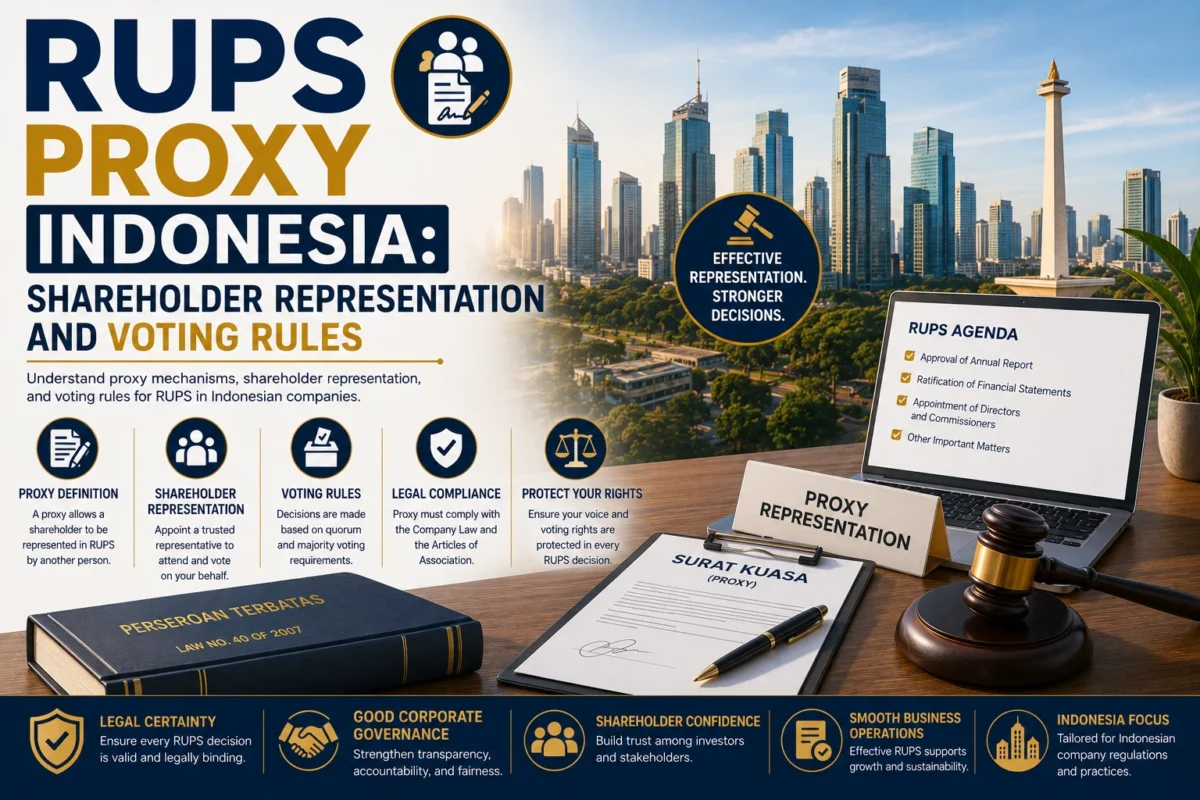
A RUPS Proxy Indonesia: Shareholder Representation and Voting Rules analysis starts with a clear rule: an Indonesian company shareholder does not always have to attend a General Meeting of Shareholders personally. A shareholder may generally attend and exercise voting rights through an authorized proxy, subject to the shareholder’s voting rights, the Limited Liability Company Law, the company’s Articles of Association, and any additional rules applying to the company.
Indonesia’s RUPS framework is based on Law No. 40 of 2007 on Limited Liability Companies, which the official legislation database records as Berlaku but amended.
RUPS Proxy Indonesia: Can a Shareholder Appoint a Representative?
Yes. Under Article 85 of the Limited Liability Company Law, a shareholder may attend an RUPS personally or through a proxy and exercise voting rights according to the number of shares held.
That does not mean every Power of Attorney automatically works for every RUPS. The proxy should still be checked against the company’s Articles of Association, the RUPS notice and agenda, the shareholder’s voting rights, and any meeting-specific requirements.
Who Can Vote Through a Proxy?
The basic right belongs to the shareholder whose shares carry voting rights.
The same Article 85 states that this rule does not apply to holders of shares without voting rights.
Non-Voting Shares
A proxy does not create a voting right that the underlying shares do not possess.
The first question should therefore be whether the shareholder’s class of shares carries voting rights for the relevant matter. The company’s Articles of Association should be checked alongside the statutory rule because share classifications and their rights may differ between companies.
Directors, Commissioners, and Employees as Proxies
A company insider should not automatically be selected as a voting proxy.
This restriction is important because a proxy document may appear valid as a general authorization but still be unsuitable for the voting function at the RUPS if the proposed representative falls within the prohibited categories.
Can One Shareholder Use Multiple Proxies?
Article 85 restricts split voting through multiple proxies.
It provides that a shareholder may not appoint more than one proxy for separate portions of the shareholder’s shares and instruct those proxies to cast different votes.
For an ordinary shareholder in a closed company, this means the shareholder should not attempt to divide the same holding among different representatives so that part votes in favor and another part votes against the same resolution.
The statutory explanation links this rule to the principle that the shareholder’s votes are cast consistently rather than split. Public companies can be subject to additional capital-market rules, so those cases should be reviewed separately.
What Happens If the Shareholder Attends Personally?
A proxy does not remain controlling if the shareholder appears personally at the RUPS.
If the shareholder later attends the RUPS personally, Article 85 states that the previously granted proxy does not apply to that meeting.
This matters operationally. The company and meeting registrar should know whether the shareholder or the proxy is exercising the voting rights so the same shares are not counted or voted twice.
The chair of the meeting is also authorized to determine who may attend, subject to the Limited Liability Company Law and the company’s Articles of Association.
Does a Proxy Count Toward the RUPS Quorum?
Generally, represented voting shares can count toward the meeting’s attendance quorum.
Under the general Article 86 quorum rule, an RUPS may proceed when more than one-half of all voting shares are present or represented, unless the law or Articles of Association require a higher quorum.
That is only the general first-meeting rule. Different decisions can have different statutory quorum and approval thresholds. Amendments to the Articles of Association, mergers, acquisitions, dissolutions, and other specified corporate actions may require higher thresholds.
A proxy therefore affects more than who sits in the meeting room. Proper representation can determine whether the meeting has enough represented voting shares to proceed.
What Should the Proxy Document Cover?
The Limited Liability Company Law establishes the right to act through a proxy, but a practical RUPS proxy should also be clear enough for the company to identify the shareholder, representative, meeting, and voting authority.
Jakarta Legal ID’s existing Notary Services for Foreign Investors guide covers broader shareholder and corporate documentation. For an RUPS proxy specifically, the document should be reviewed against the actual meeting rather than reused mechanically from another transaction.
Identify the Meeting and Shareholder
A practical proxy should make clear:
- who the shareholder is
- which company is holding the RUPS
- which meeting is covered
- the shares represented
- who is appointed as proxy
- whether the authority covers attendance, voting, signing attendance records, receiving documents, or other meeting acts
The meeting notice and the company’s Articles may impose additional document or identification requirements.
State Voting Instructions Clearly
A shareholder may want the proxy to exercise discretion or follow agenda-specific voting instructions.
Where voting instructions are important, they should be written clearly enough to avoid uncertainty over how the proxy should vote on each agenda item. The document should also avoid instructions that conflict with Article 85’s prohibition on split voting for portions of the same shareholder’s holding.
Public Company RUPS and Electronic Proxy
Public companies have an additional capital-market framework.
For public companies, POJK No. 15/POJK.04/2020 is currently listed by OJK as the regulation governing the planning and conduct of public-company RUPS.
OJK explains that public companies must provide an electronic proxy alternative and that electronic authority can be granted through an e-RUPS system.
KSEI’s current eASY.KSEI user guidance describes e-Proxy as a module that allows shareholders to grant authority and voting instructions electronically.
These public-company mechanisms should not be mechanically applied to every privately held PT. A private company’s RUPS should first be reviewed under the Limited Liability Company Law and its Articles of Association, while a public company must also comply with the applicable OJK and capital-market framework.
RUPS Proxy Review Checklist
Before relying on a shareholder proxy, check:
- Shareholder identity. Confirm that the principal is the shareholder entitled to participate in the RUPS.
- Voting rights. Confirm that the relevant shares carry voting rights for the agenda.
- Proxy eligibility. Check that the representative is not prohibited from acting as a voting proxy.
- Meeting details. Identify the exact company, meeting date, and RUPS covered by the authorization.
- Shares represented. State the relevant shareholding clearly.
- Authority granted. Specify attendance, voting, signing, document receipt, or other intended meeting functions.
- Voting instructions. Decide whether the proxy has discretion or must follow agenda-specific instructions.
- No prohibited split voting. Avoid appointing multiple proxies to cast different votes for portions of the same shareholder’s shares where Article 85 prohibits it.
- Articles of Association. Check company-specific meeting and representation rules.
- Meeting notice and registration requirements. Confirm identification, document, submission, and deadline requirements stated for the RUPS.
- Personal attendance. If the shareholder decides to attend personally, account for the rule that the proxy no longer applies to that meeting.
- Public-company rules. For a public company, check the current OJK and electronic-proxy framework in addition to the Companies Law.
Conclusion
A RUPS proxy in Indonesia is more than a generic Power of Attorney. It is a shareholder-representation mechanism operating inside the company’s voting and meeting framework.
Article 85 allows shareholders to attend and vote through a proxy but imposes important restrictions: non-voting shares do not gain voting rights, company directors, commissioners, and employees cannot act as voting proxies, prohibited split voting cannot be created through multiple representatives, and the proxy ceases to apply if the shareholder attends personally.
Before the meeting, the shareholder and company should align the proxy with the Articles of Association, voting rights, meeting notice, agenda, quorum requirements, and any public-company rules that apply.
Review the RUPS Proxy Before the Meeting
Before relying on a shareholder proxy, review the shareholder’s voting rights, the proposed representative, the company’s Articles of Association, the meeting notice, voting instructions, and any public-company requirements that apply. A document that is valid as a general Power of Attorney may still need meeting-specific wording or supporting documents for an RUPS.
Jakarta Legal ID is the relevant same-domain starting point for consultation, while its verified Notary Services for Foreign Investors guide covers broader shareholder and corporate documentation.
FAQ – RUPS Proxy Indonesia
Can a shareholder appoint a proxy to attend an RUPS in Indonesia?
Yes. Article 85 of the Limited Liability Company Law allows a shareholder to attend an RUPS personally or through a proxy and exercise voting rights according to the shares held.
Can a director act as a shareholder’s voting proxy?
Article 85 prohibits members of the Board of Directors, Board of Commissioners, and employees of the relevant company from acting as a shareholder’s proxy in voting.
Can a shareholder appoint two proxies to vote differently?
Article 85 prohibits a shareholder from appointing more than one proxy for portions of the shareholder’s shares and having those proxies cast different votes.
What happens if the shareholder attends the RUPS after giving a proxy?
The previously granted proxy does not apply to that meeting when the shareholder attends personally.
Do represented shares count toward the RUPS quorum?
Under the general Article 86 rule, the first RUPS may proceed when more than half of all voting shares are present or represented, unless the law or Articles of Association require a higher quorum.
Can a holder of non-voting shares appoint a proxy to vote?
A proxy does not create voting rights. Article 85 expressly excludes holders of non-voting shares from its basic attendance-and-voting proxy rule.
Does an RUPS proxy need to be notarized?
Article 85 establishes the right to be represented but does not by itself create one universal notarization rule for every RUPS proxy. The Articles of Association, meeting notice, company procedures, public-company rules, and other applicable requirements should be checked.
Can a proxy vote without specific instructions from the shareholder?
That depends on the authority granted in the proxy and the applicable meeting requirements. If the shareholder wants agenda-specific voting instructions, they should be stated clearly.
Are electronic proxies available for Indonesian public companies?
Yes. OJK’s public-company RUPS framework requires an electronic proxy alternative, and eASY.KSEI includes an e-Proxy module for electronic authority and voting instructions.
What should a foreign shareholder prepare before appointing an RUPS proxy?
The shareholder should review the meeting notice, Articles of Association, share and voting rights, representative eligibility, required identification or corporate documents, proxy wording, voting instructions, and any authentication requirements for documents executed outside Indonesia.
References & Sources
- Law Number 40 of 2007 on Limited Liability Companies
- Law Number 6 of 2023 on the Enactment of Government Regulation in Lieu of Law Number 2 of 2022 on Job Creation into Law
- Limited Liability Companies | Directorate General of Taxes
- Planning and Implementation of General Meetings of Shareholders of Public Companies
- Press Release: OJK Issues Regulations Related to Handling the Impact of COVID-19
- eASY.KSEI Application User Guide
- Notary Services for Foreign Investors in Indonesia: A Complete Legal Guide