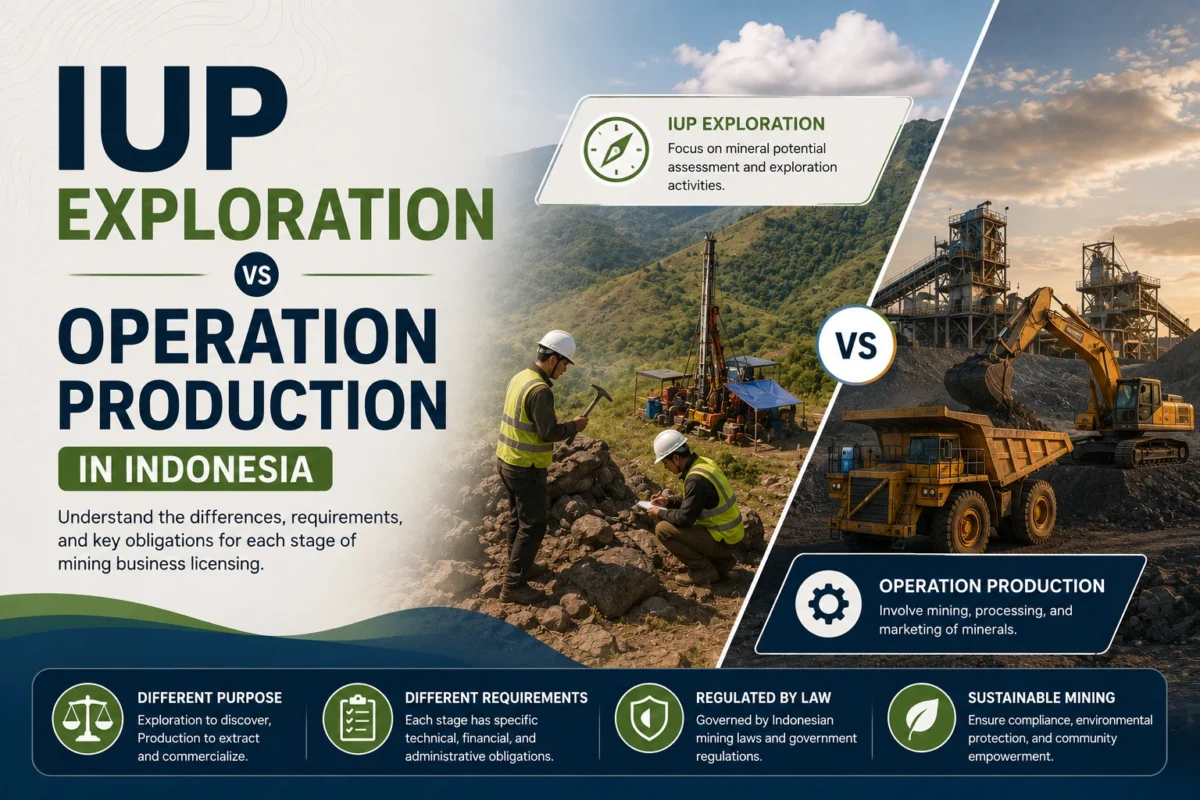
IUP exploration vs operation production is fundamentally a comparison between two different stages of an Indonesian mining business. An Exploration-stage IUP is used while the project is investigating the resource and establishing feasibility, while the Operation Production stage covers the activities required to construct, mine, process or utilize, transport, and sell the mining product.
For investors, that difference is critical. A company holding an Exploration-stage IUP should not automatically be treated as if it already has authority to conduct full commercial mining and sales.
Indonesia’s current mining-law framework must be read together with Law Number 2 of 2025, the fourth amendment to Law Number 4 of 2009 on Mineral and Coal Mining, which the official legislation database records as in force.
The implementing framework includes Government Regulation Number 96 of 2021, which the Ministry of Energy and Mineral Resources JDIH records as in force but amended by Government Regulation Number 25 of 2024 and Government Regulation Number 39 of 2025. The most recent amendment in that sequence is Government Regulation Number 39 of 2025, which the ESDM JDIH records as in force and as the second amendment to Government Regulation Number 96 of 2021.
For the wider licensing review, read our mining licensing and compliance guide, which connects activity selection, corporate records and operational readiness.
IUP Exploration vs Operation Production: The Core Difference
Under Government Regulation Number 96 of 2021, an IUP consists of two activity stages: Exploration and Operation Production.
The practical distinction is straightforward:
- Exploration is focused on understanding the resource and determining whether the mining project is technically and economically feasible
- Operation Production is the stage in which the project advances into construction and mining-related production activities, including the applicable processing or utilization, transportation, and sales functions
These stages should therefore be compared as a project lifecycle rather than as two unrelated licensing products.
What Is the IUP Exploration Stage?
The same Government Regulation Number 96 of 2021 states that the Exploration stage consists of General Investigation, Exploration, and Feasibility Study activities.
What Exploration Is Designed to Establish
At this stage, the project is still establishing the information needed to understand the mining opportunity and determine whether further development is justified.
Exploration itself is aimed at obtaining detailed information about matters such as the location, form, dimensions, distribution, quality, and measured resources of the mineral deposit, together with relevant social and environmental information.
The Feasibility Study then becomes a key decision point because the project must evaluate whether the mining business is economically and technically feasible before moving into the production-stage framework.
What an Exploration-Stage IUP Does Not Mean
An Exploration-stage IUP should not be interpreted as unrestricted authority to begin commercial extraction and sales.
The legal framework separates exploration from Operation Production specifically because the two stages serve different purposes and involve different levels of project readiness and regulatory exposure.
For investors, this distinction should affect valuation and due diligence. A company may control a promising mining project while still being materially different from a company that has already completed the requirements necessary to enter the Operation Production stage.
What Is the IUP Operation Production Stage?
By contrast, the Operation Production stage includes construction, mining, processing and/or refining or development and/or utilization, transportation, and sales.
The current statutory definition reinforces that distinction: Law Number 2 of 2025 defines Operation Production as the mining-business stage covering construction, mining, processing and/or refining or development and/or utilization, transportation and sales, together with environmental-impact control facilities in accordance with the feasibility study.
Production and Commercial Activities
This is the stage associated with moving the project from resource evaluation toward actual production and commercialization.
Depending on the commodity and project structure, Operation Production can include:
- construction of mining facilities
- extraction of minerals or coal
- processing and/or refining for relevant mineral activities
- development and/or utilization for relevant coal activities
- transportation
- sale of mining output
That does not mean every holder performs every activity in exactly the same way. Commodity type, project design, applicable approvals, environmental requirements, and other sector-specific obligations can alter the operating structure.
Operation Production Still Requires Ongoing Compliance
Reaching Operation Production does not end regulatory compliance.
Licensing stage is not the only compliance issue: the Ministry of Energy and Mineral Resources states that RKAB is mandatory for IUP and IUPK holders and functions as a planning reference across exploration, operation production, processing or refining, and post-mining activities.
A production-stage mining company therefore still needs to evaluate its current work plan, environmental obligations, technical compliance, financial requirements, and other mining-governance obligations that apply to the project.
IUP Exploration vs Operation Production Comparison
The following matrix shows the main commercial and regulatory differences. It is intended as a decision aid; the exact requirements for a project must still be checked against the current mining regulations and the company’s specific commodity and licence status.
| Comparison | IUP Exploration Stage | IUP Operation Production Stage |
|---|---|---|
| Main purpose | Establish resource information and project feasibility | Develop and operate the mining project |
| Core activities | General Investigation, Exploration, Feasibility Study | Construction, mining, processing/refining or development/utilization, transportation, sales |
| Commercial mining | Not the defining purpose of the stage | Mining production is part of the stage |
| Sales | Not the core Exploration-stage function | Sales are included within Operation Production |
| Project maturity | Resource and feasibility development | Development and operational stage |
| Investor question | Can the project establish a viable resource and satisfy advancement requirements? | Is the project legally and operationally ready to produce under its current approvals? |
| Compliance focus | Exploration programme, feasibility, environmental and technical readiness | Production planning, technical operation, environmental management, RKAB and ongoing mining compliance |
The key implication is that an Exploration-stage company and an Operation Production-stage company can have very different legal and commercial risk profiles even where they relate to the same commodity and mining area.
Can an Exploration IUP Automatically Move to Operation Production?
No. The transition should not be described as automatic.
An Exploration-stage holder should therefore not treat commercial production as an automatic continuation of exploration: Government Regulation Number 96 of 2021 requires the holder to obtain approval for advancement to the Operation Production stage and satisfy the applicable administrative, technical, environmental, and financial requirements.
This is one of the most important points for investors reviewing an early-stage mining company. Holding an Exploration-stage IUP is relevant, but the company should still be assessed on whether the project has completed the work and approvals necessary to advance.
Investor Due Diligence: Which IUP Stage Does the Company Actually Hold?
Before acquiring shares, funding a mining company, entering a joint venture, or relying on projected production, verify the actual IUP stage rather than relying only on a statement that the company ‘has an IUP.’
At minimum, review:
- The exact IUP stage. Determine whether the company is still at Exploration or has progressed to Operation Production.
- The commodity and mining area. Confirm that the corporate and project documents relate to the same mining business being evaluated.
- Feasibility status. Determine whether the project has completed the relevant feasibility work needed for progression.
- Environmental readiness. Check the applicable environmental documents and obligations rather than assuming that an IUP alone resolves environmental compliance.
- Technical readiness. Confirm whether the project has the technical basis and required submissions for its current stage.
- Financial compliance. Review the financial requirements and obligations applicable to advancement and operation.
- RKAB status. Confirm the current planning and approval position relevant to the company’s mining activities.
- Corporate consistency. Check whether the licence holder, shareholders, management, and corporate documents are consistent with the transaction being considered.
A due-diligence review should also look for suspension, sanctions, overlapping rights, unresolved compliance issues, or other restrictions that could affect the project’s practical ability to proceed.
Documents and Compliance to Review Before Production
Before a mining project is treated as production-ready, the company should review more than the headline licence name.
Relevant checks can include:
- IUP document and current activity stage
- WIUP and project-area consistency
- feasibility-study status
- required environmental documentation
- technical documentation
- applicable administrative requirements
- applicable financial requirements
- RKAB position
- reclamation and post-mining obligations where applicable
- corporate documents and licence-holder identity
- additional approvals required for the project’s commodity and operating model
The exact checklist varies by project. A mineral project involving processing or refining can raise different issues from a coal project involving development or utilization, and a company entering a transaction may also require separate corporate and investment review.
Which IUP Stage Does Your Project Need?
If the project is still proving the resource, defining the deposit, and determining technical and economic feasibility, the Exploration stage is the relevant part of the IUP lifecycle.
If the project has completed the relevant exploration and feasibility work and intends to move into construction, extraction, applicable processing or utilization, transportation, and commercial sales, the Operation Production stage becomes the relevant regulatory objective.
The decision should be based on actual project maturity and regulatory readiness rather than simply choosing the licence stage associated with a more advanced mining business.
Conclusion
IUP Exploration and IUP Operation Production serve different functions within Indonesia’s mining-licensing framework.
Exploration covers General Investigation, Exploration, and Feasibility Study. Operation Production moves the project into construction, mining, applicable processing or utilization, transportation, and sales.
For business owners, the central question is whether the project is still establishing feasibility or is legally and technically ready to advance into production. For investors, the more important question is whether the company’s actual licence stage and compliance status support the production assumptions being used in the transaction.
Before relying on an IUP for investment, acquisition, financing, or operational planning, verify the licence stage, advancement status, feasibility, environmental and technical requirements, RKAB position, and current regulatory compliance.
Review the IUP Stage Before Advancing the Mining Project
Before investing in, acquiring, or advancing an Indonesian mining project, confirm whether the company holds an IUP at the Exploration or Operation Production stage and whether its feasibility, environmental, technical, financial, and RKAB position supports the planned activities.
Jakarta Legal ID provides a relevant starting point for consultation on mining licensing and related corporate compliance. A project-specific review is important because the applicable requirements can differ by commodity, licence history, project stage, and transaction structure.
FAQ – IUP Exploration vs Operation Production in Indonesia
What is the main difference between IUP Exploration and IUP Operation Production?
Exploration focuses on General Investigation, Exploration, and Feasibility Study. Operation Production covers the later project stage, including construction, mining, applicable processing or utilization, transportation, and sales.
Can a company mine commercially with only an Exploration-stage IUP?
An Exploration-stage IUP should not be treated as general authority for full commercial Operation Production activities. The legal framework separates the Exploration and Operation Production stages and requires advancement to the production stage.
Does IUP Operation Production automatically follow an Exploration-stage IUP?
No. Advancement is regulated. The holder must obtain the relevant approval and satisfy applicable administrative, technical, environmental, and financial requirements.
Is a feasibility study part of IUP Exploration?
Yes. Government Regulation Number 96 of 2021 places General Investigation, Exploration, and Feasibility Study within the Exploration stage.
Can an IUP Operation Production holder sell minerals or coal?
Sales are included within the Operation Production stage, but the holder must still comply with the separate rules, planning requirements, commodity-specific obligations, and other approvals that apply to the actual sale.
Is construction part of Exploration or Operation Production?
Construction is included within the Operation Production stage under the mining regulatory framework.
Does an Operation Production IUP remove the need for RKAB?
No. ESDM states that RKAB is a mandatory planning document for IUP and IUPK holders and covers mining activities including exploration and Operation Production.
What should an investor check before buying shares in an Exploration-stage mining company?
Review the exact IUP stage, mining area and commodity, feasibility status, environmental and technical readiness, financial obligations, RKAB position, corporate ownership, and whether unresolved compliance issues could prevent advancement.
Is an Operation Production-stage company automatically ready to start mining?
Not necessarily. The licence stage is only one part of regulatory readiness. The project should also be checked for current planning, environmental, technical, financial, and other applicable approvals and obligations.
Are the rules the same for every mineral and coal project?
No. The general IUP-stage framework is important, but detailed requirements can differ by commodity, mining area, project design, processing or utilization model, licence history, and current regulatory status.
References & Sources
- Law Number 2 of 2025: Fourth Amendment to the Mineral and Coal Mining Law
- Official Text of Law Number 2 of 2025 on the Fourth Amendment to the Mineral and Coal Mining Law
- Government Regulation Number 96 of 2021 on the Implementation of Mineral and Coal Mining Business Activities
- Official Text of Government Regulation Number 96 of 2021 on Mineral and Coal Mining Business Activities
- Government Regulation Number 39 of 2025: Second Amendment to Government Regulation Number 96 of 2021
- From Licensing to RKAB: ESDM Strengthens Mining Governance
- Jakarta Legal ID