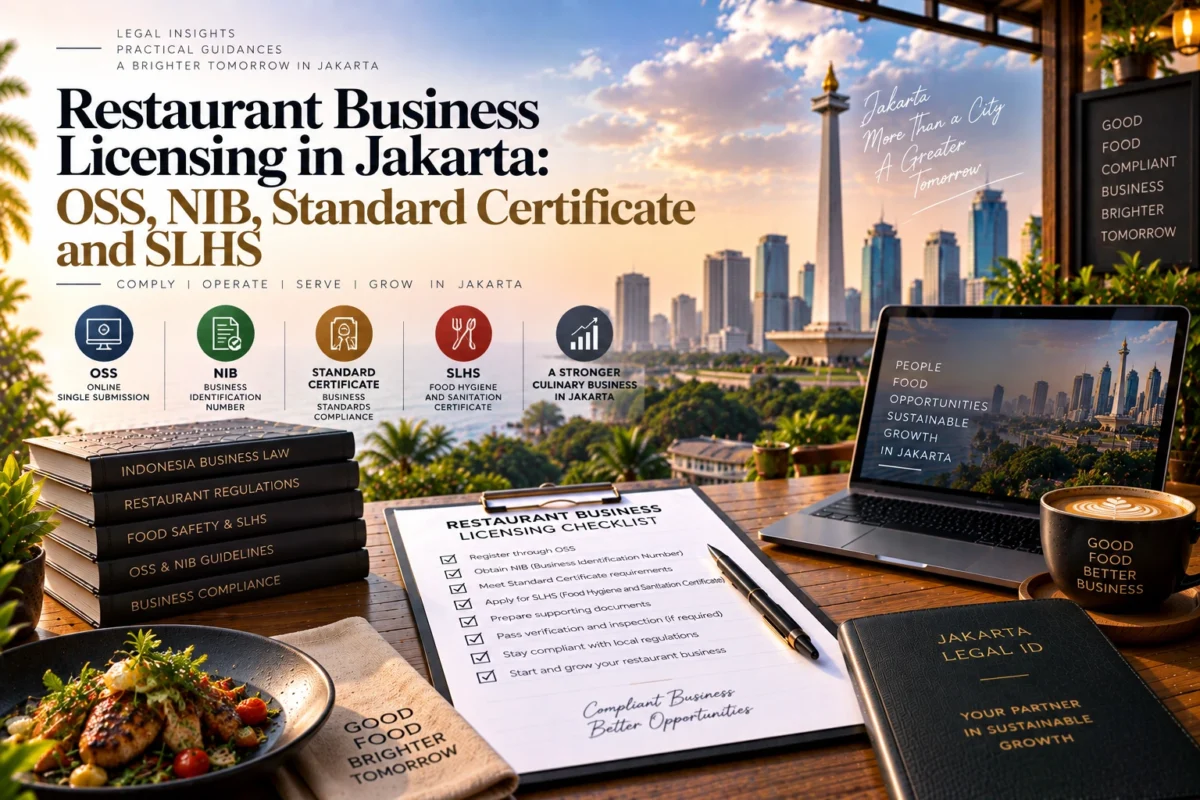
Opening a restaurant in Jakarta in 2026 is not simply a matter of obtaining an NIB. The licensing path depends on the restaurant’s current business classification, business scale, OSS risk level, Standard Certificate status, hygiene-sanitation requirements and any supporting licences triggered by what the restaurant actually sells or does.
Indonesia’s current overarching risk-based licensing framework is Government Regulation No. 28 of 2025, which is in force from 5 June 2025 and revoked Government Regulation No. 5 of 2021.
Restaurant Business Licensing Jakarta: What You Need in 2026
For a typical fixed-location restaurant, the core decision sequence is:
- identify the correct KBLI and restaurant scope
- confirm the business scale and resulting OSS risk level
- obtain the NIB and applicable Standard Certificate
- complete verification where the activity is medium-high risk
- obtain and maintain the applicable hygiene-sanitation certification
- check PB UMKU triggered by specific activities such as direct alcohol sales
- confirm building, spatial, environmental and other basic requirements shown for the actual project in OSS
The important point is that these layers are connected. A document issued at company-registration stage should not automatically be treated as proof that every restaurant-specific operational requirement is complete.
Start With the Correct Restaurant KBLI
The current OSS KBLI 2025 entry for code 56101 covers fixed-building food-service activities including restaurants, rumah makan, canteens or cafeterias, fast-food restaurants and take-away restaurants.
This is broader than simply asking whether the venue calls itself a restaurant. The actual operating model matters. A permanent restaurant, movable food stall, catering operation and beverage-focused café can fall into different business classifications or scopes.
Before creating the OSS project, describe what the business will actually do: where food is prepared, whether the premises are permanent, whether customers eat on site, whether takeaway or delivery is offered, and whether other activities such as catering or alcohol sales are part of the model.
Restaurant Risk Level Depends on Business Scale
Restaurant licensing is not one identical OSS path for every operator.
For the restaurant scope regulated by Minister of Tourism Regulation No. 6 of 2025, micro-scale restaurants are classified as medium-low risk, while small, medium and large restaurants are classified as medium-high risk.
The official Ministry of Tourism legal database lists Minister of Tourism Regulation No. 6 of 2025 as in force and records that it repealed Ministerial Regulations Nos. 4 and 8 of 2021.
That scale distinction changes how the Standard Certificate works. The following table summarizes the core OSS difference.
| Restaurant category | Risk level | Core Business Licensing | Operational implication |
|---|---|---|---|
| Micro restaurant | Medium-low | NIB + Standard Certificate without verification | Core licence follows the medium-low OSS pathway |
| Small restaurant | Medium-high | NIB + verified Standard Certificate | Verification must be completed for operational/commercial legality |
| Medium restaurant | Medium-high | NIB + verified Standard Certificate | Verification must be completed for operational/commercial legality |
| Large restaurant | Medium-high | NIB + verified Standard Certificate | Verification must be completed for operational/commercial legality |
The table shows why investors should determine the actual scale before assuming that another restaurant’s OSS documents are an appropriate model for their own project.
Medium-Low Restaurant Licensing
Under Article 186 of Minister of Investment and Downstream Industry/Head of BKPM Regulation No. 5 of 2025, medium-low-risk Business Licensing consists of an NIB and a Standard Certificate without verification, while medium-high risk uses an NIB and a Standard Certificate with verification.
For a restaurant that falls into the medium-low category, this makes the core OSS pathway simpler than the medium-high route. It does not remove continuing restaurant standards or PB UMKU that apply to the activity.
The correct question is therefore not only, “Has the NIB been issued?” but also, “Which obligations remain attached to the restaurant after the core Business Licensing is issued?”
Medium-High Restaurant Licensing
For a medium-high-risk restaurant, the verification stage is a material operational milestone.
For a medium-high-risk activity, Article 189 states that the NIB and Standard Certificate marked as unverified provide only limited legality for business preparation and cannot be used for operational and/or commercial activities.
This distinction matters when setting an opening date. Receiving an NIB or seeing an unverified Standard Certificate in OSS does not mean the restaurant should automatically be treated as ready to serve customers commercially.
Build verification time into the pre-opening plan and make sure the underlying restaurant standard documents are prepared before the intended launch date.
SLHS Is a Separate Restaurant Compliance Layer
Food-business licensing has an additional health and sanitation dimension.
The restaurant obligations in Minister of Tourism Regulation No. 6 of 2025 require a Sertifikat Laik Higiene Sanitasi, or SLHS, for both medium-low and medium-high restaurant businesses.
The health-sector implementation is also current: Minister of Health Regulation No. 11 of 2025 contains the SLHS standard for KBLI 56101 restaurants and other specified ready-to-eat food businesses.
The Ministry of Health JDIH lists Minister of Health Regulation No. 11 of 2025 as in force and records that it repealed the earlier risk-based health licensing standards under Minister of Health Regulations Nos. 14 of 2021, 8 of 2022 and 17 of 2024, among other instruments.
For restaurant owners, the practical implication is that kitchen design, sanitation, food-handling procedures and other SLHS requirements should be planned before opening rather than treated as a post-launch paperwork exercise.
Check Conditional PB UMKU Before Opening
Not every restaurant needs every supporting licence shown in OSS. The operating model determines which PB UMKU becomes relevant.
The current OSS restaurant entry lists SLHS and Surat Keterangan Penjual Langsung Minuman Beralkohol for categories A and B/C among the PB UMKU associated with restaurant activities.
If the restaurant will sell alcoholic beverages directly to customers, confirm the applicable alcohol-sale authorization instead of assuming the ordinary restaurant Standard Certificate covers that activity. If the business handles activities connected to animal-product controls, check whether the relevant veterinary-control requirement applies to the actual operation.
The safest method is to read the PB UMKU generated for the restaurant’s real OSS project rather than copying a permit list from another venue.
Jakarta’s Old SLHS Procedure Has Been Revoked
Restaurant owners should be especially cautious with older Jakarta licensing articles and checklists.
For Jakarta specifically, Governor Regulation No. 12 of 2026 is in force and revoked Governor Regulation No. 24 of 2015 on the former procedure for issuing SLHS to restaurants, eating houses and catering businesses.
Jakarta’s current local administrative framework also includes Governor Regulation No. 7 of 2025, which remains in force as the implementing regulation for investment and one-stop integrated services.
This means a 2026 restaurant project should not rely on a checklist that still presents the revoked 2015 Jakarta SLHS procedure as current. Use the current OSS, ministry standards and Jakarta PTSP framework for the live application.
Pre-Opening Restaurant Licensing Checklist
Use the following checklist before fixing the commercial opening date. Its purpose is to reveal incomplete licensing stages early enough to address them.
| Check | What to confirm |
|---|---|
| Business model | Fixed restaurant, movable food operation, catering, café or combination |
| KBLI | Current code and scope match the real activities |
| Business scale | Micro, small, medium or large classification is confirmed |
| OSS risk level | Current restaurant risk output matches the scale and activity |
| NIB | Issued for the correct restaurant project and location |
| Standard Certificate | Issued in the correct medium-low or medium-high pathway |
| Verification | Completed before operations where the restaurant is medium-high risk |
| SLHS | Current hygiene-sanitation requirements have been fulfilled |
| Alcohol | Applicable direct-sale alcohol authorization checked if alcohol will be sold |
| PB UMKU | All supporting licences generated by the actual activity are reviewed |
| Basic requirements | Spatial, environmental and building-related dependencies are checked in OSS |
| Opening decision | Commercial launch occurs only after the required operational licensing stage is complete |
If several rows are unresolved, the business should map the dependencies before committing to a hard opening date, signing supply contracts that assume immediate operation or announcing a launch that the licensing schedule may not support.
Jakarta Legal ID’s NIB and OSS registration guide provides broader context on Indonesia’s risk-based licensing system.
For businesses that need implementation support, Jakarta Legal ID currently lists PT PMA/PMDN setup, NIB OSS and business licensing within its service scope.
Conclusion
Restaurant business licensing in Jakarta is a layered process rather than a single restaurant permit. The core path begins with the correct business classification and scale, then moves through the NIB and Standard Certificate route that corresponds to the restaurant’s risk level.
For micro restaurants under the current restaurant tourism standard, the relevant risk category is medium-low. Small, medium and large restaurants fall into the medium-high category, making Standard Certificate verification a critical operational step. SLHS and any activity-specific PB UMKU must then be checked separately.
The practical rule is simple: identify the real restaurant activity first, verify the current OSS output second, and treat commercial opening as the final milestone rather than the starting assumption.
Map the Restaurant Licensing Path Before Opening
If you are establishing a restaurant through a PT PMDN or PT PMA in Jakarta, Jakarta Legal ID provides company setup, NIB OSS and business licensing services within its current service scope.
Request a consultation to review the proposed restaurant activity, business scale, OSS licensing stage and supporting licences before the commercial opening date is finalized.
FAQ – Restaurant Business Licensing Jakarta
What KBLI is used for a restaurant in a permanent building?
The current OSS KBLI 2025 uses code 56101 for fixed-building food-service activities, including restaurants, rumah makan, canteens, fast-food restaurants and take-away restaurants.
Is an NIB enough to open a restaurant in Jakarta?
Not for the restaurant categories discussed here. The current restaurant tourism standard places micro restaurants in medium-low risk and small, medium and large restaurants in medium-high risk, so the applicable Standard Certificate and other obligations must also be completed.
What is the difference between medium-low and medium-high restaurant licensing?
Medium-low risk uses an NIB and Standard Certificate without verification. Medium-high risk uses an NIB and Standard Certificate with verification, and an unverified certificate is limited to preparation rather than operational or commercial activity.
Does a Jakarta restaurant need SLHS?
The current tourism restaurant standard requires SLHS for medium-low and medium-high restaurants, and Minister of Health Regulation No. 11 of 2025 contains the current health-sector SLHS standard for KBLI 56101 restaurants.
Do restaurants selling alcohol need another licence?
The current OSS restaurant entry lists direct-sale alcoholic beverage certificates for categories A and B/C among restaurant PB UMKU. The exact requirement should be checked against the beverages and activities of the specific restaurant.
Can I follow an old Jakarta SLHS guide from 2015?
Not as current procedure. Jakarta Governor Regulation No. 12 of 2026 revoked Governor Regulation No. 24 of 2015, so a current application should be checked against the present OSS, ministry and Jakarta PTSP framework.
References & Sources
- Government Regulation No. 28 of 2025 on Risk-Based Business Licensing — peraturan.go.id
- Current OSS KBLI 2025 — Fixed-Building Food Service Activities — oss.go.id
- Minister of Tourism Regulation No. 6 of 2025 — jdih.kemenpar.go.id
- Minister of Tourism Regulation No. 6 of 2025 — Official Full Text — jdih.kemenpar.go.id
- Minister of Investment and Downstream Industry/Head of BKPM Regulation No. 5 of 2025 — jdih.bkpm.go.id
- Minister of Investment and Downstream Industry/Head of BKPM Regulation No. 5 of 2025 — Official Full Text — jdih-storage.bkpm.go.id
- Minister of Health Regulation No. 11 of 2025 — jdih.kemkes.go.id
- Minister of Health Regulation No. 11 of 2025 — Official Full Text — jdih.kemkes.go.id
- Current OSS KBLI 56101 Restaurant Supporting Licences — oss.go.id
- Jakarta Governor Regulation No. 7 of 2025 on Investment and One-Stop Integrated Services — jdih.jakarta.go.id
- Jakarta Governor Regulation No. 12 of 2026 Revoking the Former Restaurant SLHS Procedure — jdih.jakarta.go.id
- Jakarta Legal ID NIB and OSS Registration Guide — jakartalegalid.com
- Jakarta Legal ID Company Setup and Licensing Services — jakartalegalid.com
Recommended Next Articles
- NIB and OSS registration guide for Indonesian businesses — jakartalegalid.com