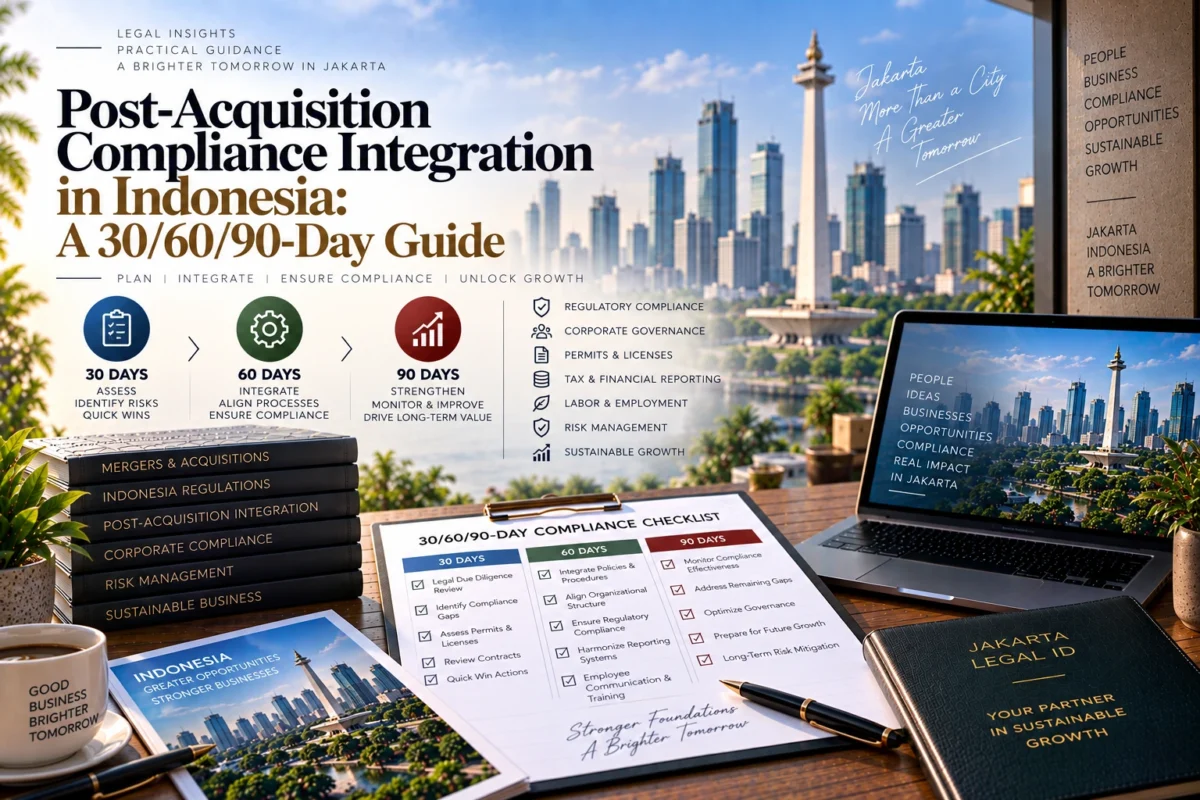
Post Acquisition Compliance Integration Indonesia: Post-acquisition integration in Indonesia should not begin with the assumption that every government registration must be replaced. Start by identifying what legally changed at closing, then update each corporate, licensing, tax and workforce record that no longer matches the target company’s actual facts.
Under Article 125 of Law No. 40 of 2007 on Limited Liability Companies, an acquisition is carried out through shares already issued or to be issued and, for this purpose, is the acquisition of shares that results in the transfer of control over the company.
The Ministry of Law’s AHU FAQ explains that, unlike a merger in which the merging company’s legal-entity status ends, an acquisition leaves the acquired company in existence while control changes.
Post Acquisition Compliance Integration Indonesia: Start With What Actually Changed
That distinction determines the integration strategy. In a share acquisition, the target PT normally continues to be the same legal entity, but its ownership, management, beneficial ownership, group policies, signatory controls or operational plans may have changed.
Do not therefore create a blanket instruction to replace every registration. Build a closing-change list containing only the facts that actually changed, such as:
- shareholder identity or shareholding percentage
- directors or commissioners
- beneficial-owner information
- registered address or contact data
- capital or investment data where relevant
- business activities or project locations
- authorized tax and finance users
- employer or worker data
- licences whose conditions depend on ownership, management, scale or operational facts
The integration team can then map each changed fact to the system that needs it.
Build One Post-Closing Corporate Source of Truth
Before updating AHU, OSS, tax or payroll systems, create one approved post-closing record that every workstream uses.
At minimum, reconcile the closing deed or share-transfer documents, latest articles of association, shareholder register, directors and commissioners, company address, NPWP, NIB, current business activities, project locations and existing sector licences.
If different departments start with different shareholder names, addresses or management structures, inconsistent government filings can be created even when each team believes it is making the correct update.
Assign one owner to the master record and record the effective date of every corporate change.
First 30 Days: Reconcile AHU and Beneficial Ownership
Corporate records should be reviewed first because other systems may depend on them.
The official AHU company-change guide includes notification workflows for changes to directors and commissioners, share transfers and shareholder data.
That does not mean every acquisition produces every type of AHU filing. Compare the actual closing documents with the latest AHU profile and identify which data is different.
Beneficial ownership requires a separate analysis. Indonesia’s beneficial-ownership framework under Presidential Regulation No. 13 of 2018 remains officially listed as in force.
The implementing procedure, Minister of Law and Human Rights Regulation No. 15 of 2019, is also officially listed as in force.
Do not assume that every direct shareholder change automatically produces a different beneficial owner, or that beneficial ownership remains unchanged merely because the target company itself still exists. Apply the applicable beneficial-owner criteria to the new ownership and control structure.
AHU’s current beneficial-owner FAQ states that previously reported beneficial-owner data can be changed through the beneficial-owner application using its change or updating functions.
Reconcile OSS and Sector Licences
After the corporate baseline is correct, compare it with OSS.
OSS currently provides a business-data change workflow, so the post-acquisition review should compare the target’s live OSS information with the corporate and operational facts after closing.
Do not limit this review to the company name and NIB. Check business activities, investment status, project locations, contact information and other data relevant to the actual target.
Then review licences outside the core NIB record. Industrial, mining, construction, environmental and other regulated operations may have conditions tied to facts that have changed after acquisition.
The correct question is not, “Does the company still have an NIB?” It is, “Does every material licence still describe the company and operation that now exist?”
A licence should not be amended simply because ownership changed unless the applicable rule or the licence conditions require an update. Use a trigger-based review rather than unnecessary re-filing.
Reconcile Tax Administration and Accounting Access
A share acquisition does not by itself mean the target company becomes a new taxpayer. The post-closing task is to ensure the tax administration reflects the actual company and authorized people after the transaction.
For tax administration, the Directorate General of Taxes provides a current corporate taxpayer data-change process using the corporate taxpayer change form and supporting documents showing the relevant change.
The current administrative framework is DJP Regulation PER-7/PJ/2025, whose corporate taxpayer change documentation includes data associated with corporate changes and the taxpayer’s updated administrative profile.
The finance integration team should reconcile:
- taxpayer profile and responsible management data
- Coretax user and authorization access
- registered contact details
- accounting policies and chart-of-account mapping
- tax calendar ownership
- open audits, objections or tax correspondence
- withholding and VAT processes where applicable
- historical filing archives and supporting documentation
Do not wait for the next return deadline to discover that former management still controls an essential administrative account.
Reconcile BPJS, Payroll and Workforce Administration
A share acquisition and an employment transfer are not the same event. Because the acquired PT continues to exist in a conventional share acquisition, first determine whether the legal employer, employment terms, workplace or payroll data actually changed.
For BPJS Ketenagakerjaan administration, Article 4 as amended by Minister of Manpower Regulation No. 1 of 2025 requires employers to report specified participation-data changes including the company name and address, business group, assets and turnover, wage and contribution data, number of workers and programs followed.
Use the post-closing payroll review to compare BPJS data, employee master data, wage components and company information against the actual post-acquisition organization.
Where directors, authorized HR personnel or payroll-bank signatories change, update internal authority separately from employee terms. Do not alter employment contracts merely for consistency with the acquisition integration plan unless there is a real employment change requiring it.
60 to 90 Days: Review Operational Dependencies
After the main government data is reconciled, expand the review to controls that can disrupt operations even though they are not a new licence.
Check bank mandates, internet banking administrators, contract signatories, powers of attorney, digital certificates, insurance notices, landlord records, customer and supplier master data, customs or sector accounts where relevant, and access to regulated reporting systems.
Also review agreements for change-of-control, consent or notification clauses. A contract can remain legally in place while still requiring a notice or counterparty consent because control changed.
The integration team should record each item as one of four outcomes: no change required, administrative update, third-party notification, or substantive approval required.
Post-Acquisition Compliance Integration Matrix
The table below converts the integration exercise into a trigger-based control list rather than a blanket re-registration exercise.
| Workstream | Post-closing check | Update trigger |
|---|---|---|
| AHU corporate data | Shareholders, directors, commissioners and company data | Actual registered data changed |
| Beneficial ownership | Reapply BO criteria to new ownership/control | Reported beneficial-owner information changed |
| OSS | Compare business-actor and project data with post-closing facts | OSS data no longer reflects actual corporate or operational facts |
| Sector licences | Review ownership, management and operational conditions | Applicable licence or regulation requires amendment/notification |
| Tax | Reconcile corporate profile, management and authorized access | DJP data or access no longer reflects current facts |
| Accounting | Map balances, policies, tax positions and reporting ownership | Buyer requires integration while preserving statutory records |
| BPJS | Company and participant data | Reportable employer or participant information changed |
| Payroll | Employee master data, wage data, banking and approvals | Actual payroll or authority structure changed |
| Banking | Account mandates and administrators | Authorized signatories or control protocols changed |
| Contracts | Change-of-control and notification clauses | Contract terms require notice, consent or other action |
The matrix shows why the integration team should work from verified closing facts rather than automatically changing every system. Unnecessary amendments create their own risk, while missed trigger events leave inconsistent records behind.
Jakarta Legal ID’s NIB and OSS registration guide provides broader context for the licensing workstream.
For companies that need implementation support, Jakarta Legal ID currently lists PT PMA/PMDN setup, business licensing, tax and bookkeeping among its service areas.
Conclusion
Post acquisition compliance integration in Indonesia is primarily a reconciliation exercise. The transaction may change control without replacing the acquired company’s legal identity, so each government and operational system should be reviewed according to the fact that changed.
Start with one approved post-closing corporate record. Reconcile AHU and beneficial ownership first, then OSS and sector licences, followed by tax administration, BPJS, payroll and operational authorities.
The objective is not to generate the largest possible list of filings. It is to ensure that every material record, licence and administrative account describes the company that actually exists after closing and that each continuing compliance obligation has a clearly assigned owner.
Turn the Closing File Into a Compliance Integration Plan
If an acquisition changes the ownership or management of an Indonesian company, Jakarta Legal ID provides corporate setup, business licensing, tax and bookkeeping services within its current service scope.
Request a consultation to identify which corporate, OSS and tax records require post-closing reconciliation and which items can remain unchanged.
FAQ – Post Acquisition Compliance Integration Indonesia
Does an acquisition create a new Indonesian company?
Not in an ordinary share acquisition. The target company’s legal entity continues while control changes. A merger is different because the merging entity can cease to exist by operation of the merger.
Does every share acquisition require every company registration to be replaced?
No. Review each system against the actual post-closing facts. Some records may require an update, while others remain accurate and need no change.
Should beneficial ownership be reviewed after an acquisition?
Yes. Reapply the applicable beneficial-owner criteria to the new ownership and control structure. Update the AHU beneficial-owner data where the reportable information has changed.
Does an acquisition require a new NIB?
Do not assume that it does. Compare the existing OSS and NIB data with the post-closing corporate and operational facts and use the appropriate OSS change process where an update is required.
What tax records should be checked after closing?
At minimum, review the corporate taxpayer profile, management and responsible-person data, administrative access, contact details, filing ownership and outstanding tax matters against the post-closing organization.
Do employee contracts automatically change after a share acquisition?
A share acquisition and an employment change are separate questions. First confirm whether the legal employer or employment terms actually changed, then update payroll, BPJS or employment documentation only where the facts require it.
References & Sources
- Law No. 40 of 2007 on Limited Liability Companies — peraturan.go.id
- Law No. 40 of 2007 on Limited Liability Companies — Official Full Text — peraturan.go.id
- Directorate General of General Legal Administration FAQ — portal.ahu.go.id
- AHU Online Guide — Limited Liability Company Changes — panduan.ahu.go.id
- Presidential Regulation No. 13 of 2018 on Beneficial Ownership of Corporations — peraturan.go.id
- Minister of Law and Human Rights Regulation No. 15 of 2019 on Beneficial Ownership Procedures — peraturan.go.id
- OSS Guide — Business Licensing Changes: Business Data — oss.go.id
- Minister of Investment and Downstream Industry/Head of BKPM Regulation No. 5 of 2025 — Official Full Text — peraturan.go.id
- DJP Service Guide — Corporate Taxpayer Data Changes — pajak.go.id
- DJP Regulation PER-7/PJ/2025 on Taxpayer and PKP Administration — stats.pajak.go.id
- Minister of Manpower Regulation No. 1 of 2025 Amending Employment Social Security Administration Rules — peraturan.go.id
- Jakarta Legal ID NIB and OSS Registration Guide — jakartalegalid.com
- Jakarta Legal ID Company Setup and Licensing Services — jakartalegalid.com
Recommended Next Articles
- NIB and OSS registration guide for Indonesian businesses — jakartalegalid.com