
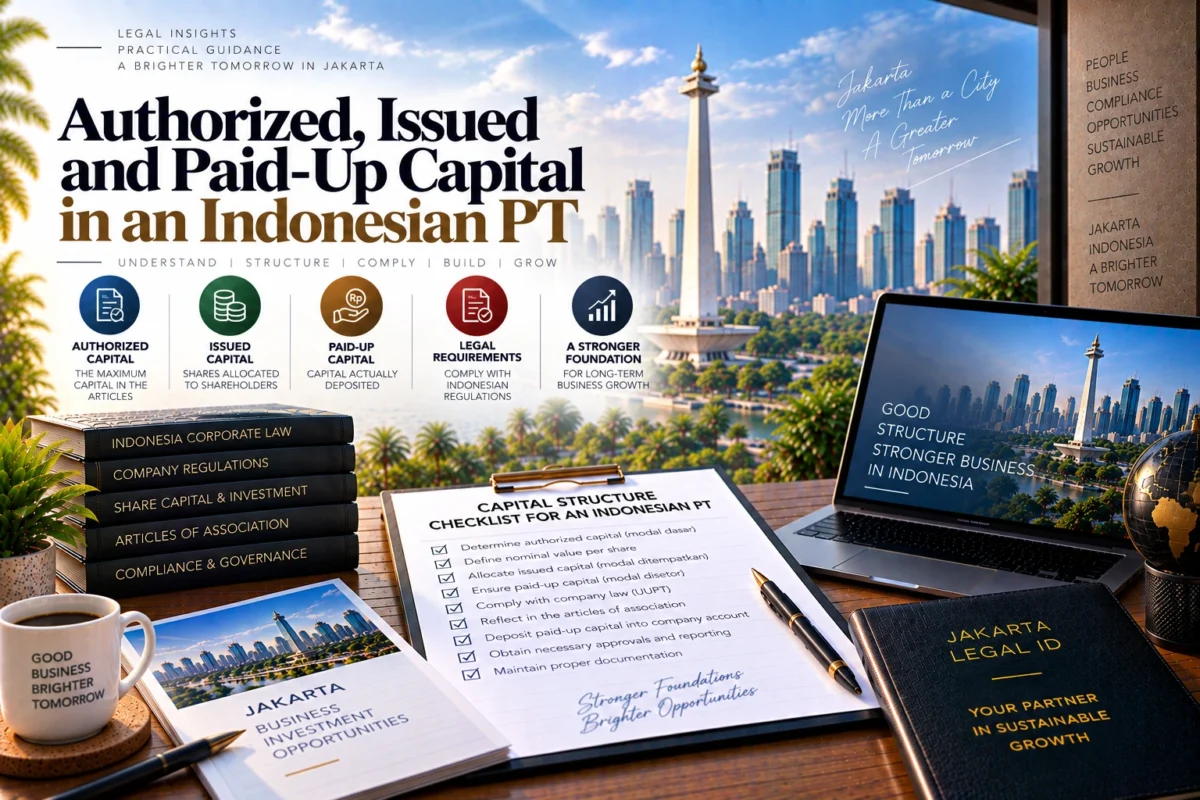
An Indonesian PT can show three different capital figures without any contradiction: authorized capital, issued capital and paid-up capital. Authorized capital is the overall share-capital framework, issued capital is the portion shareholders commit to take, and paid-up capital is the amount actually contributed for those issued shares.
Understanding the distinction matters because the three numbers affect incorporation documents, shareholder percentages, future share issues and, for PT PMA companies, separate investment requirements.
Authorized Issued Paid Up Capital PT: The Three Numbers
The three figures sit inside one capital structure rather than describing three separate pools of money.
| Capital term | What it represents |
|---|---|
| Authorized capital | Maximum share capital created under the company’s articles |
| Issued capital | Portion of that authorized capital subscribed or committed by shareholders |
| Paid-up capital | Issued capital that has actually been paid by the shareholders |
The official BPK legal glossary describes issued capital as the portion of authorized capital stated in the articles that shareholders have undertaken to subscribe.
The official BPK legal glossary describes paid-up capital as the portion of issued capital that has actually been paid by its owners.
Authorized Capital Sets the Share-Capital Ceiling
Under Article 31 of Law No. 40 of 2007 on Limited Liability Companies, a PT’s authorized capital consists of the total nominal value of its shares.
In practical terms, authorized capital establishes how much nominal share capital the articles make available before the company needs to amend that ceiling.
The important 2026 point is that the former general minimum of IDR 50 million should not be treated as the current universal rule.
Under the current Government Regulation No. 8 of 2021, the amount of a PT’s authorized capital is determined by the founders rather than by the former general statutory IDR 50 million minimum.
Authorized Capital Is Not Cash in the Bank
If a company has IDR 1 billion of authorized capital, that does not mean IDR 1 billion has already been contributed. It means the company’s articles create that amount of nominal share-capital capacity.
Unused Authorized Capital Creates Headroom
Where only part of the authorized capital has been issued, the difference can provide capacity for later share issuance, subject to the articles, shareholder approvals and applicable corporate procedures.
Issued Capital Is the Portion Shareholders Commit to Take
Issued capital sits inside the authorized-capital ceiling.
If the authorized capital is IDR 1 billion and shareholders subscribe for shares with a total nominal value of IDR 250 million, the issued capital is IDR 250 million.
The current general rule links issued capital directly to payment. The same Government Regulation No. 8 of 2021 requires at least 25% of the authorized capital to be issued and fully paid, supported by valid evidence of payment.
This means founders cannot create a large authorized-capital figure while issuing only a token amount below the statutory proportion.
Paid-Up Capital Is the Amount Actually Contributed
Paid-up capital measures the portion of issued capital that has actually been fulfilled by the shareholders.
For the minimum issued portion required at establishment, Indonesian law uses the formulation issued and fully paid. In other words, the minimum 25% cannot merely be promised and left unpaid.
For the initial capital payment, Government Regulation No. 8 of 2021 requires the valid proof of payment to be submitted electronically to the Minister within 60 days from the deed of establishment, or from the establishment statement for an individual company.
The evidence matters because the capital figure is a corporate record, not merely an informal agreement between founders.
How the 25% Rule Works
Assume a standard PT adopts the following structure at establishment:
- authorized capital: IDR 1,000,000,000
- issued capital: IDR 250,000,000
- paid-up capital: IDR 250,000,000
Here, 25% of the authorized capital has been issued and that issued portion has been paid in full.
If the same company wanted IDR 500 million issued at incorporation, the shareholders would need to pay the full IDR 500 million issued amount rather than only 25% of that IDR 500 million.
The formula is therefore not 25% of issued capital must be paid. The general rule is that at least 25% of authorized capital must be issued and fully paid.
This distinction prevents a common calculation mistake when preparing an incorporation cap table.
Sector Rules Can Override the General Minimum
Founder flexibility does not mean every Indonesian company can choose any capital figure without further review.
The general flexibility is not universal because Article 5 of Government Regulation No. 8 of 2021 requires companies conducting particular regulated activities to follow any minimum authorized-capital requirement imposed by the applicable sector legislation.
A company entering a regulated industry should therefore run two checks:
- What does the general PT capital framework require?
- Does the sector regulator impose a larger authorized, issued or paid-up capital requirement?
The sector-specific rule should be resolved before the deed and capitalization table are finalized.
PT PMA Has a Separate Capital and Investment Test
Foreign-owned companies require an additional layer of analysis.
For a PT PMA, the general corporate-capital floor is different: Article 26 paragraph (10) of Minister of Investment and Downstream Industry/Head of BKPM Regulation No. 5 of 2025 requires minimum issued and paid-up capital of at least IDR 2.5 billion per PT PMA unless another law provides otherwise.
That IDR 2.5 billion figure should not be confused with the separate PMA investment-value rule because Article 26 paragraph (2) generally requires total investment greater than IDR 10 billion, excluding land and buildings, per five-digit KBLI per project location, subject to stated exceptions.
The distinction is important:
- issued/paid-up capital is part of the company’s legal share-capital structure
- investment value is the regulatory investment plan calculated under the investment rules
A PT PMA should therefore not automatically record IDR 10 billion as paid-up capital merely because its project is subject to a greater-than-IDR-10-billion investment requirement.
What Happens When the PT Raises More Capital?
A later capital increase changes one or more of the three figures depending on how the transaction is structured.
If the company still has sufficient unused authorized capital, it may increase issued and paid-up capital without necessarily increasing the authorized-capital ceiling. If the proposed share issuance would exceed that ceiling, the authorized capital itself must first be addressed through the applicable corporate-amendment process.
The corporate filing should also be supported by evidence of the additional payment. When a later corporate amendment increases issued and paid-up capital, Minister of Law Regulation No. 49 of 2025 requires supporting evidence such as company bank proof, the current-year balance sheet or another form of valid payment evidence.
This article stops at the conceptual distinction because shareholder approvals, pre-emptive rights and Ministry filing mechanics deserve a separate capital-increase guide.
Capital Structure Checklist
Before incorporating a PT or approving a capital amendment, review the numbers together.
| Review item | Question to answer |
|---|---|
| Authorized capital | What is the total nominal share-capital ceiling in the articles? |
| Issued capital | How much of that ceiling have shareholders subscribed? |
| Paid-up capital | Has the full issued amount been contributed as required? |
| 25% threshold | Is at least 25% of authorized capital issued and fully paid? |
| Payment evidence | Is valid evidence available for the capital contribution? |
| Sector rule | Does the business activity impose a higher capital minimum? |
| PT PMA status | Does the IDR 2.5 billion minimum issued/paid-up capital apply? |
| Investment value | Is the separate PMA investment-value requirement satisfied? |
| Future issuance | Is there sufficient unused authorized-capital headroom? |
| Corporate amendment | Would the proposed transaction change the articles or registered capital data? |
The three capital labels should always reconcile mathematically and legally. Paid-up capital should correspond to the issued shares that have actually been fulfilled, while issued capital cannot exceed the authorized-capital ceiling.
Jakarta Legal ID’s notary guide for foreign investors provides related context on corporate amendments and capital-increase documentation, while its NIB and OSS guide explains how capital information forms part of broader company and licensing data.
Conclusion
Authorized, issued and paid-up capital describe different levels of the same PT share-capital structure. Authorized capital sets the ceiling, issued capital is the portion shareholders take, and paid-up capital is the amount actually fulfilled for those issued shares.
Under the current general PT framework, founders determine the authorized-capital amount, but at least 25% must be issued and fully paid. Regulated industries can impose different minimums, and PT PMA companies have an additional current minimum issued/paid-up capital requirement plus a separate investment-value test.
The practical rule is to review all three numbers together. A capital structure is not correct merely because one figure meets a threshold; the authorized ceiling, issued shares, actual payment, sector rules and investment requirements must all be consistent.
Review the Capital Structure Before the Deed or Amendment Is Filed
If you are establishing or amending an Indonesian PT, Jakarta Legal ID provides PT PMA/PMDN setup and notary services within its current service scope.
Request a consultation to review the proposed authorized, issued and paid-up capital structure before the company deed or amendment is finalized.
FAQ – Authorized, Issued, Paid Up Capital PT
What is authorized capital in an Indonesian PT?
Authorized capital is the total nominal share-capital amount established under the company’s articles. Under the current general framework, founders determine its amount, subject to any sector-specific minimum.
What is issued capital?
Issued capital is the portion of authorized capital that shareholders have committed to take through issued shares.
What is paid-up capital?
Paid-up capital is the portion of issued capital that shareholders have actually contributed.
Does an Indonesian PT still need IDR 50 million of authorized capital?
Not as a universal current rule. The current general framework allows the founders to determine the amount of authorized capital, although particular regulated activities can impose their own minimum.
Does only 25% of issued capital need to be paid?
No. The general rule is that at least 25% of authorized capital must be issued and fully paid. The issued portion used to meet that threshold must therefore be paid in full.
Is the PT PMA IDR 10 billion investment requirement the same as paid-up capital?
No. Under the current general PT PMA rules, issued and paid-up capital is at least IDR 2.5 billion per company, while the generally greater-than-IDR-10-billion figure is a separate investment-value requirement subject to calculation rules and exceptions.
References & Sources
- Law No. 40 of 2007 on Limited Liability Companies — Official Full Text — peraturan.go.id
- Law No. 6 of 2023 Enacting the Job Creation Government Regulation in Lieu of Law — peraturan.go.id
- Government Regulation No. 8 of 2021 on Authorized Capital and Company Registration — jdih.kemenkeu.go.id
- BPK Legal Glossary — Authorized and Paid-Up Capital — jdih.bpk.go.id
- BPK Legal Glossary — Issued Capital — jdih.bpk.go.id
- BPK Legal Glossary — Paid-Up Capital — jdih.bpk.go.id
- Minister of Law Regulation No. 49 of 2025 — Official Full Text — peraturan.go.id
- Minister of Investment and Downstream Industry/Head of BKPM Regulation No. 5 of 2025 — Official Full Text — jdih-storage.bkpm.go.id
Recommended Next Articles
- notary services for foreign investors and corporate amendments — jakartalegalid.com
- NIB and OSS company registration guide — jakartalegalid.com