
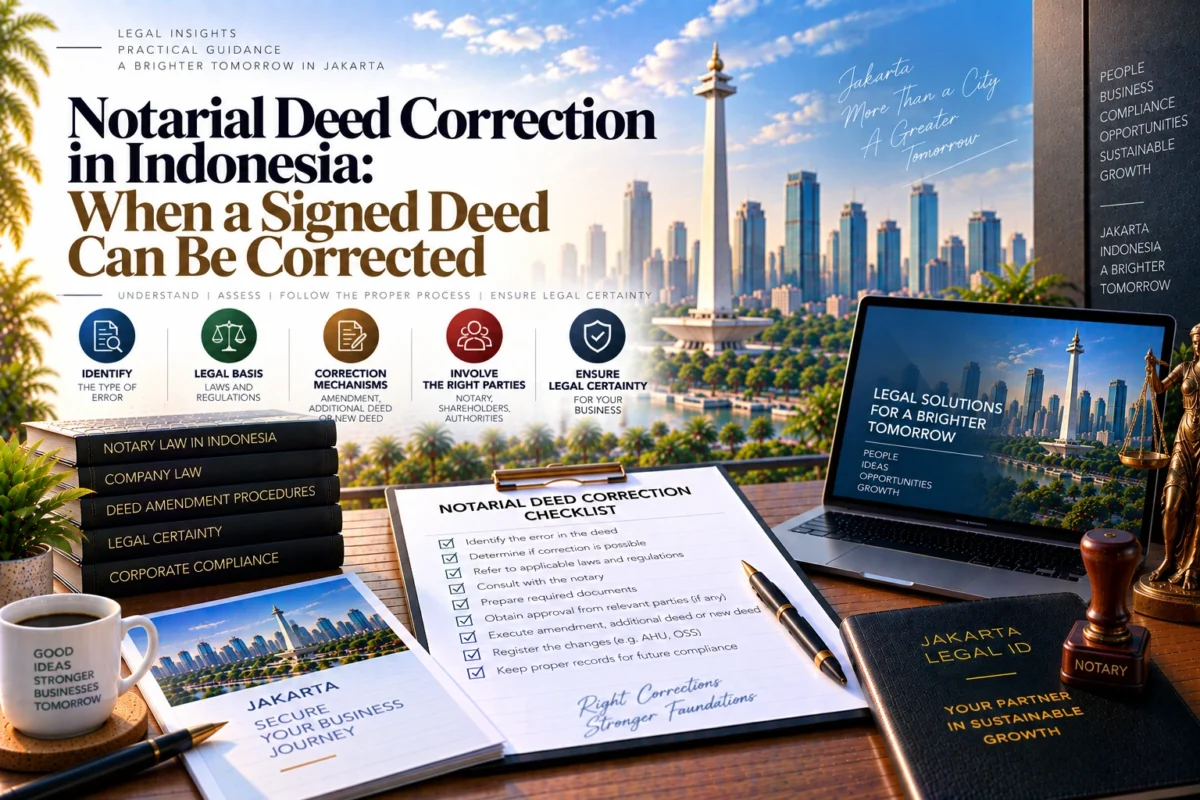
A signed Indonesian notarial deed can be corrected in a limited situation: Article 51 permits a notary to correct writing and typing errors in the signed Minuta Akta. The correction is not an informal replacement of the deed and should not automatically be used to change the commercial substance of the parties’ transaction.
The operative correction rule comes from Law No. 2 of 2014, which is officially listed as in force and amended Law No. 30 of 2004 on the Office of Notary.
Notarial Deed Correction Indonesia: The Short Answer
Under Article 51 paragraph (1) of Law No. 2 of 2014, a notary is authorized to correct a writing error and/or typing error contained in a Minuta Akta that has already been signed.
That wording matters. Article 51 identifies a specific error category rather than creating a general power to rewrite a completed transaction.
A useful first question is therefore not simply ‘Is something wrong in the deed?’ It is ‘Is this a writing or typing mistake, or are the parties actually trying to change what they agreed?’
First Identify Whether the Deed Has Already Been Signed
The timing of the mistake changes the applicable procedure.
If an error is identified while the deed is still being prepared or executed, the Notary Law contains separate rules for alterations within the deed. If the Minuta Akta has already been signed, Article 51 becomes the key provision for a qualifying writing or typing error.
This distinction prevents two different processes from being mixed together:
| Situation | Main legal issue |
|---|---|
| Error identified before completion/signing | Alteration within the deed under Articles 48-50 |
| Writing or typing error found in a signed Minuta Akta | Correction procedure under Article 51 |
| Parties want to change substantive rights or transaction terms | Assess whether a new amendment or other deed is required rather than assuming Article 51 applies |
The third category is a practical legal assessment, because Article 51 itself expressly refers to writing and typing errors rather than defining every possible substantive amendment scenario.
Article 51 Is for Writing and Typing Errors
A genuine clerical correction can involve text that was entered incorrectly even though the intended legal transaction has not changed.
Examples that may warrant review as possible clerical errors include an incorrect spelling, mistyped number or similar transcription problem. Whether a particular mistake legally falls within Article 51 should still be assessed from the deed and underlying documents rather than from the label used by the parties.
By contrast, a proposed change to matters such as ownership percentages, consideration, shareholder rights, contractual obligations, corporate capital or the parties themselves may alter the transaction rather than merely correct its recording.
For material changes, the safer legal question is whether the parties need an amendment deed or another appropriate instrument. That is an interpretation based on the narrow statutory wording of Article 51, not a separate statutory list of matters that can never be corrected.
How the Correction Procedure Works
Article 51 does not authorize the notary simply to edit the signed Minuta and issue a fresh copy.
The correction procedure is formal: Article 51 paragraph (2) requires it to be carried out before the appearers, witnesses and notary, recorded in minutes, and noted on the original Minuta Akta together with the date and number of the correction deed.
The practical file should therefore connect three records:
- the original signed Minuta Akta
- the correction minutes or correction deed
- the notation made on the original Minuta identifying that correction
This creates an audit trail instead of silently replacing the text of the original deed.
The Original Minuta Remains Important
The statutory mechanism expressly requires a notation on the original Minuta. That means the correction is documented in relation to the original signed deed rather than treated as though the original never existed.
The Parties Participate in the Correction Process
Article 51 paragraph (2) expressly requires the correction to be carried out before the appearers, witnesses and notary. A company should therefore not assume that discovering a typo allows the notary’s office to change the executed deed unilaterally without following the statutory process.
The Correction Record Must Be Delivered to the Parties
Afterward, Article 51 paragraph (3) requires a copy of the correction minutes to be delivered to the parties.
Businesses should retain that document together with the original deed copy and any corporate, transaction or licensing records that rely on the corrected information.
This is especially useful where a third party later reviews the deed. The correction record explains why the original Minuta contains a notation and provides the documentary chain supporting the corrected reading.
Why the Formalities Matter
The Article 51 procedure is not merely administrative housekeeping.
The procedural safeguards are consequential because Article 51 paragraph (4) states that violating paragraph (2) causes the deed to have only the evidentiary force of a private deed and can become a basis for an injured party to claim costs, damages and interest from the notary.
For a business, this means the correction process should be treated as part of document-risk management. An apparently small typo should not be repaired through an informal method that creates a larger evidentiary problem.
Correction vs Amendment: A Practical Decision Test
Before asking for a correction, compare the deed against the supporting transaction documents and ask four questions.
1. Was the Intended Agreement Already Clear?
If the underlying resolution, contract, shareholder instruction or identity document consistently shows the intended information and the deed contains an obvious transcription mistake, Article 51 may be relevant.
2. Would the Fix Change Anyone’s Rights or Obligations?
If the proposed change alters who owns what, who owes what, the amount paid, voting rights, corporate authority or another substantive legal position, treat the issue as potentially more than clerical.
3. Are the Parties Confirming an Existing Intention or Making a New Decision?
A correction records accurately what should already have appeared. A substantive amendment changes the transaction or corporate decision itself.
4. Do Other Registrations Depend on the Incorrect Text?
Even where the deed can be corrected, a separate administrative update may be necessary if incorrect information has already been reflected in company records, licensing data, tax records, banking documents or another government system.
The correction deed does not automatically prove that every downstream database has been updated.
Changes Made During Execution Follow Different Rules
Article 51 should also be distinguished from changes made before a deed is completed.
For changes made as part of preparing or executing the deed itself, Article 48 of the Notary Law separately provides that an addition, replacement or deletion is valid only when authenticated by the appearers, witnesses and notary.
The placement of those changes is also regulated because Article 49 requires them to be made in the left margin or, when that is not possible, before the deed’s closing section while identifying the portion being changed.
Where text is crossed out, Article 50 requires the original words, letters or numbers to remain readable and provides for authentication of the deletion by the appearers, witnesses and notary.
The practical distinction is therefore chronological as well as substantive: Articles 48-50 govern controlled alterations within the deed-making process, while Article 51 addresses qualifying writing or typing errors discovered in a Minuta Akta that has already been signed.
Check Corporate and Licensing Records After the Deed Is Fixed
For a business deed, correcting the notarial document may be only the first step.
After completing the correction, review whether the incorrect data was already used elsewhere. Depending on the type of deed, useful checks can include:
- company articles and amendment history
- shareholder and director records
- Ministry corporate data
- NIB and OSS information
- licences linked to the corporate data
- tax and bookkeeping records
- bank documentation
- contracts relying on the incorrect deed information
- beneficial-ownership records where relevant
Do not update those records merely because a typo existed. First identify whether the corrected fact is a field that the relevant system or authority actually records.
Jakarta Legal ID’s notary guide for foreign investors provides broader context on establishment deeds, corporate resolutions, amendments and other corporate notarial documentation.
Conclusion
Notarial deed correction in Indonesia is a formal legal process, not an informal editing exercise. Article 51 allows a notary to correct writing or typing errors in a signed Minuta Akta, but the correction must follow the statutory procedure involving the appearers, witnesses, notary, correction minutes and notation on the original Minuta.
The key decision is whether the problem is truly clerical. If the proposed change alters the substance of the parties’ agreement, ownership, corporate decision or obligations, it should be assessed as a possible amendment rather than automatically forced into Article 51.
For businesses, the final step is document consistency: once the deed issue has been resolved, verify whether any corporate or licensing record that relied on the incorrect information also needs a separate update.
Determine Whether Your Deed Needs a Correction or an Amendment
If your company has identified an error in an establishment deed, amendment deed or other corporate notarial document, Jakarta Legal ID provides notary services and PT PMA/PMDN corporate support within its current service scope.
Request a consultation to review whether the issue is a qualifying clerical correction, a substantive amendment or a document inconsistency that also requires follow-up in corporate or licensing records.
FAQ – Notarial Deed Correction Indonesia
Can a signed notarial deed be corrected in Indonesia?
Yes. Article 51 permits a notary to correct a writing or typing error in a Minuta Akta that has already been signed, provided the statutory correction procedure is followed.
Can the notary simply edit the signed deed?
No. Article 51 requires the correction to be made before the appearers, witnesses and notary, recorded in correction minutes and noted on the original Minuta Akta with the correction deed’s date and number.
Do the parties receive proof of the correction?
Yes. Article 51 paragraph (3) requires a copy of the correction minutes to be delivered to the parties.
What happens if the Article 51 correction procedure is not followed?
A violation of the paragraph (2) procedure can cause the deed to have only the evidentiary force of a private deed and can provide a basis for an injured party to claim costs, damages and interest from the notary.
Can Article 51 be used to change substantive transaction terms?
Article 51 expressly refers to writing and typing errors. A change to substantive rights, obligations, ownership or commercial terms should therefore be reviewed separately to determine whether an amendment or another deed is required.
What is the difference between Articles 48-50 and Article 51?
Articles 48-50 regulate controlled alterations made within the deed-making process, while Article 51 provides the correction procedure for qualifying writing or typing errors in a Minuta Akta that has already been signed.
References & Sources
- Law No. 30 of 2004 on the Office of Notary — peraturan.bpk.go.id
- Law No. 30 of 2004 on the Office of Notary — Official Full Text — peraturan.go.id
- Law No. 2 of 2014 Amending the Law on the Office of Notary — peraturan.bpk.go.id
- Law No. 2 of 2014 — Official Full Text — peraturan.go.id
Recommended Next Articles
- notary services for foreign investors and corporate documentation — jakartalegalid.com
- NIB and OSS registration guide for company data — jakartalegalid.com