
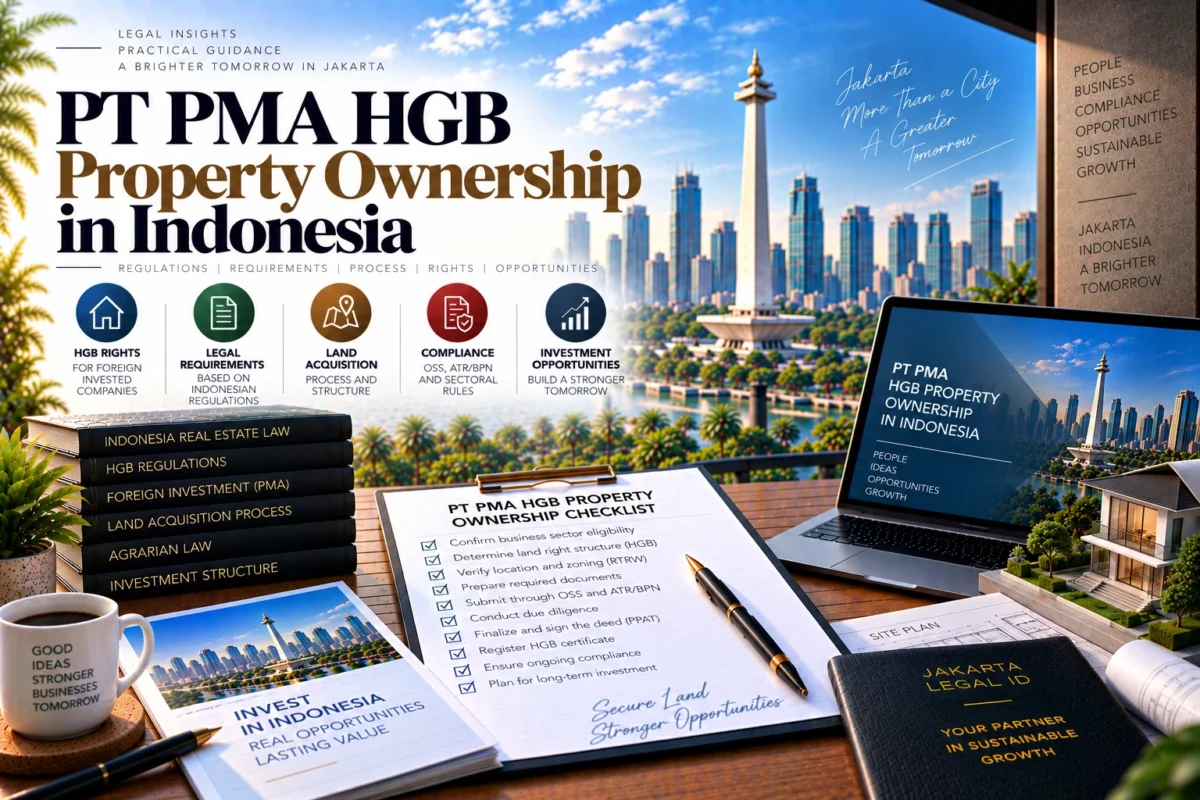
A PT PMA can generally hold Hak Guna Bangunan (HGB) because the company is an Indonesian legal entity, even when some or all of its shareholders are foreign. The important distinction is that the PT PMA holds the HGB; the foreign shareholders own shares in the company rather than owning the Indonesian land title personally.
Under Article 5 paragraph (2) of Law No. 25 of 2007 on Investment, foreign investment must generally be conducted through a limited liability company established under Indonesian law and domiciled in Indonesia unless another law provides otherwise.
Separately, Article 36 of Law No. 5 of 1960 allows HGB to be held by Indonesian citizens and by legal entities established under Indonesian law and domiciled in Indonesia.
Read together, those rules explain the basic PT PMA/HGB structure: the foreign investor owns the Indonesian company, while the qualifying Indonesian company is the registered HGB holder.
PT PMA HGB Property Ownership: The Short Answer
A PT PMA is not a special land title. It is the corporate investment vehicle. HGB is the land right.
The legal nature of HGB is defined in Article 35 of the Basic Agrarian Law as a right to establish and own buildings on land that is not owned by the HGB holder under Hak Milik.
That distinction matters because marketing phrases such as ‘foreign freehold through a company’ can blur two different concepts. A foreign investor may control the shares of a PT PMA that holds HGB, but the title itself remains HGB with a defined legal term and conditions.
Why a PT PMA Can Qualify as an HGB Holder
The qualification comes from the company’s Indonesian legal status, not from the nationality of each shareholder.
A PT PMA is established as an Indonesian PT for foreign-investment purposes. The agrarian rule then looks at whether the HGB holder is a legal entity established under Indonesian law and domiciled in Indonesia.
This also explains why a foreign corporation incorporated abroad cannot simply register Indonesian HGB in its own foreign company name. The relevant property-holding entity must satisfy the Indonesian HGB subject requirements.
For investors comparing structures, Jakarta Legal ID’s PT PMA vs local PT guide explains the broader corporate distinction between foreign-investment and domestic-investment companies.
HGB Is Not Hak Milik
HGB should not be described as perpetual freehold ownership.
By contrast, Article 21 of the Basic Agrarian Law generally reserves Hak Milik to Indonesian citizens and allows only legal entities specifically designated by the Government to hold that title.
For a normal commercial PT PMA property structure, the relevant analysis is therefore usually the company’s eligibility for HGB or another permitted land right, not an assumption that foreign shareholding converts the company into a Hak Milik holder.
This distinction affects transaction documents, valuation and exit planning. An investor buying shares in a company that holds HGB is acquiring an interest in a company whose asset is a time-limited registered land right, not personally acquiring Indonesian Hak Milik.
What Land Can Carry HGB?
Under the current Government Regulation No. 18 of 2021, HGB may be granted over State Land, Hak Pengelolaan land and Hak Milik land.
Those categories should not be treated as interchangeable during due diligence.
| HGB basis | Practical question for the buyer |
|---|---|
| State Land | What is the remaining HGB term and are extension or renewal conditions satisfied? |
| Hak Pengelolaan | What agreement or consent conditions apply with the Hak Pengelolaan holder? |
| Hak Milik | What is the underlying Hak Milik arrangement and the term of the HGB created over it? |
The certificate, underlying land status and any relevant agreement should therefore be reviewed together rather than relying only on the visible buildings on the site.
How Long Can a PT PMA Hold HGB?
The answer depends on the underlying land.
For HGB over State Land or Hak Pengelolaan land, Article 37 of Government Regulation No. 18 of 2021 provides an initial term of up to 30 years, an extension of up to 20 years and a renewal of up to 30 years.
That creates a potential lifecycle of up to 80 years across the grant, extension and renewal stages, but investors should not describe the entire period as one unconditional perpetual title. Extension and renewal remain legal stages that should be managed before the relevant term expires.
The same Article 37 treats HGB over Hak Milik differently: the initial period is up to 30 years and renewal is made through a deed granting HGB over the underlying Hak Milik.
For acquisition due diligence, always record the actual certificate expiry date, not merely the theoretical maximum duration available under the regulation.
What Rights Does the PT PMA Have Under HGB?
HGB provides significant commercial rights, but those rights operate within the title’s purpose and legal conditions.
Under Articles 44 and 45 of Government Regulation No. 18 of 2021, an HGB holder may use the land according to its designation, own buildings on it, transfer the right and encumber the HGB with Hak Tanggungan subject to applicable law.
This means HGB can function as a valuable corporate asset. Depending on the transaction and applicable requirements, it may be transferred or used as security rather than operating only as a right to occupy land.
The company’s land records should nevertheless remain consistent with the actual holder, certificate, corporate name and approved use.
HGB Does Not Replace Business or Land-Use Compliance
Holding HGB answers the land-right question. It does not by itself answer every business-licensing question.
A company may hold a valid HGB while still needing the correct KBLI, OSS Business Licensing, zoning or spatial-use compliance, building approvals and sector-specific permissions for the activity actually carried out on the property.
The HGB regulation itself links use of the land to its designation and applicable legal requirements. For an investor, the correct diligence sequence is therefore:
- confirm that the PT PMA is the correct HGB holder
- verify the certificate and underlying land category
- check the remaining HGB term
- confirm the intended physical use of the property
- compare that use with the company’s corporate purposes and KBLI
- review the OSS and sector licensing required for the operation
- confirm building and spatial-use documents separately
A valid company structure should not be used as a substitute for checking whether the intended hotel, warehouse, factory, office, rental operation or other commercial activity is actually permitted at the site.
What If the PT PMA Becomes Dormant?
A dormant company should not assume that an HGB certificate is a passive asset that can be ignored indefinitely.
HGB is not perpetual because Article 46 of Government Regulation No. 18 of 2021 lists grounds for its termination that include expiry, specified breaches, designation as abandoned land and the holder no longer qualifying as a proper HGB subject.
This does not mean that a temporarily inactive company automatically loses HGB. It means that corporate inactivity should be reviewed together with the property’s actual use, the HGB conditions, renewal timetable and any separate land-abandonment process rather than assuming that no compliance action is required.
For investors holding property in a PT PMA that has stopped trading, useful checks include:
- whether the company still legally exists and its corporate data is current
- whether the HGB certificate is approaching expiry
- whether the land is being used consistently with the granted right
- whether property taxes and other land-related obligations remain current
- whether OSS and company data still match the real activity
- whether the property is subject to financing, security or contractual restrictions
That creates the connection between property ownership and dormant-company compliance without treating dormancy itself as automatic loss of title.
PT PMA Property Due-Diligence Checklist
Before acquiring property through a PT PMA or buying shares in a PT PMA that already holds property, review the title and the company together.
| Review item | What to verify |
|---|---|
| HGB holder | Is the certificate registered to the correct Indonesian legal entity? |
| Shareholding | Does the buyer understand that shareholders own the company, not the HGB personally? |
| Underlying land | State Land, Hak Pengelolaan or Hak Milik? |
| Term | Grant date, expiry date and any extension or renewal history |
| Encumbrances | Is the HGB subject to Hak Tanggungan or another registered burden? |
| Transfer history | Is the chain of registered transfers consistent? |
| Land use | Does actual use match the title conditions and spatial rules? |
| Corporate purposes | Does the deed support the company’s intended property-related activity? |
| KBLI and OSS | Does the business licensing match what occurs on the property? |
| Building documentation | Are the buildings separately compliant with applicable building requirements? |
| Dormancy risk | If operations stopped, are land use, renewal and corporate obligations still being managed? |
For transaction documentation and title review context, Jakarta Legal ID’s notary guide for foreign investors covers broader corporate and property documentation issues.
Conclusion
PT PMA HGB property ownership is best understood as company-held land rights, not personal foreign freehold ownership.
The foreign investor owns shares in an Indonesian PT PMA. The PT PMA, as the Indonesian legal entity, can qualify to hold HGB. HGB then gives the company substantial rights to use, build on, transfer and finance the property, but only for the legally defined term and subject to applicable conditions.
Before acquiring the asset, verify the holder, underlying land category, HGB expiry, encumbrances, actual land use and the company’s business licensing. For an existing or dormant PT PMA, continue monitoring the title after acquisition because HGB has a lifecycle and should not be treated as a permanent certificate that no longer requires compliance attention.
Verify the PT PMA and HGB Structure Before You Acquire the Property
If a foreign-investment company will acquire or already holds Indonesian property, Jakarta Legal ID provides PT PMA/PMDN setup, notary and property-document support within its current service scope.
Request a consultation to review the proposed company structure, HGB title, corporate documents and licensing alignment before the transaction is finalized.
FAQ – PT PMA HGB Property Ownership in Indonesia
Can a PT PMA hold HGB in Indonesia?
Yes, an Indonesian-incorporated PT PMA can qualify as an HGB holder because HGB may be held by a legal entity established under Indonesian law and domiciled in Indonesia.
Does the foreign shareholder personally own the HGB?
No. The PT PMA is the registered legal entity holding the HGB. The foreign investor owns shares in the PT PMA.
Is HGB the same as Hak Milik or freehold?
No. HGB is a separate, time-limited land right. Hak Milik is governed by a different eligibility regime and is generally reserved to Indonesian citizens, subject to specially designated legal-entity exceptions.
How long can HGB last?
For HGB over State Land or Hak Pengelolaan, the current regulation provides up to 30 years initially, an extension of up to 20 years and a renewal of up to 30 years. HGB over Hak Milik follows a different renewal mechanism.
Can a PT PMA sell or mortgage an HGB?
Government Regulation No. 18 of 2021 permits HGB to be transferred and permits it to be encumbered with Hak Tanggungan, subject to applicable legal and registration requirements.
Does owning HGB mean the PT PMA can operate any business on the property?
No. The land right and the business licence are separate compliance layers. The company still needs to check its KBLI, OSS licensing, land-use rules, building requirements and any sector-specific approvals relevant to the activity.
Does a dormant PT PMA automatically lose its HGB?
No. Dormancy by itself should not be described as automatic loss of HGB. However, expiry, breach of HGB obligations, formal abandonment status or loss of eligibility as an HGB holder can affect the right, so an inactive company should still monitor the property and title.
References & Sources
- Law No. 5 of 1960 on Basic Agrarian Principles — Status Record — peraturan.go.id
- Law No. 5 of 1960 on Basic Agrarian Principles — Official Full Text — peraturan.go.id
- Law No. 25 of 2007 on Investment — Official Full Text — peraturan.go.id
- Government Regulation No. 18 of 2021 on Land Rights and Land Registration — Status Record — jdih.atrbpn.go.id
- Government Regulation No. 18 of 2021 — Official Full Text — jdih.atrbpn.go.id
- Minister of Agrarian Affairs and Spatial Planning/Head of BPN Regulation No. 18 of 2021 — jdih.atrbpn.go.id
Recommended Next Articles
- PT PMA vs local PT structure for foreign investors — jakartalegalid.com
- notary services for foreign investors and property documentation — jakartalegalid.com
- cost and scope of notary services for property transactions — jakartalegalid.com