
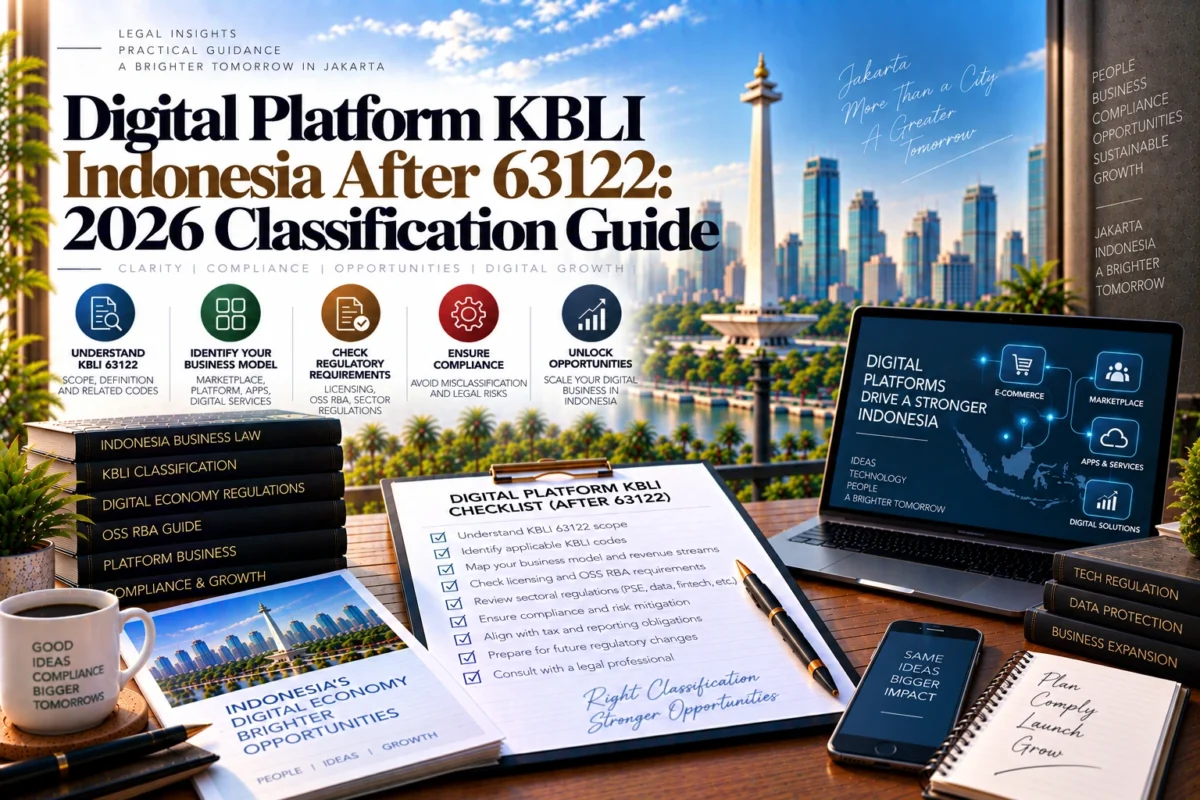
A digital platform in Indonesia can no longer assume that legacy KBLI 63122 is the default classification simply because it operates a marketplace, booking application or other commercial online intermediary. Under KBLI 2025, the former broad platform code has been divided according to the underlying economic activity.
For founders and investors researching digital platform KBLI Indonesia, the practical question is now: what transaction or service does the platform actually intermediate?
Digital Platform KBLI Indonesia: Why 63122 No Longer Has One Replacement
Under KBLI 2020, code 63122 covered commercial web portals and digital platforms broadly enough to become familiar to many marketplace and platform operators. The current framework is much more activity-specific.
The decisive change is visible in the current OSS conversion record for legacy KBLI 63122, which shows that the former commercial web-portal and digital-platform code was split into 33 separate KBLI 2025 codes.
Those destinations span retail intermediation, wholesale agency, transport, accommodation, food and beverage, software publishing, telecommunications, real estate, rentals, healthcare and several other service categories. There is therefore no single “new 63122” that can be copied into every company’s OSS profile.
The current starting point is BPS Regulation No. 7 of 2025, which established KBLI 2025 as Indonesia’s official economic-activity classification and replaced the previous KBLI 2020 framework.
The framework was most recently amended by BPS Regulation No. 6 of 2026, effective 10 September 2026, whose official abstract identifies the principal changes as codes 27201, 27203 and 68122 rather than the digital-platform classifications discussed here.
Start With the Transaction, Not the Technology
The most useful way to choose a platform KBLI is to temporarily ignore the fact that the business uses an app or website.
Instead, describe the commercial role in one sentence. Does the company connect sellers of physical goods with retail buyers? Does it match guests with accommodation providers? Does it intermediate restaurant reservations or food-service transactions? Does it sell passenger tickets, arrange rides, match clients with professional services, or provide only the software used by someone else’s marketplace?
That distinction matters because KBLI 2025 distributes intermediation across the sectors where the underlying transaction occurs. Two businesses may both operate mobile apps and charge commissions while belonging to completely different KBLI groups.
A second question is whether the platform merely intermediates or actually supplies the underlying goods or services itself. Many of the intermediation descriptions expressly refer to connecting parties for a fee or commission without the intermediary itself supplying or taking ownership of the item being intermediated.
KBLI 47901 for Retail Marketplace Platforms
Retail marketplaces have one of the clearest platform-specific classifications under KBLI 2025.
For a retail marketplace, KBLI 2025 code 47901 covers operation of a digital platform that facilitates retail trade between sellers and buyers for a fee or commission without supplying or taking ownership of the goods being intermediated.
This is a closer fit for a conventional marketplace connecting merchants with consumers than automatically reusing the former 63122 classification.
The distinction between intermediary and seller remains important. A business that buys inventory, takes ownership and resells goods is not performing exactly the same economic activity as a platform that earns commission for connecting independent sellers and buyers.
Accommodation and Food Platforms Use Different Codes
Sector-specific service platforms illustrate why “digital platform” is no longer enough to determine the code.
Accommodation Booking — KBLI 55400
A platform matching customers with accommodation providers instead needs to examine KBLI 2025 code 55400, which covers accommodation intermediation, including booking services, whether performed through digital or nondigital channels.
The code focuses on the accommodation transaction rather than on the technology used to arrange it. An online hotel-booking marketplace and a retail-goods marketplace can therefore share similar platform mechanics while belonging to different classifications.
Food and Beverage Intermediation — KBLI 56400
For food and beverage intermediation, KBLI 2025 code 56400 covers services that connect customers with food or beverage providers for a fee or commission through digital or nondigital channels.
Its description also demonstrates why the exact service matters: it distinguishes food and beverage intermediation from certain delivery-platform activities that belong elsewhere. A platform should therefore map what it actually arranges—restaurant reservations, food transactions, delivery, or another service—before selecting the activity.
Transport Platforms Need a Transport-Specific Review
Passenger transport is another area where the platform’s precise role controls the classification analysis.
Ticket Booking — KBLI 52321
For passenger-ticket platforms, KBLI 2025 code 52321 expressly includes operation of online platforms for booking road, rail, water or air passenger tickets.
The same description separates ticket-booking applications from applications that are merely developed as software products, which reinforces the difference between operating the intermediation business and building the software used by that business.
Ridesharing and Other Passenger Intermediation
Ridesharing and similar passenger-transport platforms require a different review because the current KBLI 5232 passenger-transport intermediation subgroup includes online ridesharing booking platforms and intermediaries such as taxi-hailing services where the intermediary does not itself provide the transport.
The subgroup contains several more specific classifications, including 52321 for ticket sales and 52329 for other passenger-transport intermediation. The platform operator should therefore identify whether it sells tickets, arranges rides, represents transport operators, or performs another passenger-transport role before selecting the specific code.
When KBLI 82400 May Be Relevant
The 63122 conversion list also points to KBLI 82400, but that does not make 82400 a universal replacement for platforms that cannot immediately identify another code.
For activities that are genuinely business-support intermediation and are not classified elsewhere, KBLI 2025 code 82400 functions as a residual category while expressly excluding many sector-specific forms of intermediation that belong in their own KBLI groups.
Those exclusions include retail, transport, accommodation, food and beverage, telecommunications, real estate, rentals, education, healthcare and other intermediation activities. A platform should therefore test the specific sector first rather than choosing 82400 simply because its service does not look like a traditional marketplace.
How to Choose the Current KBLI for a Digital Platform
A practical classification review can be done in four steps.
First, identify the underlying transaction. Write down exactly what two sides of the platform are being connected and what they exchange. Second, identify who supplies the underlying product or service. If the platform itself owns inventory or provides the service, a pure intermediation classification may not describe the full activity. Third, identify how the platform earns revenue—commission, booking fee, subscription, advertising or another model—and determine whether that revenue reflects intermediation or a separate software, advertising or service activity. Fourth, compare each material activity with the current KBLI 2025 description and the OSS conversion data rather than relying on an old company deed or legacy article.
Multi-activity platforms may need more than one genuine business activity. For example, a company may operate a marketplace while also developing and licensing proprietary software or providing another regulated service. The goal is not to add as many codes as possible, but to ensure the company’s material activities are represented accurately.
The OSS conversion page itself cautions that a conversion result does not automatically mean every new code fits the business. That is particularly important with 63122 because its 33-way split reflects many fundamentally different economic activities.
Check the Live OSS Scope After Selecting the Code
KBLI classification is only the first step in the licensing analysis. Once a candidate code has been identified, the company should review its current OSS scope, risk classification, responsible authority and any supporting business-licensing requirements shown for the actual activity.
After selecting the activity, businesses should review the current OSS scope and licensing outputs because Minister of Investment and Hilirisasi/BKPM Regulation No. 5 of 2025 is the current procedural framework for risk-based business licensing through the OSS system.
This is especially relevant for platform models that operate in regulated sectors. The fact that a business is digital does not remove sector-specific licensing, certification or supporting-permit requirements that may attach to the underlying activity.
Conclusion
Legacy KBLI 63122 should no longer be treated as a universal digital-platform code. OSS now maps it into 33 KBLI 2025 classifications, and the appropriate destination depends on what the platform actually intermediates.
Retail marketplaces should examine 47901. Accommodation platforms should review 55400. Food and beverage intermediation may point to 56400. Passenger-ticket and ridesharing platforms need transport-specific codes, while 82400 is relevant only where the activity is genuinely residual business-support intermediation not classified in a more specific sector.
For owners and investors, the strongest method is to classify the underlying transaction first, confirm the platform’s role and revenue model, compare that activity with the current KBLI description, and then check the live OSS licensing scope before filing.
Map Your Platform Activity Before Filing in OSS
If you are establishing a marketplace, booking platform or other digital intermediary in Jakarta and need to align its business model with PT PMA or PMDN setup and OSS activities, Jakarta Legal ID can be consulted to review the classification and licensing pathway.
Business setup and licensing assistance can be considered as part of that review; no separate service-page link is included because the supplied verified inventory did not identify an approved service URL.
FAQ – Digital Platform KBLI Indonesia After 63122
What replaced KBLI 63122 for digital platforms in Indonesia?
There is no single replacement. The OSS conversion record shows that legacy KBLI 63122 was split into 33 KBLI 2025 codes covering different activities, so the correct code depends on what the platform intermediates or provides.
What KBLI applies to an online retail marketplace?
KBLI 47901 should be examined where the platform facilitates retail transactions between sellers and buyers for a fee or commission without itself supplying or taking ownership of the intermediated goods.
Do hotel-booking platforms use the same KBLI as retail marketplaces?
No. Accommodation intermediation is separately classified under KBLI 55400, which includes accommodation booking services performed through digital or nondigital channels.
What KBLI applies to a ridesharing platform?
Passenger ridesharing belongs within the KBLI 5232 passenger-transport intermediation family. The specific code should be selected according to the platform’s exact role; 52329 covers other passenger-transport intermediation, while 52321 specifically concerns passenger-ticket sales.
Can every former 63122 platform use KBLI 82400?
No. KBLI 82400 is a residual category for business-support intermediation not classified elsewhere and expressly excludes numerous sector-specific activities. The relevant sector-specific KBLI should be checked first.
References & Sources
- BPS Regulation No. 7 of 2025 — Indonesian Standard Industrial Classification 2025 — jdih.bps.go.id
- BPS Regulation No. 6 of 2026 — Amendment to KBLI 2025 — jdih.bps.go.id
- OSS Conversion of Legacy KBLI 63122 to 33 KBLI 2025 Codes — oss.go.id
- KBLI 47901 — Digital Platform for Retail Trade Intermediation — oss.go.id
- KBLI 55400 — Accommodation Intermediation Services — oss.go.id
- KBLI 56400 — Food and Beverage Intermediation Services — oss.go.id
- KBLI 52321 — Passenger Transport Ticket Sales Agent — oss.go.id
- KBLI 5232 — Passenger Transport Intermediation Services — oss.go.id
- KBLI 82400 — Other Business Support Intermediation Services — oss.go.id
- Minister of Investment/BKPM Regulation No. 5 of 2025 — OSS Risk-Based Licensing Procedure — peraturan.bpk.go.id