For an ordinary Indonesian limited liability company, the annual General Meeting of Shareholders—Rapat Umum Pemegang Saham Tahunan or annual GMS—is not merely a year-end formality. It is the shareholder forum where the annual report and financial statements are presented for approval and where decisions such as profit allocation can be taken.
The main statutory framework is Law No. 40 of 2007 on Limited Liability Companies, which the BPK regulations database lists as in force and amended, including by Law No. 6 of 2023.
This guide focuses on ordinary non-public PT companies, including the type of corporate governance issues commonly encountered by PT PMA and PT PMDN owners. Public companies have additional OJK rules discussed separately below.
What Are the Annual GMS Requirements in Indonesia?
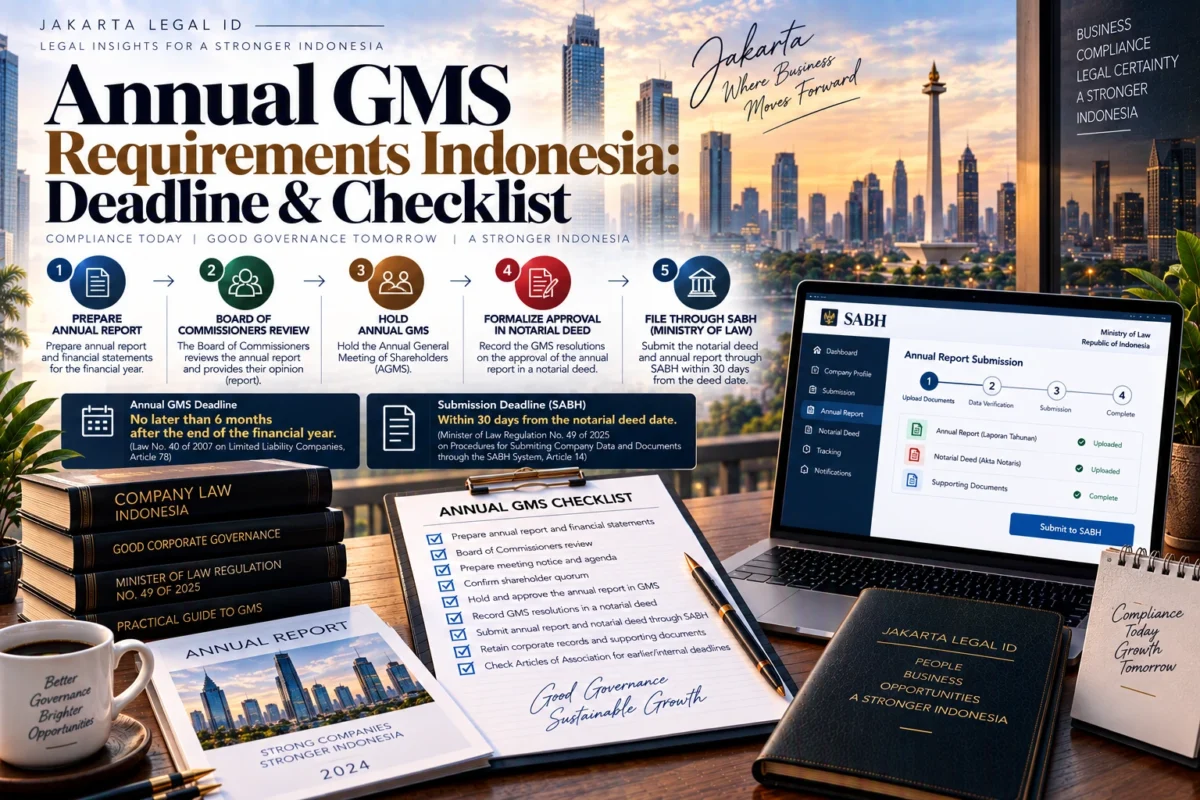
The first requirement is the deadline. Article 78 provides that the annual GMS must be held no later than six months after the end of the company’s financial year, and the annual-report documents referred to in Article 66 must be submitted at that meeting.
For a company whose financial year ends on 31 December, the statutory six-month window therefore makes the first half of the following year the critical preparation period. Companies should not use the sixth month as the starting point for preparing accounts, commissioner review, shareholder materials and the meeting notice.
The articles of association should also be checked. They can contain company-specific governance provisions that must be followed alongside the statutory framework.
What Must Be Prepared Before the Annual GMS?
The practical preparation work starts with the annual report rather than with the meeting invitation.
Annual Report and Financial Statements
Article 66 requires the directors to submit the annual report to the GMS after it has been reviewed by the board of commissioners, within six months after the financial year ends.
A useful internal preparation file should therefore reconcile the financial statements with the corporate records, director and commissioner information, major events during the year and any proposed shareholder decisions. Do this before the meeting notice is issued so the materials made available to shareholders are complete and internally consistent.
Check Whether an External Audit Is Required
Do not assume that every private PT has exactly the same external-audit requirement. Article 68 identifies specified situations in which the financial statements must be submitted to a public accountant for audit, and other sector rules can also create audit obligations.
The annual GMS calendar should therefore include an early audit-applicability check. If an audit is legally required, the audited financial statements must be ready for the annual-report approval process rather than treated as a later administrative step.
What Should Be on the Annual GMS Agenda?
The annual agenda should reflect the decisions that shareholders actually need to take. Avoid copying an old agenda without checking whether management changes, dividend decisions or other corporate actions are genuinely required for the current year.
Annual Report and Supervisory Report Approval
Under Article 69, approval of the annual report, ratification of the financial statements and approval of the board of commissioners’ supervisory report are carried out by the GMS.
This is the core annual agenda. The meeting materials should allow shareholders to understand what they are being asked to approve rather than presenting resolutions without the underlying annual-report documents.
Additional agenda items can be added where needed—for example, management appointments or other corporate actions—but those items should be checked separately against the articles of association and the statutory voting rules applicable to that action.
Profit, Reserve and Dividend Decisions
Where the company has profit available for allocation, the annual meeting is also the natural point to decide how that profit will be used.
Articles 70 and 71 provide that the GMS decides the use of net profit, including the allocation to the statutory reserve, while the reserve is accumulated until it reaches at least 20 percent of issued and paid-up capital where the company has a positive profit balance.
Dividend wording should therefore be coordinated with the approved accounts, retained earnings and statutory reserve position. A resolution declaring a distribution should not be drafted independently from the financial information being approved at the same meeting.
Notice, Quorum and Voting Rules
Meeting validity depends on procedure as well as substance.
Articles 81 and 82 provide that the directors generally call the shareholders before the GMS and that the notice must be given at least 14 days before the meeting, excluding the notice date and the meeting date.
Article 82 also requires the notice to state the date, time, place and agenda and to inform shareholders that the meeting materials are available at the company’s office.
For an ordinary agenda, Article 86 provides that the first GMS can proceed when more than one-half of all voting shares are present or represented, unless the law or the articles of association require a larger quorum.
These default thresholds should not be applied mechanically to every agenda item. Amendments to the articles of association, mergers, acquisitions, demergers, dissolution and certain other major actions are subject to different statutory thresholds. If an annual GMS also handles one of those matters, check the specific rule before finalizing the quorum and resolution wording.
What Must the GMS Minutes Contain?
A completed meeting needs a defensible corporate record.
Article 90 requires minutes for every GMS, signed by the meeting chair and at least one shareholder appointed by the participants, unless the minutes are made in the form of a notarial deed.
In practice, the minutes should accurately record the meeting date and place, attendees or represented shares, agenda, quorum, key resolutions and voting outcome. Where the meeting also approves a corporate action that must be documented or notified through a notarial or government process, coordinate the minutes and supporting deed documentation before the post-meeting filing is prepared.
For a capital-based PT, the annual-report approval also follows Article 16 of Permenkum 49/2025, as explained by BPHN. The GMS approval must be recorded in a notarial deed and submitted to the Minister through the notary via SABH within 30 days after the deed is signed. The Article 90 distinction between ordinary and notarial minutes should not be read as removing this annual-report approval requirement.
Annual GMS Checklist for PT PMA and PT PMDN
Use this sequence as a working file before the annual meeting:
- Confirm the company’s financial-year closing date
- Calculate the six-month annual GMS deadline
- Review the articles of association for company-specific meeting rules
- Close and reconcile the annual financial statements
- Check whether a statutory or sector-specific external audit is required
- Complete the annual report and commissioners’ supervisory report
- Obtain the required director and commissioner signatures
- Prepare the proposed annual GMS agenda and resolutions
- Review the statutory reserve and proposed profit or dividend allocation
- Confirm the current shareholder register and voting rights
- Issue the meeting notice within the required timeframe
- Make the meeting materials available for shareholder inspection
- Confirm attendance or proxies and calculate the applicable quorum
- Hold the meeting and record each resolution and voting result
- Complete the GMS minutes, arrange the notarial deed recording annual-report approval, and submit that approval through the notary via SABH within the Article 16 deadline
- Identify any corporate, AHU, tax, licensing or accounting follow-up created by the approved resolutions
The last step is important. Approval of the annual accounts may end the annual-meeting process, but a separate resolution—such as changing management or amending corporate information—can create a different filing or documentation requirement.
Public Companies Need an Additional OJK Review
The general company-law checklist above should not be used as the complete meeting procedure for a listed or other public company.
Public companies need a separate compliance check because OJK Regulation No. 15/POJK.04/2020 specifically governs the planning and conduct of GMS for public companies.
Public-company teams should therefore apply the relevant OJK timetable, announcement, disclosure, meeting and capital-market requirements in addition to the company-law framework.
Conclusion
The annual GMS process in Indonesia is best managed as a calendar, not as a single meeting date. Start with the financial-year end and six-month deadline, then work backward through financial reporting, commissioner review, audit assessment, shareholder materials and notice.
At the meeting, confirm the correct quorum and voting standard, approve the annual reporting matters, address profit allocation where relevant and create compliant minutes. If the agenda includes management changes, amendments or another corporate action, review that resolution separately because it may trigger different voting thresholds and post-meeting filings.
Prepare the Annual GMS Before the Deadline Becomes a Filing Problem
If your Jakarta company needs help organizing its annual GMS documents, corporate resolutions or follow-up corporate records, Jakarta Legal ID can be consulted before the meeting package is finalized.
Notary coordination, PT PMA or PT PMDN corporate support, tax and bookkeeping assistance can then be scoped according to the resolutions and financial records actually involved.
For help coordinating the annual meeting records and any deeds required by the approved corporate actions, review our Notary Services and agree the scope according to the company’s documents and proposed actions.
Read More: Notarial Documents in Indonesia: Company, Contract and Property Guide
FAQ Annual GMS Requirements Indonesia
When must an Indonesian company hold its annual GMS?
For a company subject to the ordinary Limited Liability Companies Law framework, the annual GMS must be held no later than six months after the end of the financial year.
Does every annual GMS need a notarial deed?
For the annual-report approval of a capital-based PT, Article 16 of Permenkum 49/2025 requires the approval to be recorded in a notarial deed and submitted through the notary via SABH within 30 days after signing. Ordinary minutes under Article 90 of the Companies Law do not replace that separate administrative requirement.
What documents should shareholders receive for the annual GMS?
The annual-report package should be prepared and made available for shareholder inspection in accordance with the Companies Law. It includes the required financial statements and other annual-report components, together with the commissioners’ supervisory reporting.
Can the annual GMS approve dividends?
Yes, where the company’s financial position permits it. The GMS decides the use of net profit, including the statutory reserve allocation, and the dividend decision should be consistent with the approved financial statements and positive profit balance.
Do public companies follow the same GMS procedure?
Not entirely. Public companies are also subject to OJK Regulation No. 15/POJK.04/2020 and other applicable capital-market requirements, so the ordinary private-company checklist is not sufficient by itself.
References & Sources
- BPK Regulations Database — Law No. 40 of 2007 on Limited Liability Companies — peraturan.bpk.go.id
- Directorate General of Taxes — Limited Liability Companies Law Text — pajak.go.id
- BPK Regulations Database — Law No. 6 of 2023 on Job Creation — peraturan.bpk.go.id
- OJK — Planning and Conduct of General Meetings of Shareholders of Public Companies — ojk.go.id