
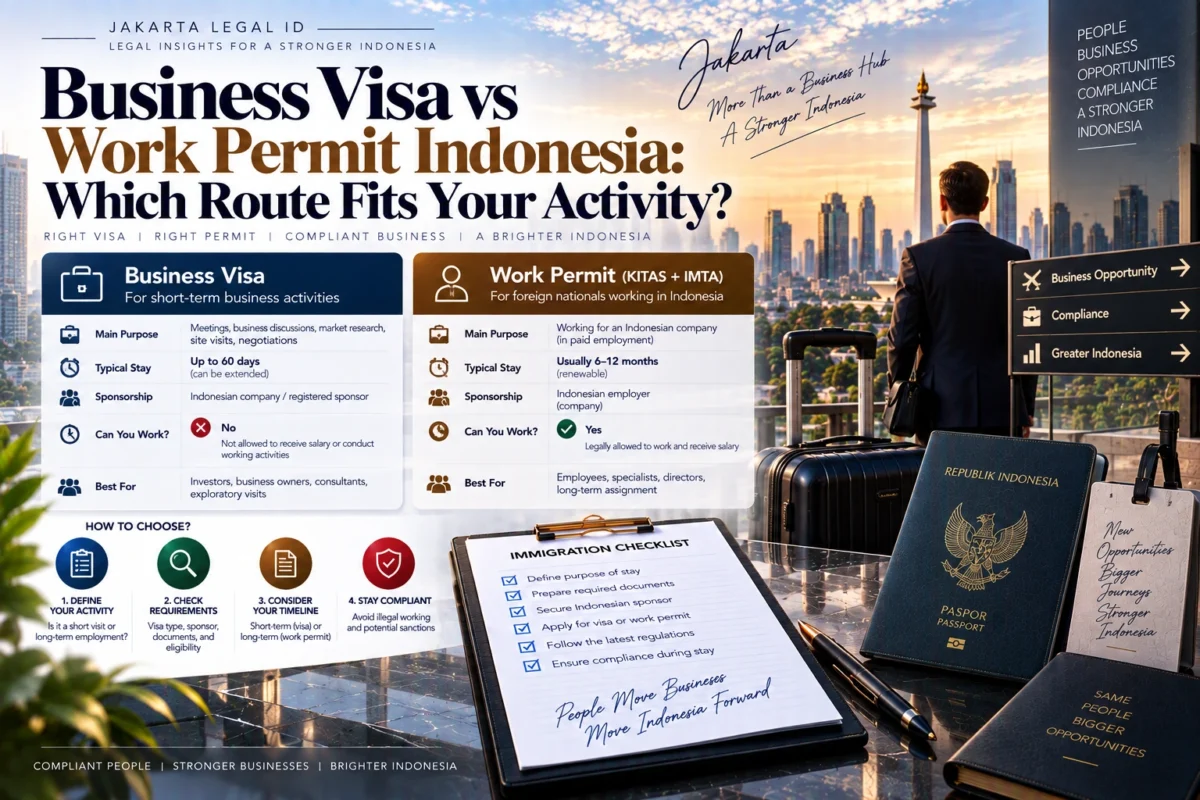
The practical difference in business visa vs work permit Indonesia is the activity the foreign national will actually perform. A business visitor can attend meetings, negotiate and sign business agreements under an appropriate visitor category, while a person who will occupy a job and perform work for an Indonesian employer needs a work-oriented immigration and manpower review.
Indonesia’s current immigration guidance states that the C2 Business Visitor Visa can be used for business, meetings, purchasing, discussions, negotiations, signing business agreements and checking goods at an office, factory or production site.
The same official visa page states that a foreigner using this stay permit is not allowed to sell goods or services or receive salary, wages or compensation for work or business from individuals or corporations in Indonesia.
That boundary is more useful than asking which document sounds simpler. The company should classify the planned duties before selecting the immigration route.
Business Visa vs Work Permit Indonesia: The Core Difference
A business visa is for permitted visitor activity. A work route is for a foreign national who will actually perform employment duties in Indonesia.
The phrase work permit can be misleading because the current system is not simply one document with that title. A foreign worker can require the correct work-oriented immigration status while the Indonesian employer separately addresses the manpower framework, including RPTKA authorization where applicable.
On the manpower side, Government Regulation No. 34 of 2021 on the Utilization of Foreign Workers is listed by the Ministry of Manpower JDIH as currently in force.
The implementing manpower regulation, Minister of Manpower Regulation No. 8 of 2021, is also listed as in force and covers RPTKA procedures, employer and foreign-worker documentation, DKPTKA procedures and reporting.
What a C2 Business Visitor Visa Allows
The C2 route is designed around temporary business-visitor activities rather than employment.
Examples of activities expressly described by Immigration include attending meetings, negotiating commercial terms, purchasing goods, signing business agreements and checking goods at business or production locations.
That makes C2 potentially suitable for an overseas executive who travels to Jakarta for negotiations, a supplier meeting or an inspection of products without taking up an Indonesian employment role.
The restriction on receiving Indonesian salary, wages or compensation is a critical decision point. A visitor route should not be used merely because the visit will be short if the person will actually perform compensated employment duties in Indonesia.
What the Work Route Involves
The work route combines immigration status with employer-side manpower compliance. The exact route depends on the proposed position, sector, sponsor and circumstances of the foreign worker.
Immigration Status for Work
Current Immigration service information lists E23 as a limited-stay visa for sponsored work and also identifies work categories covering management, industry, marketing, mining, digital roles and executive positions.
The appropriate category should therefore be matched to the person’s actual role rather than selected from a generic assumption that every foreign employee uses the same visa code.
RPTKA and Employer Compliance
The manpower side is separate from the visitor-versus-work visa label.
Article 6 provides that an employer of foreign workers is obligated to have an RPTKA legalized by the Minister or an appointed official.
Article 4 also provides that foreign workers may only be employed in an employment relationship for certain positions and periods and must have competencies appropriate to the position they will occupy.
Companies should therefore review both the foreign national’s immigration category and the employer’s manpower obligations before employment begins. Do not treat possession of a visitor visa as a substitute for that employment analysis.
Business Visa vs Work Permit Decision Matrix
The comparison below is a practical screening tool, not a substitute for checking the exact visa and manpower requirements for the intended role.
| Decision point | Business visitor route | Work route |
|---|---|---|
| Main purpose | Temporary permitted business activity | Performing employment duties in Indonesia |
| Meetings and negotiations | Generally compatible with C2 activities | May occur as part of employment, but work status is driven by the actual job |
| Signing business agreements | Listed as a C2 activity | Also possible as part of an authorized employment role |
| Indonesian salary or work compensation | C2 expressly restricts receiving it | Employment route requires work-specific compliance review |
| Employment relationship | Not the purpose of the visitor route | Central to the foreign-worker framework |
| Immigration category | Visitor category such as C2 when its conditions fit | Work-oriented limited-stay category matched to position and sponsor |
| Employer manpower review | Usually not the reason for the visit | RPTKA and related employer obligations must be checked |
The key implication is that trip duration is not the decisive criterion. A three-day negotiation visit can be a genuine business visit, while a short assignment involving actual employment duties can still require a work-route analysis.
Which Route Fits Common Scenarios?
The following examples help classify the activity before an application is prepared.
Meetings and Contract Negotiation
A foreign shareholder or overseas supplier coming to Jakarta to meet management, negotiate prices and sign a commercial agreement is performing activities that fit the current C2 description, subject to the visa’s conditions and the person’s specific circumstances.
The analysis changes if that person starts performing the day-to-day duties of a local employee or receives Indonesian work compensation.
Factory or Product Checks
C2 expressly includes checking goods at an office, factory or production site. That can fit a visitor scenario where the person is inspecting goods or discussing a transaction rather than taking over an operational job in the Indonesian business.
If the activity becomes hands-on operational work, installation, technical services or another work function, do not assume the same visitor category remains appropriate. Classify the actual duties before travel.
Performing an Ongoing Job in Indonesia
A foreign manager, engineer, marketing professional or other person who will occupy an ongoing position is fundamentally different from a visitor attending meetings.
The company should review the appropriate limited-stay work category together with its RPTKA and related manpower obligations. Job title alone is not enough; the proposed functions, employer, sector and period of employment matter.
Foreign Directors and Executives
Current Immigration information includes work-oriented categories for commissioners, directors, managers and other executives. Companies should nevertheless check the individual’s actual function and the applicable immigration and manpower treatment rather than assuming that corporate-office status automatically determines the full compliance route.
Employer Checklist Before the Foreign National Travels
Use this sequence before booking the person as a business visitor or onboarding them as a foreign worker:
- Write down the actual activities the foreign national will perform in Indonesia
- Separate meetings, negotiation and observation from operational job duties
- Confirm whether the person will receive salary, wages or other work compensation from an Indonesian person or entity
- Determine whether an employment relationship will exist
- Identify the proposed position and duration
- Check the current Immigration category that matches that activity
- If employment is involved, review the employer’s RPTKA requirement and any applicable exception
- Check supporting foreign-worker documents under the current manpower framework
- Align the immigration application with the position and sponsor information used in the manpower process
- Do not allow the foreign national to begin duties that fall outside the approved purpose merely because the individual is already physically in Indonesia
This activity-first review is especially useful for PT PMA companies because shareholders, directors, overseas group employees and technical specialists can travel to Indonesia for very different purposes even when they are all described internally as coming for ‘business.’
Common Decision Mistakes
One mistake is treating every company trip as a business visit. The correct classification depends on what the foreign national will actually do after arrival.
Another is treating every foreign national connected to an Indonesian company as an employee. A shareholder attending a negotiation can have a very different immigration purpose from a manager performing daily operational duties.
A third mistake is focusing only on Immigration and forgetting the manpower side of actual employment. Conversely, completing employer-side documentation does not mean the foreign national can enter or stay under any visitor category regardless of purpose.
Finally, do not rely on old terminology without checking current visa classifications. Immigration currently uses detailed purpose and occupation-based categories, so application planning should use the current category rather than an outdated label from a previous assignment.
Conclusion
Choose the business-visitor route when the person is genuinely coming for permitted temporary activities such as meetings, negotiations, purchasing or signing business agreements and is staying within the visitor conditions.
Choose the work-route analysis when the person will occupy an employment role or perform work for an Indonesian employer. In that situation, identify the correct work-oriented immigration category and review RPTKA and related manpower obligations before the person starts work.
There is no universal winner between a business visa and a work route. The compliant choice depends on the actual activity, employment relationship, compensation, position, sponsor and duration.
Classify the Activity Before Filing the Visa
If your Jakarta business is bringing a foreign shareholder, executive, specialist or employee to Indonesia, Jakarta Legal ID can be consulted to review the corporate and compliance context before the trip or onboarding process begins.
PT PMA or PMDN setup, corporate-document coordination, notary services and related compliance support can then be scoped according to the company’s actual structure and the foreign national’s proposed role.
To align the company’s incorporation and licensing records with its proposed staffing arrangements, review our Business Setup service and agree the scope according to the company’s documents and proposed actions.
Read More: Company Setup in Jakarta: Structure, Registration and Licensing Guide
FAQ Business Visa vs Work Permit Indonesia
Can a foreigner attend business meetings in Indonesia without a work permit?
A C2 Business Visitor Visa expressly covers activities such as business meetings, discussions, negotiations and signing business agreements. The person must remain within the conditions of the visitor status and should not perform employment duties outside that purpose.
Can a C2 business visitor receive a salary from an Indonesian company?
The current official C2 guidance states that a holder may not receive salary, wages or compensation for work or business from individuals or corporations in Indonesia.
Is RPTKA the same as an Indonesian work visa?
No. RPTKA belongs to the manpower framework for the employer’s utilization of foreign workers. Immigration separately uses work-oriented visa and stay-permit categories. Employment planning should therefore check both systems.
Can a foreign director use a business visa for every company activity?
Not automatically. A director may travel for meetings or negotiations, but if the individual will perform an ongoing work role in Indonesia, the company should review the appropriate work-oriented immigration and manpower route based on the actual duties.
Does a short assignment automatically qualify as a business visit?
No. Duration alone does not determine the correct route. The important question is whether the individual is performing permitted visitor activity or actual employment duties.
References & Sources
- Directorate General of Immigration — C2 Business Visitor Visa — kanwilpapuabarat.imigrasi.go.id
- Central Jakarta Immigration Office — Limited Stay Permit and Work Visa Categories — jakartapusat.imigrasi.go.id
- Ministry of Manpower JDIH — Government Regulation No. 34 of 2021 on the Utilization of Foreign Workers — jdih.kemnaker.go.id
- Government Regulation No. 34 of 2021 — Official English Translation — jdih.kemnaker.go.id
- Ministry of Manpower JDIH — Minister of Manpower Regulation No. 8 of 2021 — jdih.kemnaker.go.id