
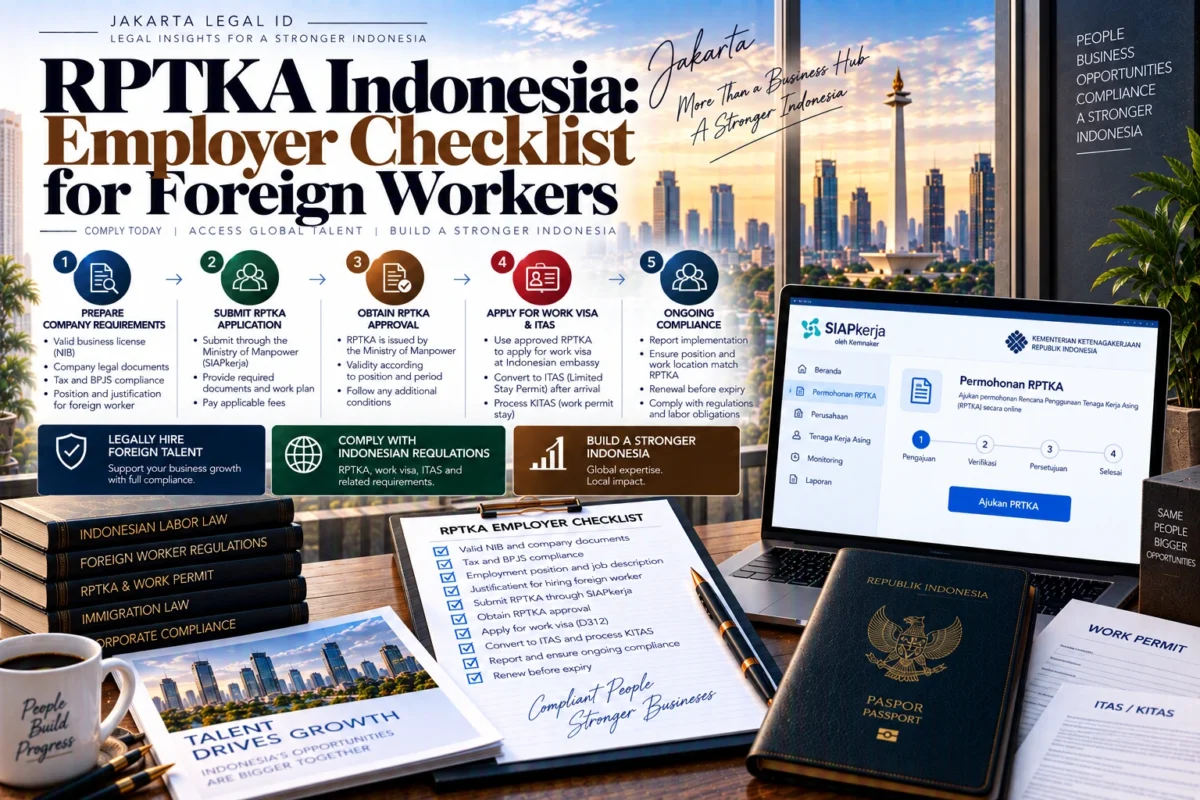
For employers, RPTKA Indonesia should be planned before a foreign worker starts performing the intended role. The central task is to align the company, proposed position, duration, work location, foreign-worker qualifications and supporting documents with Indonesia’s current foreign-worker framework.
The principal manpower framework is Government Regulation No. 34 of 2021 on the Utilization of Foreign Workers, which the Ministry of Manpower JDIH lists as currently in force.
Article 6 states that every employer of a foreign worker is obligated to have an RPTKA legalized by the Minister or an appointed official.
The implementing regulation is Minister of Manpower Regulation No. 8 of 2021, which the Ministry of Manpower JDIH lists as currently in force.
RPTKA Indonesia: What Employers Need Before Filing
The regulation defines RPTKA as the plan to use foreign workers in certain positions and for a certain period.
That definition is important for employers. RPTKA preparation is not merely an exercise in uploading a passport and company deed. The planned position, employment period, work location and business need should be internally consistent before the filing begins.
The employer should also separate the manpower approval from the foreign worker’s immigration process. RPTKA is part of the employer-side foreign-worker framework; the appropriate visa and stay status still needs to be coordinated for the individual worker.
What RPTKA Approval Covers
The approved RPTKA is tied to the employer’s planned use of the foreign worker. The same Article 6 also requires the employer to employ the foreign worker in accordance with the legalized RPTKA.
That makes early role design important. Changing the actual position, work location or employment arrangement after filing can create a mismatch between the approved plan and the way the foreign worker is actually used.
Match the Position and Employment Plan
Before filing, define the proposed job, reporting line, work location and intended duration. The company’s organizational structure should support the position shown in the application rather than treating the foreign-worker title as a standalone administrative label.
For an application covering work of more than six months or work in a Special Economic Zone, Article 10 requires application data including the employer’s identity, reason for using the foreign worker, position, number of foreign workers, utilization period, work location, Indonesian associate identity and annual Indonesian-worker absorption plan.
Check the Foreign Worker’s Qualifications
The candidate also needs to fit the proposed position. Article 4 requires the foreign worker to have education appropriate to the position, competence or at least five years of work experience matching the position, and to transfer expertise to an Indonesian associate.
Employers should therefore review the candidate’s education, experience and proposed responsibilities before fixing the position in the application. A strong corporate file does not solve a mismatch between the worker’s background and the role being requested.
Employer Documents for an RPTKA Application
The exact document set depends on the application category. For a common application covering work of more than six months or work in a Special Economic Zone, Article 10 also requires supporting documents including the RPTKA application letter, authorization letter, NIB and/or business license, incorporation or amendment documents, proof of mandatory manpower reporting, employer domicile, a draft employment or other agreement and the company organization chart.
This checklist helps an employer identify where the file may need preparation before submission:
| Review area | Typical preparation focus |
|---|---|
| Company identity | Employer legal name and corporate records |
| Business licensing | NIB and/or applicable business license |
| Corporate documents | Incorporation and relevant amendment records |
| Manpower administration | Mandatory company manpower-report evidence |
| Employment documentation | Draft employment agreement or other applicable agreement |
| Organization | Company organization chart and proposed foreign-worker position |
| Work plan | Location, duration, reason for using the foreign worker and staffing plan |
The practical implication is that RPTKA preparation often exposes corporate-document or licensing inconsistencies before the foreign-worker application is filed. Employers should resolve those inconsistencies rather than copying old company data into a new application.
How the RPTKA Process Works
Article 6 requires the employer to submit the RPTKA legalization application online through TKA Online.
The same provision sets out a workflow covering employer registration, application data and supporting documents, feasibility assessment, foreign-worker candidate data, a DKPTKA payment notification and issuance of the RPTKA legalization.
A practical employer workflow can therefore be organized into four stages: company readiness, RPTKA application preparation, candidate data preparation and completion of the payment and approval steps applicable to the case.
Feasibility Assessment and Candidate Data
The company-side application should be complete and internally consistent before the feasibility assessment. Candidate data then needs to match the approved position and employment plan.
This separation is useful in practice because a company can have a suitable foreign-worker candidate but still have an incomplete employer file, or have complete corporate documentation but a candidate whose background does not match the proposed role.
DKPTKA and Approval Issuance
DKPTKA forms part of the foreign-worker framework. The regulation treats DKPTKA as compensation paid by an employer for each foreign worker employed, with exemptions for the categories stated in Article 25.
Do not assume that the same payment treatment applies to every employer or foreign-worker case. The employer category, type of RPTKA and applicable exemption rules should be checked before the payment stage.
Employer Obligations After RPTKA Approval
Receiving RPTKA legalization is not the end of foreign-worker compliance. The employer must continue using the foreign worker consistently with the approved plan.
Those obligations should be considered during planning, not added as an afterthought. The company may need to identify an Indonesian associate, define the knowledge-transfer arrangement and maintain records showing how its obligations are being implemented.
When the Standard Checklist Is Not Enough
Not every RPTKA application follows the same path. Minister of Manpower Regulation No. 8/2021 contains separate provisions for temporary work, work exceeding six months, Special Economic Zones, non-DKPTKA cases and other employer categories.
The application should therefore be classified before documents are assembled. Temporary installation or after-sales work, a long-term managerial position and employment by a qualifying non-DKPTKA institution should not be treated as interchangeable cases.
Employers should also check whether an exception applies before assuming either that RPTKA is unnecessary or that every general obligation applies in the same way. The regulations contain specific exceptions and exemptions for particular roles, employer categories and circumstances.
What an RPTKA Preparation Service Should Cover
For an employer seeking external support, the useful scope is broader than form filling. A practical RPTKA preparation engagement can include reviewing the employer’s corporate documents, identifying missing company data, mapping the proposed position and location, organizing supporting documents, checking candidate information and coordinating the application file against the current manpower requirements.
The scope should also state its boundaries. RPTKA coordination does not itself guarantee government approval, does not replace the authority’s assessment and should not be presented as automatically resolving separate immigration, tax, employment-contract or sector-specific requirements.
Conclusion
A well-prepared RPTKA application starts with the employment plan. Confirm the employer’s legal and licensing records, define the foreign worker’s position and duration, verify the candidate’s qualifications, prepare the correct supporting documents and complete the TKA Online process using consistent information.
After approval, continue checking how the foreign worker is actually employed against the legalized plan and the employer’s ongoing manpower obligations. Where the case involves temporary work, an exemption, a special employer category or a non-standard role, classify that issue before relying on a generic checklist.
Prepare the Employer File Before the RPTKA Submission
If your Jakarta company is planning to employ a foreign worker, Jakarta Legal ID can be consulted to review the corporate-document, company-setup and compliance issues that need to be aligned before the RPTKA process.
RPTKA document coordination, PT PMA or PMDN setup, notary support and related corporate compliance assistance can then be scoped according to the employer, proposed position and foreign-worker profile.
For support preparing the corporate and licensing records needed for the employer file, review our Business Setup service and agree the scope according to the company’s documents and proposed actions.
Read More: Company Setup in Jakarta: Structure, Registration and Licensing Guide
FAQ RPTKA Indonesia
What is RPTKA in Indonesia?
RPTKA is the employer’s plan for using foreign workers in specified positions and for specified periods. The current manpower framework generally requires employers of foreign workers to obtain legalized RPTKA.
Is RPTKA the same as a work visa?
No. RPTKA belongs to the employer-side manpower framework. The foreign worker’s appropriate immigration visa and stay status must also be addressed separately.
What company documents are commonly needed for RPTKA?
For common longer-term applications, the current regulation identifies documents such as the application letter, authorization letter, NIB and/or business license, incorporation or amendment documents, manpower-report evidence, employer domicile, draft employment documentation and company organization chart.
Does every RPTKA case use the same document checklist?
No. The implementing regulation has different provisions for temporary work, work exceeding six months, Special Economic Zones, non-DKPTKA cases and other employer categories.
Does RPTKA approval end the employer’s foreign-worker obligations?
No. Employers must continue to employ the foreign worker consistently with the approved RPTKA and comply with applicable continuing obligations, including knowledge-transfer and related requirements where they apply.
References & Sources
- Ministry of Manpower JDIH — Government Regulation No. 34 of 2021 on the Utilization of Foreign Workers — jdih.kemnaker.go.id
- Government Regulation No. 34 of 2021 — Official English Translation — jdih.kemnaker.go.id
- Ministry of Manpower JDIH — Minister of Manpower Regulation No. 8 of 2021 — jdih.kemnaker.go.id
- Minister of Manpower Regulation No. 8 of 2021 — Official Text — jdih.kemnaker.go.id