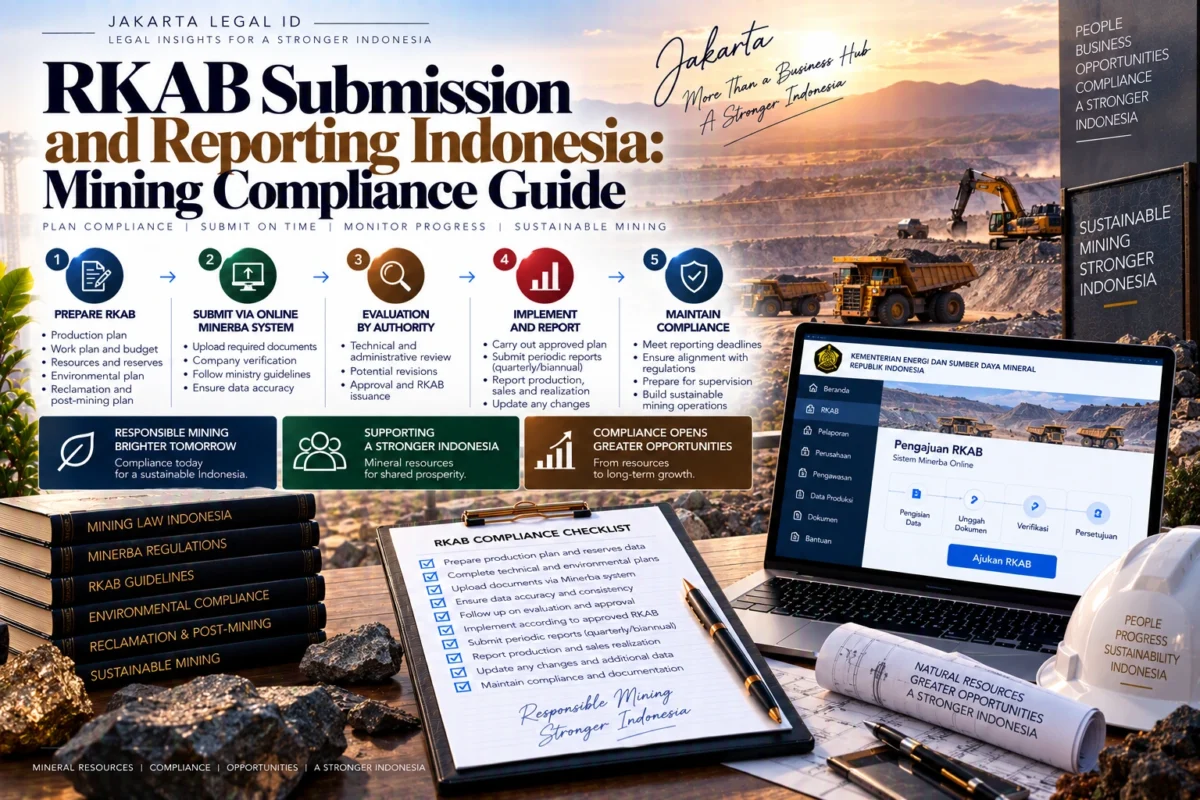
For mining operators, RKAB submission reporting Indonesia is now an annual planning and continuing reporting cycle rather than a multi-year filing exercise. Relevant mining permit holders must prepare an RKAB for each year, obtain approval through the designated system and then report actual mining activities against that approved plan.
The current framework starts with Minister of Energy and Mineral Resources Regulation No. 17 of 2025, which remains in force but is recorded by the BPK regulations database as amended by Minister of Energy and Mineral Resources Regulation No. 6 of 2026.
The latest amendment is Minister of Energy and Mineral Resources Regulation No. 6 of 2026, which took effect on 12 June 2026 and amended Regulation No. 17 of 2025.
For compliance teams, the practical lesson is to manage RKAB preparation, approval and reporting as one connected workflow. Figures approved in the work plan should be capable of being reconciled with the operational information reported during the year.
RKAB Submission Reporting Indonesia: The Current Framework
The BPK regulatory summary states that holders of relevant IUP, IUPK and continuation IUPK licences must prepare and submit an RKAB every year.
The RKAB covers the operator’s planned mining activities and functions as the approved reference for execution during the relevant year. This annual structure means a company should begin readiness work before the filing window rather than carrying forward old operational assumptions automatically.
The same current framework provides that RKAB submission is made electronically through the RKAB information system to the Minister or Governor according to the applicable authority.
Who Must Submit an Annual RKAB?
The annual RKAB requirement applies to the mining licence holders identified by the regulation, including relevant IUP and IUPK holders at exploration or production stage and continuation IUPK holders.
The filing should match the licence stage. An exploration operator and a production operator do not have the same operational profile, so their work programmes and later reporting evidence will differ.
Exploration-Stage RKAB
For exploration-stage operations, the company should align the annual programme with the exploration work it actually expects to perform. Internal preparation should reconcile planned technical activities, environment-related commitments, workforce requirements and the budget supporting those activities.
After approval, the operator should maintain records that make it possible to compare actual implementation with the approved plan. This reduces the risk that quarterly reporting becomes a separate data exercise disconnected from the RKAB.
Production-Stage RKAB
Production-stage operators need a stronger link between the approved plan and operational data. Production, sales, mining methods, equipment, environmental implementation and other regulated operating information can feed into the reporting cycle.
Before submission, internal teams should therefore reconcile production assumptions, technical plans and commercial expectations. A numerical inconsistency between the RKAB and later operational reporting can create avoidable follow-up work even when the underlying operation is lawful.
RKAB Submission Through the Information System
The electronic filing requirement makes data preparation as important as document preparation. Company details, licence information, technical data and supporting evidence should be checked before they are entered into the system.
A practical internal submission sequence is:
- Confirm the licence and authority responsible for the RKAB
- Confirm the correct annual mining stage and operational scope
- Reconcile corporate, technical and environmental data
- Check required non-tax state revenue and other administrative evidence where applicable
- Validate maps and technical attachments
- Review reclamation or environmental evidence applicable to the operation
- Reconcile annual production or exploration targets with internal budgets
- Perform a management review before electronic submission
- Track regulator comments and corrective requests
- Preserve the approved RKAB and supporting filing record for quarterly reporting
The purpose of this sequence is not to create a second regulatory checklist. It is to make sure the information submitted through the system can later be supported by the operator’s underlying records.
Quarterly Mining Reporting After RKAB Approval
RKAB approval does not end the operator’s reporting duties. Under the regulation, mining activity reporting is divided into periodic reports, final reports and special reports.
For regulated permit holders, periodic reports are generally prepared every three months and submitted no later than the 15th day of the following month after the relevant quarter ends.
That creates a predictable compliance calendar. Mining companies should close the quarter early enough to validate operational figures, investigate discrepancies and obtain internal sign-off before the filing deadline.
Reconcile Actual Performance Against the RKAB
For exploration and production-stage IUP or IUPK holders, the periodic report includes implementation of the approved RKAB together with other mining, environmental, safety, workforce and technical reporting items applicable to the licence stage.
The safest internal approach is to compare actual performance with the approved RKAB before the report is finalized. Review production or exploration progress, workforce figures, environmental implementation, safety information and other applicable operating data as one package rather than allowing each department to submit disconnected numbers.
A material deviation does not automatically mean the company should simply edit the quarterly report to match the plan. The compliance team should identify why the deviation occurred and determine whether the underlying RKAB, technical approval or other mining document needs separate action.
Final and Special Reports
Final reports apply when the relevant regulated activity reaches its reporting endpoint, while special reports arise when specified events or conditions occur.
The distinction matters because some events cannot wait until the end of a quarter. Mining safety, dangerous incidents, occupational disease events or certain environmental matters can trigger separate event-based reporting requirements under the mining framework.
Companies should therefore maintain two calendars: one for recurring quarterly reports and another escalation procedure for reportable incidents or special events.
What Changed in 2026?
According to the official regulatory summary, the 2026 amendment added changes concerning reporting of coal-blending activities and administrative correction during RKAB evaluation.
For coal businesses, the amended text confirms that production-stage IUP, IUPK and continuation IUPK holders remain subject to periodic reporting every three months.
The amendment is important for operators using old compliance templates. A checklist built only around the 2023 or 2024 RKAB regime can miss current requirements, particularly where coal operations include blending activities or where the regulator requests administrative correction during evaluation.
Compliance teams should therefore update internal SOPs, responsibility matrices and reporting templates whenever a new RKAB year is prepared.
For companies reviewing mining approvals together with broader supporting licences, Jakarta Legal ID’s PB UMKU after NIB guide provides separate context on when additional supporting licences may apply after the core business registration stage.
RKAB and Reporting Compliance Checklist
The checklist below separates annual submission work from the continuing reporting cycle.
| Compliance area | Annual RKAB review | Ongoing reporting review |
|---|---|---|
| Licence status | Confirm current IUP or IUPK stage and authority | Monitor changes affecting reporting scope |
| Work programme | Define annual exploration or production activities | Compare actual activities with approved plan |
| Production or exploration data | Set annual approved targets | Reconcile quarterly realization |
| Technical information | Confirm methods, equipment and technical assumptions | Report applicable operational realization |
| Environment | Align environmental and reclamation commitments | Report implementation and applicable monitoring |
| Workforce | Plan workforce and training data | Reconcile actual workforce information |
| Safety | Include relevant planning assumptions | Maintain quarterly statistics and event escalation |
| System filing | Submit through the required RKAB system | Submit reports through the applicable reporting system |
| Evidence retention | Keep filing documents and approved RKAB | Preserve quarterly support and regulator responses |
The key implication is that annual approval and quarterly reporting should use the same underlying data governance. If different departments maintain separate versions of production, sales, environmental or workforce data, the company increases the risk of inconsistencies across government filings.
Common RKAB Reporting Gaps
One common gap is treating the RKAB as the responsibility of only the mining technical team. The filing can involve information from finance, tax, environment, HR, legal and operations, so a single internal owner should coordinate the final dataset.
Another is waiting until the quarterly deadline to reconcile actual performance. Differences are easier to explain when they are identified monthly rather than reconstructed after the quarter has closed.
A third gap is relying on an old reporting template after a regulatory amendment. The June 2026 changes are a clear reason to review coal-reporting and RKAB-evaluation procedures before the next cycle.
Finally, avoid assuming that an approved RKAB automatically covers every later operational change. If the business changes its mining method, commercial arrangement, production approach or another material element, the company should check whether separate approval or RKAB action is required before implementing the change.
Conclusion
RKAB compliance is now best managed as a continuous annual cycle. Prepare the next year’s work plan using reconciled company and technical data, submit it through the required information system, preserve the approved version and then use that same dataset as the baseline for quarterly reporting.
The current rules also require companies to account for the June 2026 amendment. Mining operators should therefore review their reporting SOPs, coal-blending controls where relevant and administrative response procedures before each filing cycle rather than relying on templates built under the previous RKAB regime.
Review the RKAB File Before the Reporting Cycle Begins
If your Jakarta-based mining company is preparing an RKAB, reviewing mining licences or reconciling corporate documents before a filing, Jakarta Legal ID can be consulted to coordinate the legal and licensing issues around the submission.
Mining licence support, PT PMA or PMDN setup, notary coordination and related corporate compliance assistance can then be scoped according to the company’s licence stage and mining activities.
For help coordinating mining licence records and supporting corporate documents before an RKAB submission, review our Mining Licenses service and agree the scope for your licence stage and proposed activities.
Read More: Mining Licensing Indonesia: IUP, IUJP, SIPB and Compliance Guide
FAQ RKAB Submission Reporting Indonesia
Is RKAB submitted every year in Indonesia?
Yes. Under the current framework, relevant IUP, IUPK and continuation IUPK holders prepare and submit an RKAB annually for the applicable exploration or production stage.
Does RKAB approval replace quarterly mining reports?
No. RKAB approval establishes the approved annual work plan, while periodic mining reports continue during the year and include implementation against the approved RKAB together with other applicable reporting items.
When are periodic mining reports generally due?
The current framework generally requires periodic reports every three months, submitted no later than the 15th day of the month following the end of the relevant quarter.
What changed in the RKAB rules in 2026?
Minister of Energy and Mineral Resources Regulation No. 6/2026 amended Regulation No. 17/2025, including changes concerning coal-blending reporting and administrative correction during RKAB evaluation.
Should actual production always equal the RKAB figure?
The operator should report actual implementation accurately and reconcile it against the approved RKAB. If a material change affects the approved mining plan, the company should separately review whether an RKAB amendment or another regulatory action is required rather than altering actual reporting data.
References & Sources
- BPK Regulations Database — Minister of Energy and Mineral Resources Regulation No. 17 of 2025 on RKAB and Mining Activity Reporting — peraturan.bpk.go.id
- Minister of Energy and Mineral Resources Regulation No. 17 of 2025 — Official BPK Document — peraturan.bpk.go.id
- BPK Regulations Database — Minister of Energy and Mineral Resources Regulation No. 6 of 2026 — peraturan.bpk.go.id
- Minister of Energy and Mineral Resources Regulation No. 6 of 2026 — Official BPK Document — peraturan.bpk.go.id
Recommended Next Articles
- supporting licences after NIB and PB UMKU mapping — jakartalegalid.com