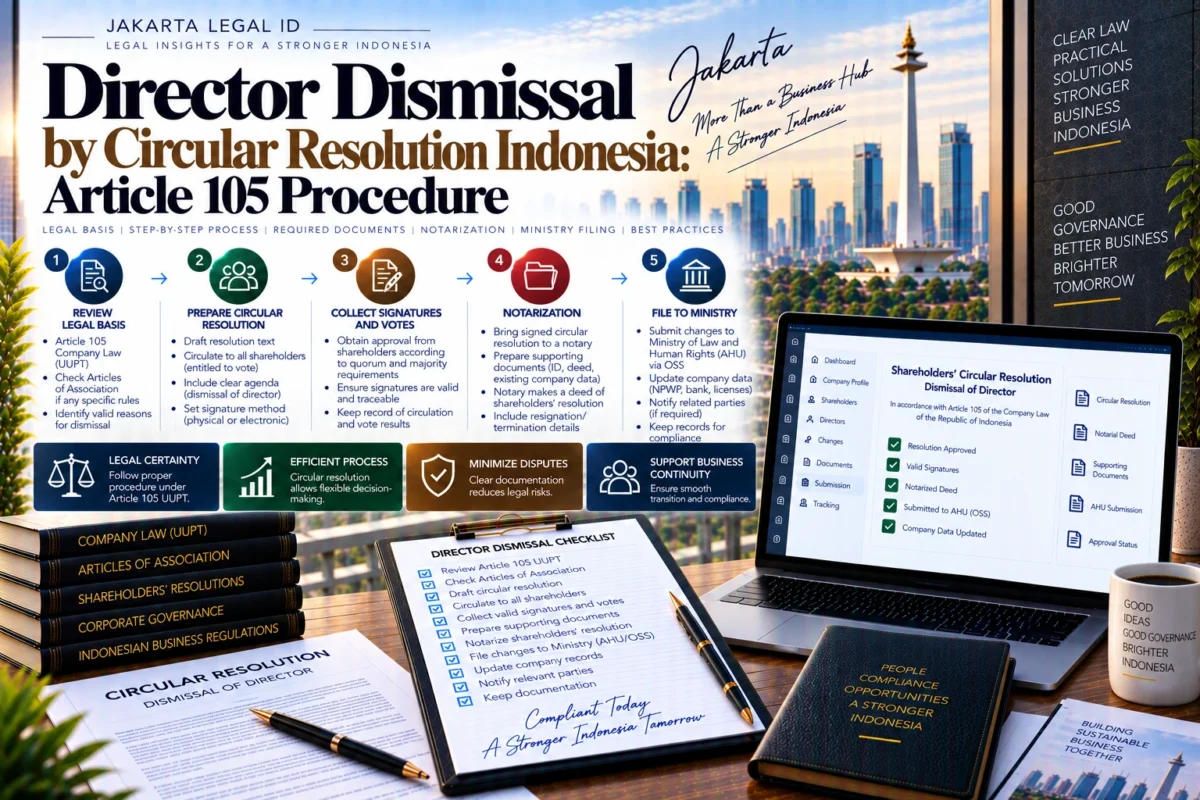
A director can be dismissed by circular shareholder resolution in Indonesia, but unanimous shareholder signatures alone are not enough. When the company uses an out-of-meeting decision, Article 105 adds a specific safeguard: the affected director must be told about the planned dismissal and given an opportunity to defend themselves before shareholders take the dismissal decision.
The Company Law used here remains in force in amended form, with the official JDIH BPK status page recording its amendment through the Job Creation legislation.
For the circular mechanism itself, Article 91 requires all shareholders with voting rights to approve the written proposal and sign it before the out-of-meeting decision becomes binding.
That makes director dismissal circular resolution Indonesia a two-layer process: first satisfy the circular-resolution rule, and then satisfy the additional dismissal procedure that protects the affected director.
Director Dismissal Circular Resolution Indonesia: The Short Answer
A company should not circulate a final dismissal resolution for signature first and try to obtain the director’s response afterward.
The substantive starting point is Article 105(1), which allows a director to be dismissed at any time by a shareholder decision but requires the dismissal decision to state its reason.
If dismissal is to be adopted outside a physical GMS, Article 105(3) requires the affected director to be notified in advance of the planned dismissal and given an opportunity to defend themselves before the dismissal decision is taken.
The safer sequence is therefore notice, written opportunity to respond, consideration of the response, and only then execution of the unanimous shareholder decision.
Step 1: Confirm the Circular Resolution Can Pass Unanimously
Before starting a removal process, confirm the current shareholder structure and voting rights.
Article 91 does not use an ordinary majority threshold. Every shareholder whose shares carry voting rights must approve the written proposal and sign it. A company that already knows one voting shareholder will not agree should not treat a circular resolution as a way to bypass that shareholder.
Review the current shareholder register, share classes, any voting restrictions, and the articles of association before preparing the document. This avoids building an Article 105 process around a circular resolution that cannot satisfy Article 91 in the first place.
Step 2: State the Proposed Reason for Dismissal
Article 105 allows dismissal at any time, but the shareholder decision must state the reason.
The official explanation to Article 105 gives examples such as a director no longer satisfying statutory requirements, conduct detrimental to the company, or another reason considered appropriate by the GMS. Those examples should not be treated as a closed list or as automatic proof that dismissal is justified in a particular dispute.
For drafting purposes, the proposed reason should be sufficiently clear for the affected director to understand what decision shareholders are considering and to respond meaningfully. A vague notice followed by a much broader final resolution can create avoidable procedural disagreement.
Step 3: Notify the Director Before the Decision Is Taken
Timing is central to Article 105(3).
The affected director must be informed of the planned dismissal before shareholders take the out-of-meeting decision. The company should therefore preserve evidence showing when the notice was sent, what proposed reason was communicated, how the notice was delivered, and how the director was invited to provide a defense.
The statute does not state one universal number of days for this circular-dismissal notice in Article 105(3). Avoid inventing a fixed response period. The process should instead give a genuine opportunity to respond before shareholders finalize the decision, while also checking the articles of association, shareholder arrangements, employment or service documents, and any other rules applicable to the company.
The Director’s Defense Must Come Before the Circular Decision
For an Article 105(3) circular dismissal, the official explanation says the defense is made in writing.
A practical notice can identify:
- the company and the affected director
- the proposed dismissal
- the reason shareholders are considering
- the documents or events relevant to that reason where appropriate
- the method for delivering the written response
- a reasonable internal response date consistent with the applicable documents and circumstances
- the person or corporate organ receiving the response
These are practical controls rather than a statutory template. The key legal point is that the director receives notice and a genuine written-defense opportunity before the dismissal decision is adopted.
Step 4: Consider the Written Defense and Finalize the Resolution
After the response opportunity has been provided, shareholders can decide whether to proceed with the proposed dismissal.
The file should demonstrate a clean chronology: proposed dismissal, advance notice, written defense or documented opportunity to provide it, final shareholder proposal, and unanimous signatures from all voting shareholders.
The final circular resolution should clearly identify the director, the dismissal decision, the reason, the effective date where the shareholders wish to specify one, and any related appointment or implementation authority that shareholders are approving.
Do Not Predate or Backfill the Defense Process
The Article 105 safeguard loses its practical purpose if the company has already completed the dismissal decision before offering the director an opportunity to respond.
For that reason, avoid collecting final shareholder signatures first and later preparing a notice merely to make the file appear complete. Corporate records should show that the defense opportunity genuinely preceded the decision.
Where the matter is contentious, keep reliable records of delivery, the response, shareholder consideration, and the final signed proposal. The article does not assume that procedural compliance eliminates every possible contractual or litigation issue; a director may have separate rights under other agreements or applicable law.
Step 5: Determine the Effective Dismissal Date
The dismissal date should not be left ambiguous.
For an out-of-meeting dismissal, Article 105(5) provides that the dismissal takes effect on the date of the decision or on another date expressly specified in that decision.
This date matters operationally. It affects when the individual’s authority as director ends and when the company should treat the board composition as changed for its corporate records and subsequent registration process.
If shareholders are simultaneously appointing a replacement director, the resolution should make the intended transition dates clear and the company should check any additional qualification, consent, beneficial-ownership, licensing, banking, employment, or sector-specific consequences separately.
Step 6: Update the Director Data Through SABH
A valid internal dismissal decision does not complete the external corporate-record update.
For implementation after dismissal, Permenkum 49/2025 treats changes in the composition or reappointment of directors and commissioners as changes to company data and permits the relevant change to be established through a GMS or a binding shareholder decision outside the GMS.
Where the dismissal changes the recorded board composition, Article 9(5) of Permenkum 49/2025 requires the change in directors or commissioners to be notified to the Minister through the Director General for recording in the company register within 30 days from the date of the change.
The same regulation provides that applications for company-data changes under Article 9 are submitted through a notary electronically through SABH.
This creates an important connection between Article 105(5) and the administrative filing: determine the effective change date carefully, then organize the notarial and SABH process without treating the signed circular resolution as the final administrative step.
Jakarta Legal ID’s verified Notary Services page explains its coordination scope for corporate resolutions, eligible amendment documents, drafting and execution records, and follow-up with the responsible licensed notary.
Practical Director-Dismissal File Checklist
Before closing the process, review the legal and administrative file as one chronology.
Check that:
- the current shareholder register and voting rights were confirmed
- every voting shareholder can participate in the Article 91 written decision
- the proposed dismissal reason is stated clearly
- the affected director received notice before the decision
- the director was given an opportunity to submit a written defense
- evidence of notice and any defense is retained
- the final proposal was not signed before the defense stage was completed
- all shareholders with voting rights approved and signed the circular resolution
- the dismissal reason appears in the final decision
- the effective dismissal date is clear
- any replacement director decision is coordinated with the dismissal where applicable
- the company’s articles of association and relevant agreements have been reviewed
- the notarial document and SABH company-data change are prepared where required
- the 30-day notification period for the director-data change is tracked from the date of change
- banking, licensing, tax, beneficial-ownership, employment, and contractual follow-up is checked separately where relevant
The objective is not merely to obtain signatures. It is to preserve a defensible sequence showing that the Article 105 protection occurred before the Article 91 decision and that the resulting company-data change was then implemented correctly.
Conclusion
A director dismissal by circular resolution in Indonesia requires more than unanimous shareholder approval. Article 91 governs the validity of the out-of-meeting shareholder decision, while Article 105 adds a separate procedural safeguard for the director being removed.
The company should state the proposed reason, notify the director before the decision, provide the opportunity for written defense, and only then collect the final unanimous shareholder approvals. The dismissal takes effect on the decision date unless another date is specified.
Afterward, the company should treat the change in board composition as a separate implementation task. Under current Permenkum 49/2025, director-data changes must be notified for recording within 30 days and processed through the applicable notarial and SABH route.
Review the Dismissal Sequence Before Shareholders Sign
If your Jakarta company is considering removing a director through a written shareholder decision, Jakarta Legal ID can assist with a consultation to organize the corporate records, shareholder approval sequence, notarial coordination, and company-data update issues that should be reviewed.
The correct approach depends on the shareholder structure, articles of association, proposed reason for dismissal, director-response process, effective date, replacement appointments, and follow-up registration requirements.
For help coordinating corporate documents, signing requirements and any required deed preparation with the responsible licensed notary, review our Notary Services and agree the scope for the specific document or corporate action.
Read More: Notarial Documents in Indonesia: Company, Contract and Property Guide
FAQ Director Dismissal Circular Resolution Indonesia
Can shareholders dismiss a director by circular resolution in Indonesia?
Yes. Article 105(3) expressly contemplates dismissal through an out-of-meeting decision under Article 91. The circular resolution must satisfy Article 91’s unanimous written-approval requirement, and the director must first receive notice of the proposed dismissal and an opportunity to defend themselves.
Must the director be notified before shareholders sign the dismissal resolution?
Yes. Article 105(3) requires advance notice of the planned dismissal and an opportunity to defend before the dismissal decision is taken.
Does the director’s defense need to be in writing?
For the Article 105(3) out-of-meeting procedure, the official explanation to the Company Law states that the defense is made in writing.
Must all shareholders agree to dismiss the director by circular resolution?
For the Article 91 circular-resolution mechanism, all shareholders with voting rights must approve the proposal in writing and sign it. If unanimity is unavailable, the company should assess the applicable GMS route instead.
When does a dismissal by circular resolution take effect?
Article 105(5) provides that an out-of-meeting dismissal takes effect on the date of the decision unless another effective date is specified in that decision.
How soon must the director change be reported after dismissal?
Under current Permenkum 49/2025, a change involving directors or commissioners must be notified for recording in the company register within 30 days from the date of the change, through the applicable notarial and SABH process.
References & Sources
- Current Status of Law No. 40 of 2007 on Limited Liability Companies — peraturan.bpk.go.id
- Official Text of Law No. 40 of 2007 on Limited Liability Companies — peraturan.go.id
- Current Status of Ministry of Law Regulation No. 49 of 2025 — peraturan.bpk.go.id
- Official Text of Ministry of Law Regulation No. 49 of 2025 — peraturan.go.id