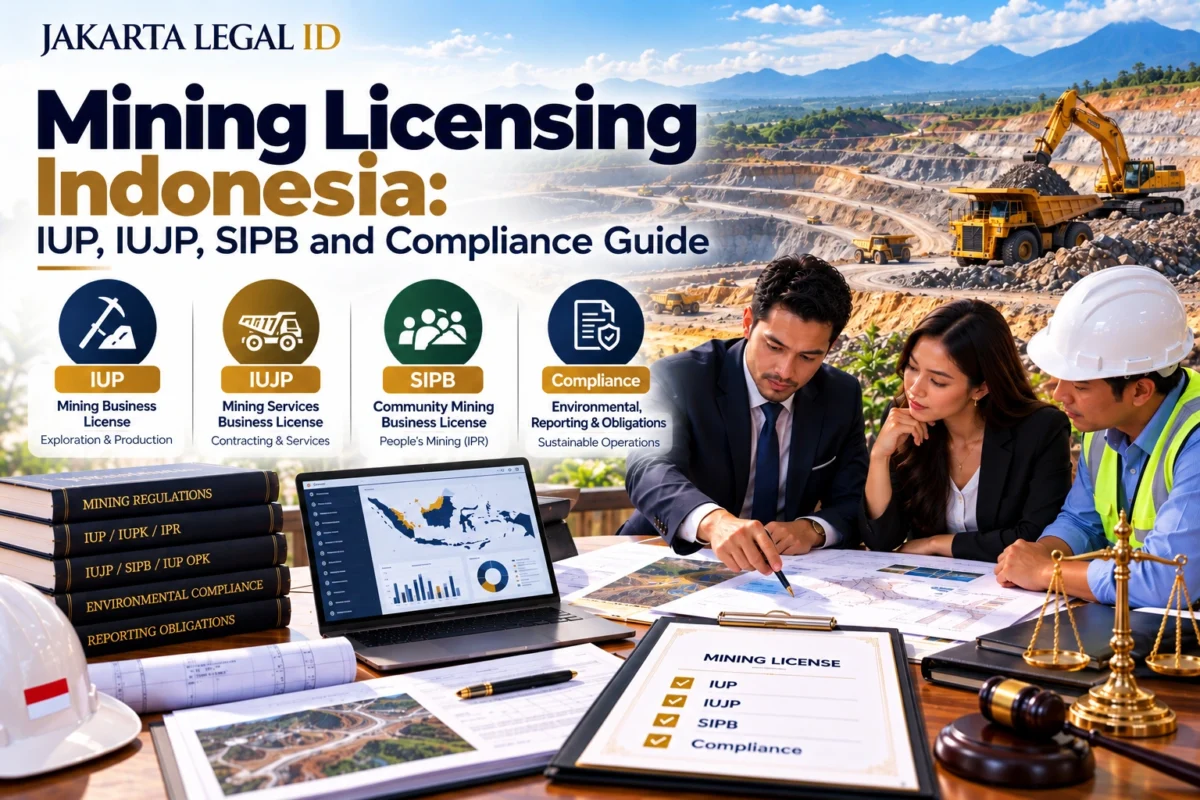
Mining licensing Indonesia should start with the activity the company will actually perform. A business developing a mineral or coal project, supplying mining services, acquiring an existing licence holder or changing an operating project may face different licensing and compliance workstreams.
For investors and business owners, the useful starting point is not simply the licence name shown in a proposal. Review the activity, commodity, project location, licence holder, authorised stage and current project records together.
This guide focuses on mineral and coal mining. Oil and gas are governed through a different regulatory framework.
Mining Licensing Indonesia: Start With the Activity, Commodity and Project Location
Before reviewing application forms or transaction documents, prepare a short operational brief covering:
- the commodity
- the proposed mining or mining-service activity
- project coordinates and operating location
- ownership and licence-holder identity
- existing licences and approvals
- land or access arrangements
- the current project stage
- who owns the project and who will perform the work
A company registered in Jakarta may have a mining project in another province. The corporate address should therefore be distinguished from the actual project location when reviewing licences, project records and the competent authority.
For the corporate workstream, Jakarta Legal ID’s Company Registration Indonesia guide provides background on company establishment and sector-specific licensing. Its NIB and OSS Registration guide provides additional context on OSS and business-registration records.
Which Mining Licence Should the Review Consider?
Indonesia’s mineral and coal framework contains different licensing pathways. The current implementing baseline includes Government Regulation No. 96 of 2021, which the official ESDM database records as in force and amended by Government Regulation No. 25 of 2024 and Government Regulation No. 39 of 2025. The statutory framework was also updated by Law No. 2 of 2025, the fourth amendment to Law No. 4 of 2009 on Mineral and Coal Mining.
Use the company’s actual role to identify the first pathway to review:
- IUP: review the project, commodity, mining area and authorised stage reflected in the actual licence and project records.
- IUPK: determine whether the project falls within the special mining-business pathway and review the applicable eligibility and project conditions.
- SIPB: assess whether the proposed rock-mining activity qualifies for the pathway; do not assume SIPB applies to every quarry or commodity.
- IUJP: assess the mining services the company intends to supply. A mining-services licence should not be treated as a substitute for the mining authority held by the project owner. Use our IUJP requirements and document readiness guide for a scope-specific preparation review.
- Other arrangements: transportation, sales, processing, project restructuring and historical licences may require separate review depending on the actual activity.
The current risk-based ESDM sector standards are set out in Minister of Energy and Mineral Resources Regulation No. 7 of 2026. Review the applicable standard for the selected activity alongside the mining-law framework.
This is a classification framework, not a universal permit checklist. Eligibility and application requirements should be checked against the specific activity, commodity, project location, licence stage and current regulatory framework.
Separate Exploration From Operation Production Readiness
For an IUP project, verify whether the licence concerns the Exploration stage or Operation Production stage. These stages should not be treated as interchangeable when assessing what the project is authorised and prepared to do.
An investor should therefore avoid treating a statement that the company “has an IUP” as proof that commercial production can immediately begin. Review the licence itself together with the authorised stage, area, commodity, project records and the approvals relevant to the proposed operations.
This distinction is particularly important in acquisitions, joint ventures and project financing because commercial assumptions may depend on activities that are not yet reflected in the current project status.
Review the Company and Mining Project Together
Mining due diligence should connect the corporate entity with the mining project rather than reviewing them in isolation.
Prepare a document index covering:
- company deed and amendments
- shareholders and management
- tax and corporate identity
- OSS records
- licence-holder identity
- project area and maps
- commodity and authorised activity
- current mining licence documents
- relevant technical and environmental records
For an investment or acquisition, keep unresolved questions separate from verified facts. Check whether the transaction entity is the actual licence holder, whether the available documents refer to the same area and commodity, whether the authorised stage matches the intended business plan and whether ownership or management changes affect information previously recorded with the authorities.
Where the investment involves a new Indonesian company, the Company Registration Indonesia guide can be used for the corporate starting point before the mining-specific review.
An IUP Alone Does Not Establish Operational Readiness
Mining licensing is only one part of operational compliance. In its June 2026 explanation of mining governance, the Ministry of Energy and Mineral Resources states that mining activities cannot be carried out merely by holding an IUP. The ministry also identifies planning, technical, environmental, safety and state-revenue obligations that must be addressed.
This matters when evaluating a project acquisition or setting a target operating date. A licence may exist while other material operational workstreams remain incomplete.
Review, where applicable:
- RKAB status
- environmental records and approvals
- technical studies
- land and project-area issues
- forestry matters where relevant
- mining-safety responsibilities
- reclamation and post-mining obligations
- state-revenue and other financial obligations
Technical and environmental matters should be reviewed by the appropriate competent professionals rather than inferred solely from corporate records.
RKAB: Use the Current 2025–2026 Framework
The current RKAB framework includes Minister of Energy and Mineral Resources Regulation No. 17 of 2025. The official ESDM database records that regulation as in force but amended by Minister of Energy and Mineral Resources Regulation No. 6 of 2026, promulgated on 12 June 2026.
The 2025 regulation governs preparation, submission, approval and reporting for RKAB in mineral and coal mining, while the 2026 regulation modifies that framework. A current project review should therefore use the amended framework rather than relying only on older RKAB procedures.
Do not rely on a historical approval screenshot as proof of current compliance. Review the applicable RKAB period, current approval position, reporting status and whether later regulatory changes affect the project’s records.
Build a Mining Document and Responsibility Matrix
A useful internal review method is to create a document-and-responsibility matrix. This is a due-diligence tool, not an official government submission checklist.
| Review item | What to record |
|---|---|
| Activity | Mining or mining-service activity covered |
| Project | Site, area, commodity and licence involved |
| Current evidence | Licence, official system record or approval available |
| Responsible party | Company, adviser or technical professional responsible |
| Dependencies | Other approvals, studies or information required first |
| Status | Verified, pending, inconsistent or unresolved |
| Evidence | Submission, acceptance, approval or other official record |
The purpose is to separate commercial assumptions from verified project records. If evidence is unavailable, mark the issue as unresolved rather than filling the gap with an estimate.
7 Critical Mining Licensing Checks Before Investment or Expansion
Before company setup, investment, acquisition or expansion, review these seven areas:
- Business role — determine whether the company will be the mining licence holder, service provider, investor or another participant.
- Licence pathway — identify whether IUP, IUPK, SIPB, IUJP or another pathway is relevant to the real activity.
- Licence stage — distinguish Exploration from Operation Production where applicable.
- Project identity — confirm commodity, location, area and licence-holder data across the available records.
- Corporate alignment — compare ownership, management, OSS and other corporate records with the project structure.
- Operational compliance — review the applicable RKAB, technical, environmental, safety and financial workstreams.
- Outstanding conditions — identify missing approvals, inconsistencies, pending updates or professional reviews before relying on an operating or investment assumption.
The order can vary by project. The objective is to identify unresolved regulatory and project issues before they affect a transaction, financing decision or operating plan.
Plan the Review Before Committing to an Operating Date
A practical review sequence is:
- Describe the business model and intended activity.
- Collect the current corporate and project documents.
- Identify the relevant mining-licensing pathway and licence stage.
- Compare ownership, location, commodity and activity information across the records.
- Review RKAB and the relevant operational-compliance workstreams.
- Obtain legal, technical or environmental review where required.
- Prepare necessary submissions, corrections or supporting documents.
- Retain approved documents and establish a compliance calendar.
For wider company and OSS context, the NIB and OSS Registration guide can help separate general business-registration records from mining-sector requirements.
If external professional assistance is used, request a written engagement scope distinguishing administrative coordination, legal review, technical or environmental studies, government charges and other third-party costs. Any estimate should identify its assumptions and external dependencies.
Frequently Asked Questions – Mining Licensing Indonesia
Does a Jakarta office determine the entire mining licensing process?
No. The review must also consider the mining location, commodity, activity, licence holder, authorised stage and competent authority. A Jakarta registered office does not by itself establish the licensing position of a project elsewhere in Indonesia.
Does every mining-related company need the same licence?
No. A project licence holder and a mining-service provider perform different activities. Determine the company’s actual role before choosing a licensing pathway.
Is an existing IUP proof that a mine is ready to operate?
No. Review the authorised stage and the applicable RKAB, technical, environmental, safety and financial position before treating the project as operationally ready.
What is the difference between IUP and IUJP?
They address different roles. An IUP relates to the mining-business project and its authorised activities, while IUJP concerns regulated mining services supplied to mining businesses. The precise scope should be checked against the actual licence and activity.
Why should an investor review RKAB status?
RKAB forms part of the current planning and reporting framework for applicable mineral and coal mining activities. Investors should verify the applicable period and current status rather than rely on historical information alone.
Can Jakarta Legal ID issue a mining licence?
Government licensing decisions remain with the competent authority. Jakarta Legal ID can provide consultation and assist with document preparation and licensing coordination within the agreed service scope.
Mining Licensing Support
Before requesting a mining licensing review, prepare the commodity, project location, available licence documents, ownership information and intended activity. This allows the consultation to focus on the project’s actual licensing and compliance position rather than a generic permit list.
For broader corporate and licensing assistance, visit Jakarta Legal ID. Corporate setup questions can also be reviewed through the site’s Company Registration Indonesia guide.