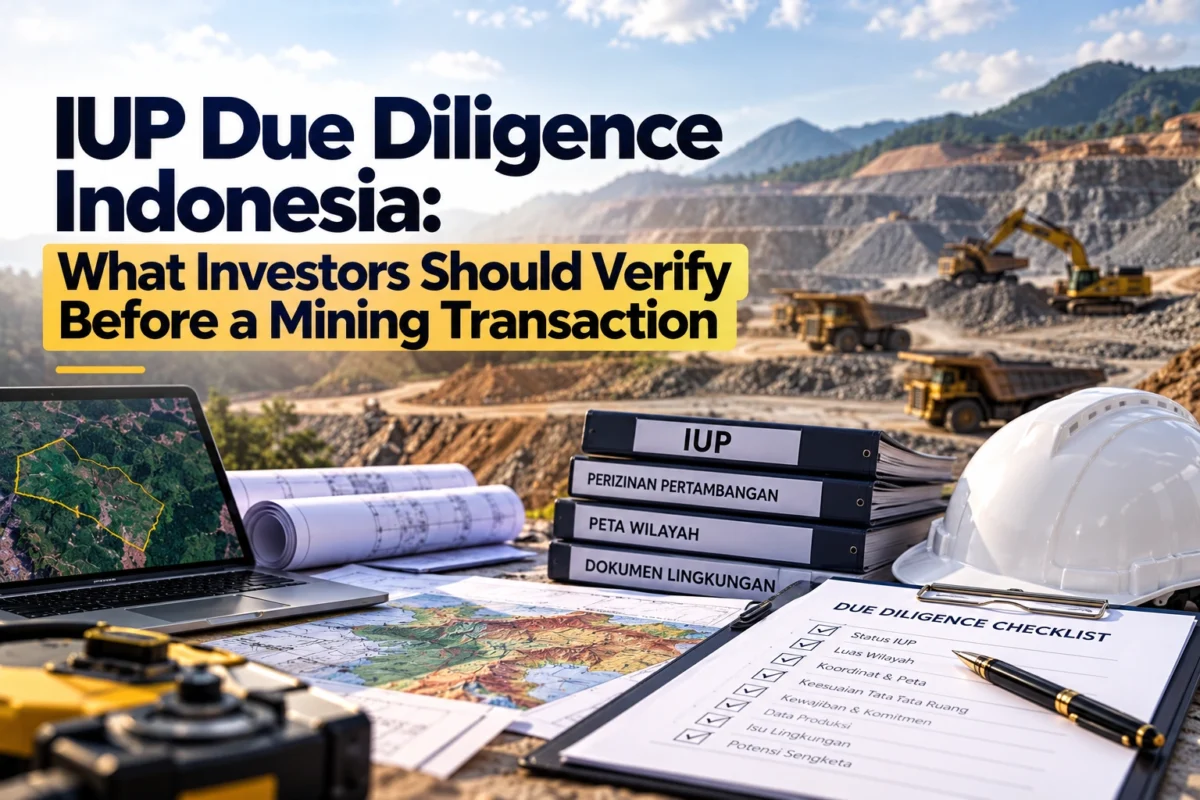
IUP due diligence in Indonesia should answer a broader question than “does the company have an IUP?” A serious investor review should test whether the licence belongs to the transaction target, covers the mining project and commodity being represented, is at the correct activity stage, and is supported by the company’s current operational and compliance records.
Indonesia’s current statutory mining framework includes Law No. 2 of 2025, the fourth amendment to Law No. 4 of 2009 on Mineral and Coal Mining, which remains in force subject to the binding Constitutional Court interpretations recorded against several provisions. The principal implementing regulation remains PP No. 96 of 2021, which is still in force but has been amended by PP No. 25 of 2024 and PP No. 39 of 2025. The latest amendment in that sequence is PP No. 39 of 2025, which has applied since 11 September 2025 as the second amendment to PP No. 96 of 2021.
IUP Due Diligence Indonesia: The Core Review
A useful review can be organized into six connected workstreams: licence identity, mining area and commodity, IUP stage, RKAB and operating compliance, corporate transaction consistency, and third-party contractor risk.
The point is reconciliation. A valid-looking document in isolation is not enough if the holder, project, stage or operating records do not match the investment case.
1. Verify the IUP Holder, Commodity and Mining Area
Begin with the legal entity named as the IUP holder. Compare that entity with the company whose shares, assets or project rights are being acquired or financed.
Then reconcile the licence with the mining area and commodity represented in the transaction. Review the WIUP coordinates and project maps against geological, feasibility, operational and transaction materials. A project may be commercially described as one asset while the regulatory records relate to a narrower area, a different commodity or a different company in the same corporate group.
At this stage, the investor should be able to answer four questions clearly:
- Which legal entity holds the IUP?
- Which commodity is covered?
- Which mining area is linked to the licence?
- Is that same entity and area actually inside the proposed transaction perimeter?
Any mismatch should be resolved before valuation or closing assumptions rely on the mining right.
2. Confirm the Actual IUP Stage
For due diligence, the licence must also be identified by activity stage because PP No. 96 of 2021 distinguishes the IUP Exploration stage from the IUP Operation Production stage.
That distinction changes the commercial meaning of the licence. An Exploration-stage project is still associated with investigation, exploration and feasibility work, while Operation Production relates to the later construction and mining-production phase and the applicable processing or utilization, transportation and sales activities.
Do not therefore accept a statement that a company “has an IUP” without identifying the exact stage. Jakarta Legal ID’s verified guide to IUP Exploration versus Operation Production provides the detailed stage comparison; the due-diligence question here is whether the company’s actual stage supports the transaction assumptions being made.
If an acquisition model assumes near-term production but the company remains at Exploration stage, that gap should be treated as a material diligence issue rather than a drafting detail.
3. Review the Current RKAB Position
The annual work-plan position is another core review area. Under Permen ESDM No. 17 of 2025, IUP, IUPK and continuation-operation holders are subject to annual RKAB submission requirements, and the RKAB framework includes administrative records, PNBP evidence, digital activity maps, reclamation guarantees, and technical and environmental documentation.
That RKAB framework must be read as amended by Permen ESDM No. 6 of 2026, which has been in force since 12 June 2026 and revised parts of the RKAB evaluation and reporting regime.
For an investor, the important question is not merely whether an RKAB file exists. Review whether the current planning position is consistent with the activities, production assumptions, commodity volumes and development schedule used in the transaction model.
A current IUP paired with an unresolved RKAB issue can present a different operating-risk profile from a project whose licence and annual plan are aligned.
4. Test Technical, Environmental and Financial Consistency
The due-diligence file should next test whether the project records support the licence and annual operating plan.
Relevant records may include the approved feasibility basis, technical submissions, environmental documents applicable to the project, reclamation arrangements, PNBP records and other financial or administrative evidence used in the current mining-compliance framework. The purpose is not to assume that possession of one document proves compliance with every obligation. It is to determine whether the regulatory records tell a consistent story about what the project is authorized and prepared to do.
A useful approach is to compare three layers:
- Licence layer: IUP holder, commodity, area and activity stage
- Project layer: feasibility, technical design, environmental basis and operational plan
- Current compliance layer: RKAB, reporting, reclamation and applicable payment or administrative records
A significant contradiction between those layers should trigger deeper legal and technical review.
5. Reconcile the IUP With the Corporate Transaction
Mining due diligence is also corporate due diligence. The licence holder should be reconciled with the company’s latest corporate records and the exact legal entity whose shares or assets are being transferred.
Check whether changes in shareholders, directors, control structure or corporate identity are consistent across the transaction documents and licensing records. Where the transaction uses a holding company or multiple subsidiaries, identify which entity actually owns the mining licence and which entity owns the supporting project assets.
The transaction perimeter should also cover material contracts, land-access arrangements, project equipment, financing security and other rights that the investment model assumes will remain available after closing.
This is where a licence can be legally relevant but commercially insufficient: the buyer may acquire shares in one company while essential licence, land or operating rights sit somewhere else in the group.
6. Separate Construction Subcontractor SBU Due Diligence
Construction subcontractor SBU due diligence is a separate workstream and should not be confused with review of the mining company’s IUP.
If mine development relies on an external construction contractor, investors can separately verify whether the contractor’s business certification and proposed scope are appropriate for the construction work being delegated. That contractor review can be important to execution risk, but an SBU held by a contractor does not replace the mining company’s own mining licence, RKAB or project-specific compliance records.
The distinction is particularly useful in a data room containing both mining and construction documents. Classify each approval by the legal entity that holds it and the activity it authorizes. Do not treat every government or professional certificate in the project file as evidence of mining-title validity.
Red Flags That Require Deeper Review
Several findings should normally trigger further document-level investigation:
- the IUP holder does not match the transaction target
- the project map and WIUP records do not reconcile
- the commodity or project description differs across key records
- the business plan assumes production while the licence remains at Exploration stage
- the latest RKAB position is unclear or inconsistent with planned activities
- material technical, environmental, reclamation or payment records are missing from the data room
- corporate changes are not reflected consistently across licensing and transaction records
- essential project rights or contracts sit outside the company being acquired
- contractor SBU documents are being presented as if they establish the mine owner’s licensing position
A red flag is not automatically proof that the investment cannot proceed. It identifies an issue that should be resolved, priced, conditioned or documented before the investor relies on the project assumption.
Conclusion
IUP due diligence in Indonesia is strongest when the licence is reviewed as one part of an integrated regulatory and transaction record. Confirm the licence holder, mining area, commodity and IUP stage; review the current RKAB and supporting compliance records; and reconcile those findings with the company and assets actually being acquired or financed.
The central decision rule is simple: do not rely on a standalone IUP document when the surrounding project and corporate records have not been reconciled. Where construction subcontractors are material to project delivery, perform their SBU due diligence as a separate contractor-risk review rather than using construction certification as a substitute for mining-licence analysis.
Review the IUP Before You Rely on the Mining Project
Before acquiring, funding or restructuring an Indonesian mining company, Jakarta Legal ID can help review the mining-licensing document path and identify inconsistencies between the IUP, project stage, corporate records and current compliance file.
Request a consultation on mining licence due diligence if you need a structured document review before an investment, acquisition, financing or project-advancement decision.
For help organising the licence, corporate and compliance records for the proposed transaction, review our Mining Licenses service and agree the document-review scope before relying on the project assumptions.
Read More: Mining Licensing Indonesia: IUP, IUJP, SIPB and Compliance Guide
FAQ IUP Due Diligence Indonesia
What is the most important document in IUP due diligence?
There is no single document that replaces the full review. Start with the IUP, but reconcile it with the licence holder, WIUP and commodity, activity stage, current RKAB, project records and the corporate entity inside the transaction.
Is an Operation Production IUP enough to prove a mine is ready to operate?
Not by itself. The activity stage is important, but current planning, technical, environmental, reclamation, financial and other project-specific compliance records should also be reviewed.
Why should an investor check the RKAB during due diligence?
The RKAB is part of the current annual mining-planning and reporting framework. Its status helps an investor test whether the company’s planned activities and production assumptions align with its current regulatory position.
Should IUP due diligence include corporate documents?
Yes. The review should confirm that the legal entity holding the licence is the same entity being acquired or otherwise sits correctly within the transaction structure, and that material corporate changes are consistent with the regulatory records.
Is construction subcontractor SBU due diligence part of IUP due diligence?
It is better treated as a separate but related contractor-risk workstream. The contractor’s SBU can be relevant to construction execution, but it does not replace the mine owner’s IUP, RKAB or other mining compliance requirements.
References & Sources
- Law No. 2 of 2025: Fourth Amendment to the Mineral and Coal Mining Law — peraturan.bpk.go.id
- Government Regulation No. 96 of 2021 on Implementation of Mineral and Coal Mining Business Activities — peraturan.bpk.go.id
- Government Regulation No. 25 of 2024: Amendment to Government Regulation No. 96 of 2021 — peraturan.bpk.go.id
- Government Regulation No. 39 of 2025: Second Amendment to Government Regulation No. 96 of 2021 — peraturan.bpk.go.id
- Minister of Energy and Mineral Resources Regulation No. 17 of 2025 on RKAB and Mining Activity Reporting — peraturan.bpk.go.id
- Minister of Energy and Mineral Resources Regulation No. 6 of 2026: Amendment to the RKAB Regulation — peraturan.bpk.go.id
Recommended Next Articles
- IUP Exploration versus Operation Production — jakartalegalid.com