Operating a business in Indonesia can involve several separate regulatory workstreams. Company establishment, corporate documentation, OSS risk-based licensing, tax administration, construction certification, mining permissions, and industrial licensing may interact, but they do not perform the same legal function.
For owners and investors researching Legal Services Jakarta, the most useful starting point is not a package of forms. It is the business itself: who owns it, what activity produces revenue, which KBLI describes that activity, where the company or project operates, and which records or licenses already exist.
Indonesia’s current risk-based licensing framework is set out in Government Regulation No. 28 of 2025, while current OSS procedures are further governed by Minister of Investment and Downstreaming/Head of BKPM Regulation No. 5 of 2025. These rules make it important to distinguish business identity, activity licensing, supporting licenses, and location-related requirements.
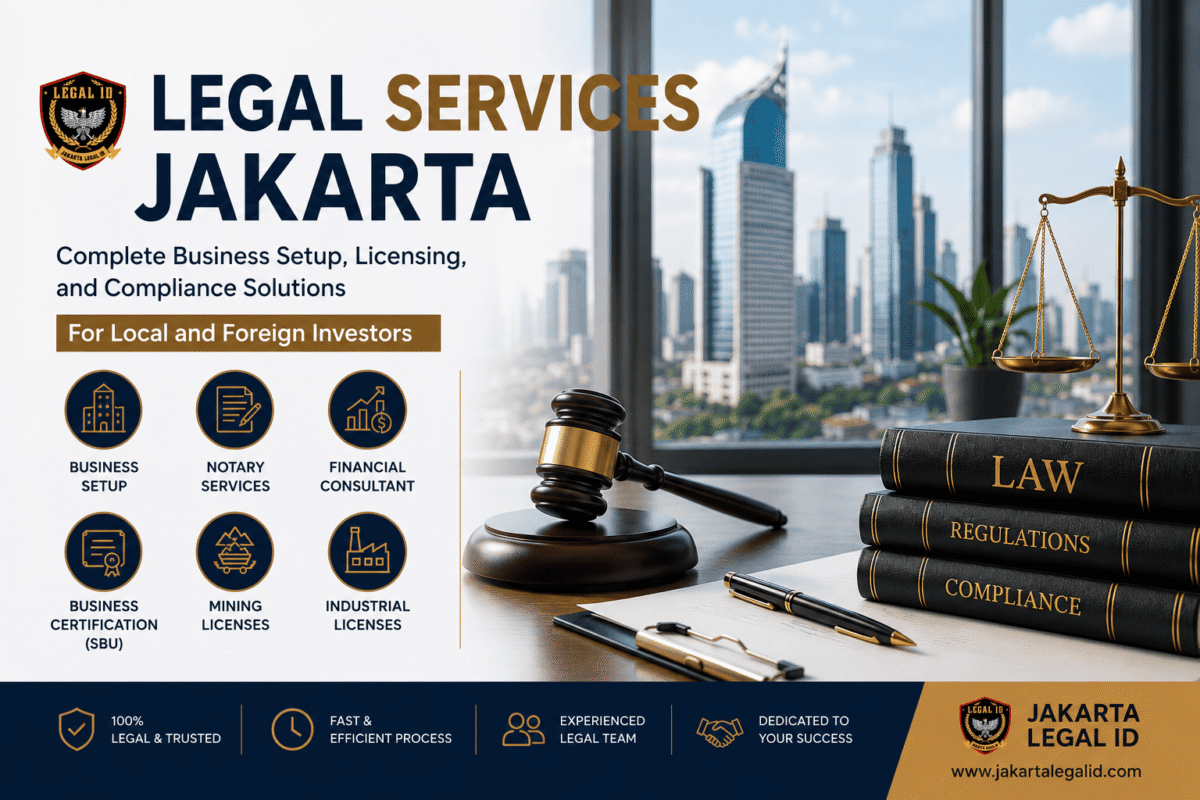
Legal Services Jakarta: Complete Business Setup, Licensing, and Compliance Solutions for Local and Foreign Investors
A practical legal and licensing review should answer five questions before documents are prepared:
- Who will own and control the company?
- What products or services will the company actually sell?
- Which KBLI activities describe those operations?
- Where will the corporate office, factory, warehouse, project, mine, or other operating site be located?
- Which corporate, OSS, tax, certification, or sector records already exist?
Those answers determine which workstream needs attention. A notarial deed does not replace OSS licensing. An NIB does not automatically establish that every additional requirement for every activity is complete. A construction certificate does not replace separate project or procurement conditions. A mining company also needs to identify the authorization relevant to its actual role and activity.
Start With Five Business Facts Before Choosing a Service
Two companies can both be incorporated as PTs and still require very different regulatory paths. Ownership, commercial activity, location, risk classification, and sector can change the analysis.
Ownership Shapes the Investment Structure
Domestic and foreign investment should be reviewed differently. A structure involving foreign shareholders needs to be checked against the investment and sector rules applicable to the activities the company intends to conduct.
The practical sequence is to determine the proposed shareholders, define the real business model, and then review the activity before finalizing the structure. Jakarta Legal ID Business Setup service covers PT PMDN and PT PMA setup together with NIB and OSS-related assistance.
This approach avoids choosing an entity label first and discovering later that the ownership structure, KBLI, or sector licensing needs to be reconsidered.
Actual Business Activity Shapes the KBLI and Licensing Path
KBLI classifies economic activities used in Indonesia’s business licensing framework. The activity should describe what the company genuinely intends to perform or sell rather than simply resemble the company’s marketing description.
The official PP No. 28 of 2025 connects sector licensing arrangements with KBLI, activity scope, business scale, risk level, licensing requirements, obligations, PB UMKU, and licensing authority. For readers who need a deeper explanation of the registration stage, Jakarta Legal ID NIB and OSS registration guide explains how NIB and OSS fit into business licensing.
A company with several revenue streams should review each material activity separately. Consulting, construction, manufacturing, and mining support can produce different licensing results even when they sit under the same corporate entity.
Company Setup and Corporate Administration
Corporate establishment creates the legal entity. Business licensing then addresses the regulatory requirements attached to that entity’s commercial activities.
Standard PT Establishment Through Notary and SABH
Current AHU guidance for PT establishment shows the standard workflow through notary access to the Legal Entity Administration System, or SABH, and includes company data, KBLI-related purposes and objectives, notarial deed information, capital, management, shareholders, and uploaded deed documentation. The current regulatory basis for PT establishment and changes is Minister of Law Regulation No. 49 of 2025.
A standard establishment review can therefore include:
- Proposed shareholders and management
- Company name
- Corporate domicile and address
- Purposes and intended business activities
- Articles of Association and establishment deed
- Capital and shareholding structure
- Corporate registration through SABH
- Follow-on business licensing through OSS
The precise documents and sequence should be matched to the entity and transaction rather than copied from another company’s checklist. For corporate documentation support, Jakarta Legal ID Notary Services provides a dedicated same-site service route.
Corporate Changes Can Trigger More Than One Update
Companies change after establishment. Directors, commissioners, shareholders, capital, activities, corporate domicile, or address can all change over time.
These changes should be classified before filing because not every change follows the same corporate route. The current PT framework covers both amendments to Articles of Association and changes to company data, with the applicable approval or notification treatment depending on what is being changed.
A corporate change can also create downstream work. If OSS, tax, banking, certification, or sector records contain the changed information, those records should be reviewed separately instead of assuming one corporate filing automatically updates every system.
OSS Risk-Based Business Licensing
OSS is the electronically integrated system used to administer Indonesia’s risk-based business licensing process.
NIB Does Not Always Complete the Licensing Process
The official English text of PP No. 28 of 2025 defines NIB as proof of business registration and as the business actor’s identity. It also distinguishes four practical risk categories.
For low-risk activities, Business Licensing is an NIB. For medium-low-risk activities, it consists of an NIB and Standard Certificate. For medium-high-risk activities, it also consists of an NIB and Standard Certificate, but the Standard Certificate follows the applicable verification process. For high-risk activities, Business Licensing consists of an NIB and a Permit.
This means the question is not simply whether the company has an NIB. The more useful question is whether each material business activity has completed the licensing requirements that apply to its risk level and sector.
The current framework also recognizes PB UMKU where supporting business licensing is required. Businesses with several KBLIs should therefore review the status of each activity rather than assume that one OSS output describes the entire company.
Business and Project Location Matter
The current regulation identifies basic requirements that can include KKPR, Environmental Approval, PBG, and SLF and states that issuance of basic requirements follows the location of the business activity.
This matters because a registered office and an operating site are not always the same place. A company can maintain its corporate office in Jakarta while operating a factory, warehouse, construction project, or regulated site elsewhere.
The licensing analysis should therefore identify both the legal entity and the location where the activity is carried out. Depending on the facts, spatial, environmental, building, industrial, or other sector requirements may need to be reviewed.
Tax, Bookkeeping and Financial Administration
Corporate establishment and OSS licensing do not replace taxpayer administration.
The Directorate General of Taxes explains through its Coretax information portal that Coretax integrates core tax-administration processes including taxpayer registration, SPT filing, payment, audit, and collection.
A company’s actual tax obligations depend on its taxpayer status and transactions. Relevant support can include bookkeeping, financial statement preparation, corporate income tax administration, withholding-tax administration where applicable, VAT administration where applicable, and taxpayer-data updates after relevant corporate changes.
Jakarta Legal ID Financial and Tax Consulting service covers tax, bookkeeping, and financial reporting within the site’s service scope. The correct work should be determined from the company’s taxpayer profile rather than from a universal checklist.
Construction SBU and Business Certification
SBU Konstruksi belongs specifically to Indonesia’s construction-services framework and should not be treated as a generic certificate for every regulated business.
The official OSS portal lists Sertifikat Badan Usaha Konstruksi as an available PB UMKU, while the Ministry of Public Works publishes Minister of Public Works Regulation No. 6 of 2025 for the current risk-based business and product or service standards in the Public Works sector.
A construction business may need to review classification, subclassification, qualification, construction workforce and competency, equipment capability, financial or experience information, and supporting company data.
Jakarta Legal ID Business Certification SBU service provides a dedicated service route, while its SBU classification construction guide explains the distinction among classification, subclassification, qualification, and KBLI.
Holding an SBU should not be presented as an automatic guarantee that a company qualifies for every tender or project because procurement and project-specific conditions can apply separately.
Mining Licensing for Operators and Service Providers
Mining businesses operate under a dedicated statutory framework, so company establishment and general OSS registration do not by themselves determine which mining authorization applies.
The current Law No. 2 of 2025 on Mineral and Coal Mining defines IUP as a license to carry out mining business activities, IUJP as a license for core mining-service activities related to stages or parts of mining business activities, and SIPB as a license for specified rock-mining activities or purposes.
A mining review should first identify whether the company is an operator or service provider, the commodity and activity involved, the project stage, the location, and any technical, environmental, or other project requirements that apply.
Jakarta Legal ID Mining Licenses service provides a same-domain route for companies that need support with mining-sector licensing. The correct permission should still be determined from the actual role and activity rather than from a generic mining-license list.
Industrial Licensing for Manufacturing Businesses
Manufacturing businesses should be assessed under the current risk-based licensing framework rather than through an outdated list of generic industrial permit names.
The Ministry of Industry confirms in its current industrial licensing guidance that PP No. 28 of 2025 forms part of the current risk-based licensing framework for the industrial sector and highlights recurring issues involving spatial conformity, environmental requirements, PBG, and SLF.
Depending on the activity and site, a manufacturer may need to review:
- Relevant KBLI and production activity
- NIB and OSS business data
- Applicable risk-based licensing outputs
- Factory or project location
- Spatial requirements where applicable
- Environmental requirements where applicable
- Building-related requirements where applicable
- Industry or product standards where applicable
A food-processing plant, machinery manufacturer, chemical producer, and another industrial operator should not automatically be assumed to follow an identical path. Jakarta Legal ID Industrial Licenses service provides a dedicated service page for this workstream.
Which Workstream Should Your Business Review First?
A business event usually points to the first workstream that deserves attention.
| Business situation | First area to review |
|---|---|
| Establishing a new Indonesian PT | Ownership, corporate establishment, KBLI and OSS planning |
| Foreign investor entering an Indonesian business | Investment structure, intended activities and OSS planning |
| Adding a new revenue-generating activity | Corporate activity scope, KBLI and licensing requirements |
| Changing directors, shareholders, capital or address | Corporate approval or notification plus affected OSS and tax records |
| Construction company seeking certification | SBU scope, qualification, personnel, equipment and supporting data |
| Mining operator or mining-service provider | Activity-specific mining permission and project requirements |
| Manufacturer opening or relocating a plant | Industrial licensing, project location and applicable basic requirements |
| Existing company managing recurring obligations | Tax, bookkeeping, corporate records and licensing maintenance |
The objective is not to create the largest possible licensing package. It is to identify the workstream that corresponds to the company’s real activity and current status.
How Corporate, OSS, Tax and Sector Records Connect
Different records serve different purposes, but changes in one area can create consequences elsewhere.
If a company adds a new business activity, the corporate documents may need review, while OSS separately determines the licensing pathway for that activity. Updating the corporate purpose does not by itself establish that the relevant OSS licensing is complete.
If a company changes address, its corporate record, OSS information, taxpayer data, and location-dependent licenses may not all represent the same type of address. Each affected record should be checked against the actual change.
If a contractor expands into another construction service, adding a KBLI can affect OSS, while SBU certification separately requires the appropriate construction scope and supporting qualification, personnel, and other evidence.
The practical goal is therefore synchronization where necessary, not indiscriminate updating of every system.
Common Compliance Planning Mistakes
Treating Incorporation as Full Operational Readiness
Establishing the legal entity is only one stage. Business licensing, tax administration, project requirements, and sector certification should still be reviewed where applicable.
Treating NIB as Universal Permission to Operate
NIB is sufficient Business Licensing for a low-risk activity under the current framework, but medium and high-risk activities have additional licensing components. The status should be checked activity by activity.
Choosing KBLI From a Competitor’s Documents
Another company may have a different business model, ownership structure, location, risk level, technical capability, or sector obligations. The actual commercial activity should drive classification.
Updating Only One Government Record
A corporate change can affect OSS or taxpayer data, while an OSS change does not replace a corporate filing that is legally required for the underlying company change.
Choosing Premises Before Reviewing the Activity
A proposed office, factory, warehouse, project site, or other operating location can raise spatial, environmental, building, or sector questions. Location should be reviewed together with the activity before major commitments are made.
Expecting Guaranteed Approval
Professional support can help analyze requirements, prepare documents, identify inconsistencies, and coordinate filings. Regulatory approval remains subject to the competent authority or certification body’s assessment under the applicable rules.
Conclusion
Business setup and regulatory compliance in Indonesia work best when corporate, OSS, tax, and sector workstreams are first separated and then coordinated.
For local owners and foreign investors in Jakarta, the practical sequence is to define ownership, the real business activity, KBLI, operating or project location, and existing records. Those facts indicate whether the next priority is company establishment, a corporate amendment, OSS licensing, tax and bookkeeping, construction SBU, mining licensing, industrial licensing, or a combination of several workstreams.
Map the Right Business Setup and Licensing Path Before Filing
A business may need incorporation, a corporate amendment, OSS licensing, sector certification, tax administration, or several of these in sequence. Reviewing ownership, actual business activities, KBLI, project location, and existing records first can help define the workstream that needs attention before documents or applications are prepared.
Jakarta Legal ID can assist local business owners and foreign investors with consultation across PT PMA and PT PMDN setup, SBU, mining, industrial licensing, notarial services, tax, and bookkeeping. The consultation can be used to map the relevant scope without assuming that every business needs the same filing package.
FAQ – Legal Services Jakarta
What do legal services in Jakarta for businesses usually cover?
Depending on the business need, support can include PT establishment, corporate amendments, notarial documentation, OSS licensing, tax and bookkeeping administration, construction SBU, mining licensing, and industrial licensing. The relevant scope depends on the company’s actual activities and current records.
What is the difference between domestic and foreign investment company setup?
Both may use an Indonesian PT structure, but foreign participation introduces investment and sector considerations that should be reviewed against the intended business activities before the ownership structure is finalized.
Is an NIB enough for every business to start operating?
No. Under PP No. 28 of 2025, NIB is sufficient Business Licensing for low-risk activities, while medium-low, medium-high, and high-risk activities have additional licensing components such as Standard Certificates or Permits, and PB UMKU or basic requirements may also apply.
Why is KBLI important when establishing or expanding a company?
KBLI identifies the economic activity used within the licensing framework. It connects the company’s actual activity with risk classification, licensing requirements, obligations, standards, and the relevant licensing authority.
Does every corporate change require the same Ministry process?
No. The PT framework distinguishes amendments to Articles of Association and changes to company data, and the applicable approval or notification treatment depends on what is changing.
What is SBU Konstruksi?
SBU Konstruksi is a business entity certificate within Indonesia’s construction-services framework and is currently listed in OSS as PB UMKU. The applicable classification, subclassification, qualification, workforce, equipment, and supporting criteria depend on the construction scope.
Which mining permissions can be relevant to a business?
Different permissions apply to different mining roles and activities. The current mining framework includes instruments such as IUP, IUJP, and SIPB, but the appropriate authorization depends on the company’s actual activity, commodity, project stage, location, and other applicable requirements.
What should a manufacturing company review before starting operations?
A manufacturer should review its KBLI, OSS licensing pathway, project location, and any applicable spatial, environmental, building, industry, or product requirements. The exact combination depends on the activity and site.
Are tax and bookkeeping obligations identical for every company?
No. Tax administration depends on the taxpayer’s status and transactions. Corporate income tax, VAT, withholding, employee-related, and other obligations should be assessed from the company’s actual taxpayer profile and activities.
When should a business request a legal and licensing review?
A review can be useful before incorporation, adding a new activity or location, changing ownership or management, entering a regulated sector, acquiring an existing company, or when corporate, OSS, tax, certification, and operational records appear inconsistent.
References & Sources
- BKPM JDIH — Government Regulation No. 28 of 2025 on Risk-Based Business Licensing
- BKPM JDIH — Minister of Investment and Downstreaming/Head of BKPM Regulation No. 5 of 2025
- AHU Online — Limited Liability Company Establishment Guide
- Directorate General of Legislation — Minister of Law Regulation No. 49 of 2025
- Directorate General of Taxes — Coretax
- OSS Indonesia — Construction Business Entity Certificate (SBU)
- Directorate General of Construction Development — Minister of Public Works Regulation No. 6 of 2025
- Ministry of Energy and Mineral Resources JDIH — Law No. 2 of 2025 on Mineral and Coal Mining
- Ministry of Industry — Risk-Based Business Licensing in the Industrial Sector