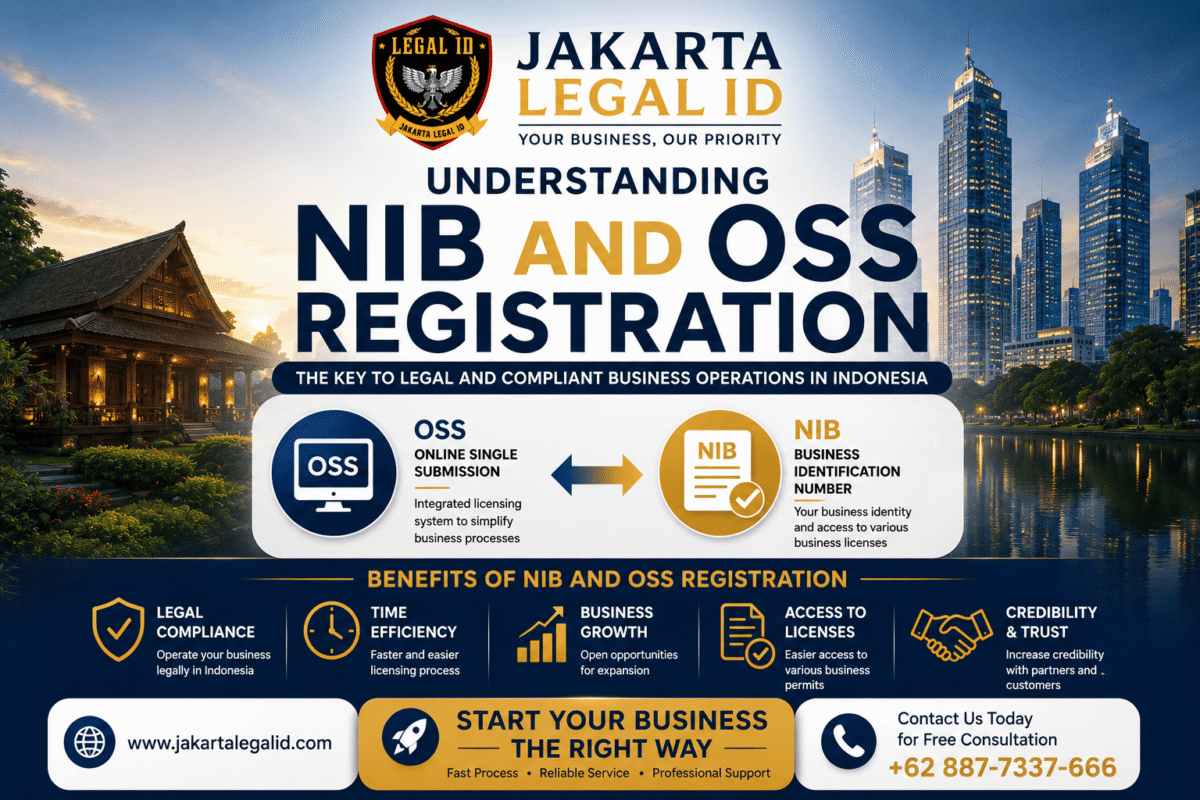
NIB and OSS Registration Indonesia is part of Indonesia’s risk-based business-licensing system. An NIB is an important business identifier, but it is not automatically the final operational approval for every activity.
The applicable legalities depend on the business activity, KBLI code, risk level, scale, location, sector rules, and whether additional approvals are required. A company should therefore review the complete licensing output in OSS instead of treating issuance of an NIB as the end of the process.
Current OSS risk-based licensing framework
The current principal framework is Government Regulation No. 28 of 2025 on Risk-Based Business Licensing. It replaced Government Regulation No. 5 of 2021. Implementation through OSS is further addressed by Minister of Investment and Downstream Industry/Head of BKPM Regulation No. 5 of 2025, which replaced the earlier BKPM regulations from 2021.
Because sector standards and OSS features can change, companies should check the current OSS output and applicable sector rules at the time of filing.
What is an NIB?
An NIB, or Business Identification Number, is issued through the official OSS system as an identifier for a business actor. Depending on the business profile and applicable rules, the NIB may also be connected with registration or access functions in other administrative areas.
Those functions should not be described as universal entitlements. Import activity, customs access, workforce registration, environmental requirements, and sector licences can involve additional data, eligibility checks, or approvals.
What an NIB does not prove
An NIB alone does not necessarily prove that:
- all business activities are licensed to operate;
- a Standard Certificate has been verified where verification is required;
- a high-risk business licence has been issued;
- all basic requirements concerning location, environment, or buildings have been fulfilled;
- the company may import every category of goods;
- the company has obtained every PB UMKU or sector-specific approval; or
- the information recorded in OSS remains accurate after corporate changes.
Risk level determines the licensing path
Risk is assessed for each business activity, not merely for the company as a whole. A company with several KBLI activities may therefore have different licensing requirements for different activities or locations.
- Low risk: the NIB generally serves as the risk-based business licence for the relevant activity.
- Medium-low risk: the licensing output generally involves an NIB and a Standard Certificate based on the applicable procedure.
- Medium-high risk: the Standard Certificate generally requires verification before the relevant operational or commercial stage.
- High risk: the business generally requires an NIB and a licence issued after the applicable requirements are fulfilled.
Sector rules may also require PB UMKU, professional or product certification, environmental approval, building-related documentation, or other prerequisites.
Why KBLI selection matters
KBLI codes describe the company’s intended business activities and influence risk classification, foreign-ownership analysis, licensing requirements, business scale, and sector supervision. A code should match the actual activity and revenue model—not simply a broad description that appears convenient.
Before filing, document:
- the goods or services to be supplied;
- how revenue will be generated;
- the operating and registered locations;
- whether goods will be manufactured, imported, distributed, or sold directly;
- the ownership structure and investment status; and
- the facilities, professional personnel, or sector standards involved.
Typical NIB and OSS registration process
- Confirm the business actor: verify the entity, corporate records, tax data, authorized management, and beneficial-owner information.
- Map activities: select the KBLI codes that reflect the actual operating model.
- Check location and basic requirements: review spatial, environmental, and building considerations where applicable.
- Complete the OSS business profile: enter consistent corporate, investment, workforce, and location data.
- Review risk-based outputs: identify NIB, Standard Certificate, licence, and PB UMKU requirements for each activity.
- Fulfil post-NIB requirements: complete verification, technical documents, sector submissions, or inspections where required.
- Maintain the record: update OSS when relevant company, activity, capital, management, or location data changes.
For the incorporation steps that may precede OSS filing, see Company Registration Indonesia.
PT PMA and PT PMDN considerations
OSS is used for both foreign-investment and domestic-investment businesses, but the review is not identical. A PT PMA must check foreign ownership and investment requirements for the intended KBLI activities. A domestic business must still choose the appropriate entity form and meet the applicable licensing standards.
Read the separate guides for PT PMA Services Jakarta and PT PMDN Setup Jakarta.
Common OSS problems
- selecting a KBLI that does not match the actual activity;
- assuming an NIB is sufficient for a medium- or high-risk activity;
- inconsistent address, shareholder, management, or tax data;
- ignoring Standard Certificate verification or PB UMKU;
- using an unsuitable location for the intended operation;
- overlooking sector requirements, deadlines, or reporting; and
- failing to update OSS after a corporate amendment.
Scope of professional assistance
Jakarta Legal ID can assist with document review, activity mapping, OSS data preparation, and coordination of licensing submissions through its Business Setup service. The scope should state which filings are included, which information remains the client’s responsibility, and which decisions are made by government authorities.
No consultant can guarantee issuance, verification, or a fixed completion time. Results depend on complete and accurate information, technical compliance, government systems, and the competent authority’s review.
Frequently asked questions
Does every business need only an NIB?
No. The required legalities depend on the activity’s risk level and sector. An NIB may be sufficient for a low-risk activity, while other activities require a Standard Certificate, licence, PB UMKU, or additional approval.
Can a company operate immediately after receiving an NIB?
Not in every case. Review the OSS output and the requirements for each KBLI activity before commencing the relevant operational or commercial activity.
Does an NIB automatically provide import and customs rights?
No universal conclusion should be drawn from the NIB alone. Import and customs activity may require appropriate registration, access, commodity compliance, and other approvals.
How long does OSS registration take?
There is no reliable universal timeline. It varies with data readiness, risk level, verification, sector requirements, and government systems.
This article provides general information. Licensing requirements should be checked against the current OSS output, the company’s facts, and regulations in force when the application is made.