
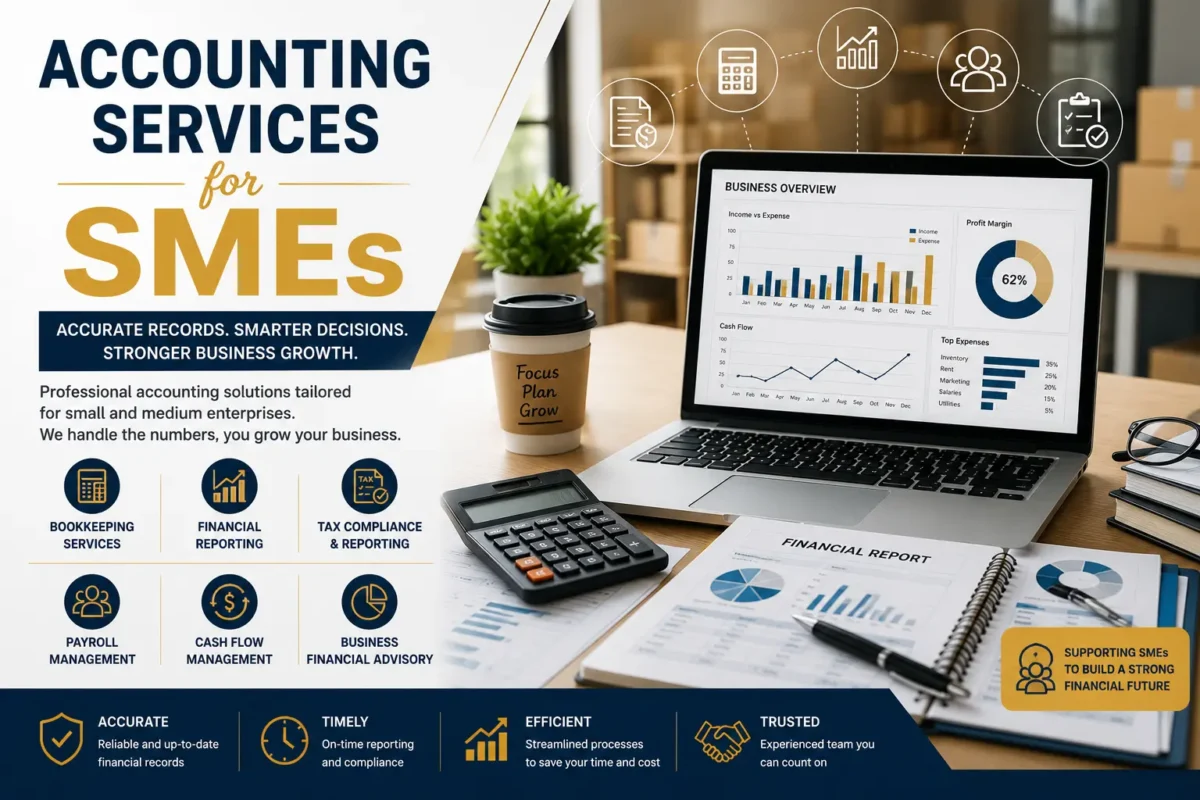
Accounting services for SMEs should produce usable records and management information without assuming that every small or medium business has the same tax or reporting obligations. “SME” describes business scale; it does not by itself determine the entity’s legal form, VAT status, income-tax treatment or required filings.
This guide focuses on practical bookkeeping and reporting for Indonesian SMEs. It separates day-to-day accounting from tax representation and independent audit services.
Regulatory references checked on 7 September 2026. The correct accounting and tax scope depends on the business’s entity type, turnover, activities, transactions, employees and registrations.
First identify the SME’s actual profile
| Profile question | Why it matters |
|---|---|
| Is the business an individual enterprise or a legal entity? | Bookkeeping, governance and filing responsibilities may differ. |
| Is it registered as a corporate taxpayer? | Corporate taxpayers are required to maintain books under Article 28 of the tax-procedure law. |
| Is it registered as a PKP? | VAT administration is relevant only when the applicable status and transactions create the obligation. |
| Does it employ staff? | Payroll records and employee-related withholding may be required. |
| Does it pay vendors, rent, professionals or overseas parties? | Different withholding rules may apply according to the payment and recipient. |
| Does it sell through several channels? | Marketplace, point-of-sale, bank and cash data need to be reconciled. |
| Does it have inventory or fixed assets? | Stock movement, cost allocation and asset schedules may be material. |
A service proposal should be based on these facts rather than a generic “complete compliance” package.
Practical monthly bookkeeping for SMEs
A consistent monthly process helps the owner see what has been recorded, what remains unsupported and where cash or balance differences require attention. It does not guarantee profit, eliminate risk or replace management judgment.
A typical scope may include:
- recording sales, purchases, operating expenses and financing transactions;
- maintaining the general ledger and selected subledgers;
- reconciling bank accounts, payment gateways and cash records;
- tracking customer receivables and vendor payables;
- maintaining inventory or fixed-asset schedules where relevant;
- preparing payroll data and related reconciliations;
- producing management reports; and
- organizing reconciled inputs for applicable tax work.
A simple monthly close
- Collect: gather invoices, receipts, contracts, bank statements, marketplace data and payroll records.
- Record: post transactions using an agreed chart of accounts.
- Reconcile: compare the ledger with bank, cash, receivable, payable and operational records.
- Clarify: prepare a list of missing documents, unusual balances and proposed adjustments.
- Approve: obtain owner or management approval for material corrections and estimates.
- Report: issue the agreed management package and retain the supporting schedules.
The document cut-off and responsible person should be agreed in advance. Late or incomplete documents reduce the usefulness of the reports.
Reports that can help SME management
The appropriate package depends on the business model. Useful reports may include:
- balance sheet and profit-and-loss statement;
- cash-flow summary;
- receivables and payables ageing;
- sales by channel, product or location;
- inventory movement or gross-margin schedules;
- budget-to-actual comparison; and
- a list of unresolved accounting items.
These reports organize available data. Forecasts, margins and cost analyses depend on assumptions and data quality, so they should not be presented as guaranteed improvements in profitability.
Bookkeeping obligations depend on entity type
The Directorate General of Taxes explains that Indonesian corporate taxpayers must maintain books and attach financial statements to their annual corporate tax returns. This applies to corporate taxpayers even where a particular income-tax calculation uses a final-tax mechanism.
Individual entrepreneurs can be subject to different bookkeeping or record-keeping provisions. An SME article should therefore avoid saying that every business, regardless of legal form, has an identical statutory accounting requirement.
Tax support must follow the taxpayer’s facts
SMEs do not automatically have every monthly tax obligation. The applicable work may involve employee withholding, vendor withholding, corporate income-tax instalments, annual income-tax reporting or VAT, but only where the business’s registrations and transactions trigger them.
Accounting support can include reconciling ledgers, organizing tax documents and preparing data schedules. Formal representation of a taxpayer by another person is governed by PMK 44/2026 and the professional provisions in PMK 55/2026.
For a detailed obligation map, see Tax Compliance Indonesia.
Accounting preparation is not an independent audit
An SME may need an audit because of a specific law, financing arrangement, shareholder requirement or commercial agreement. Not every SME is automatically subject to an audit.
Under Law No. 5 of 2011 on Public Accountants, assurance services—including audits and reviews of historical financial information—may only be provided by a licensed Public Accountant. Bookkeepers can prepare ledgers and audit-ready schedules but cannot issue an independent assurance opinion unless they act through the required licensed professional framework.
Internal controls appropriate for a growing SME
Even a small team can use basic controls:
- separate transaction approval from payment where staffing allows;
- use documented approval limits;
- reconcile bank accounts independently from payment preparation;
- restrict access to banking and accounting systems;
- number and archive invoices consistently;
- review overdue receivables and old payables;
- perform periodic stock or asset counts; and
- retain evidence of management review.
The design should be proportionate. A control that works for a ten-transaction business may be inadequate for a multi-location company.
Documents needed to begin
- identity and entity documents, NIB and NPWP;
- tax and PKP registration information, where applicable;
- opening balances or the latest trial balance;
- bank, cash and payment-gateway records;
- sales, purchase and expense documents;
- customer, vendor, inventory, asset and payroll data; and
- previous financial statements and tax returns.
Evaluating an outsourced accounting provider
Ask for a written scope stating the included accounts, document deadline, review responsibility, deliverables, frequency, data-security process and exclusions. Clarify who approves adjustments, who files returns, who may act as a tax representative and who performs any independent audit.
Outsourcing may be operationally suitable for some SMEs, while an in-house or hybrid model may be better for others. The decision depends on volume, complexity, internal capability, response time and total cost; no model guarantees lower cost or better financial performance.
How Jakarta Legal ID can support SMEs
Jakarta Legal ID can support transaction bookkeeping, ledger maintenance, reconciliations, management-report preparation and tax-data organization. Regulated tax representation and independent assurance should be assigned to professionals with the required authority or licence.
See Financial & Tax Consulting for the service overview and Accounting Services in Jakarta for the general monthly-accounting scope.
Frequently asked questions
Does every SME need the same accounting package?
No. The scope should reflect legal form, transaction volume, inventory, employees, reporting users and tax registrations.
Does every SME have to report VAT?
No. VAT work depends on PKP status and the nature of the business’s supplies and transactions.
Can outsourced accounting guarantee lower costs?
No. It may change staffing and processing costs, but the outcome depends on scope, volume, document quality and internal workflow.
Are monthly management reports audited?
Not unless a licensed Public Accountant is separately engaged to perform the relevant assurance work.
Official references
- Directorate General of Taxes: corporate bookkeeping and financial statements
- Law No. 5 of 2011 on Public Accountants
- PMK 44/2026
- PMK 55/2026
Need an SME accounting-scope review? Share the business’s entity type, transaction channels, document volume and required reports so the monthly process can be defined before work begins.