
Changing an Indonesian company’s legal name is not simply a branding exercise. For a capital-based limited liability company, the replacement name must first satisfy the statutory naming rules, and the change then proceeds as an amendment to the articles of association requiring the appropriate shareholder, notarial, and ministerial steps.
The specific company-name regulation, Government Regulation No. 43 of 2011, remains in force according to JDIH BPK and governs the application and use of limited liability company names.
Current corporate-administration procedure is also governed by Permenkum 49/2025, which has been in force since December 2025.
Change Company Name Indonesia: The Short Answer
To change company name Indonesia, treat the project as two connected processes: approval of the replacement name and amendment of the company’s articles of association.
Under the current corporate-administration rules, Article 8 of Permenkum 49/2025 classifies a change of company name as an amendment to the articles of association that requires ministerial approval.
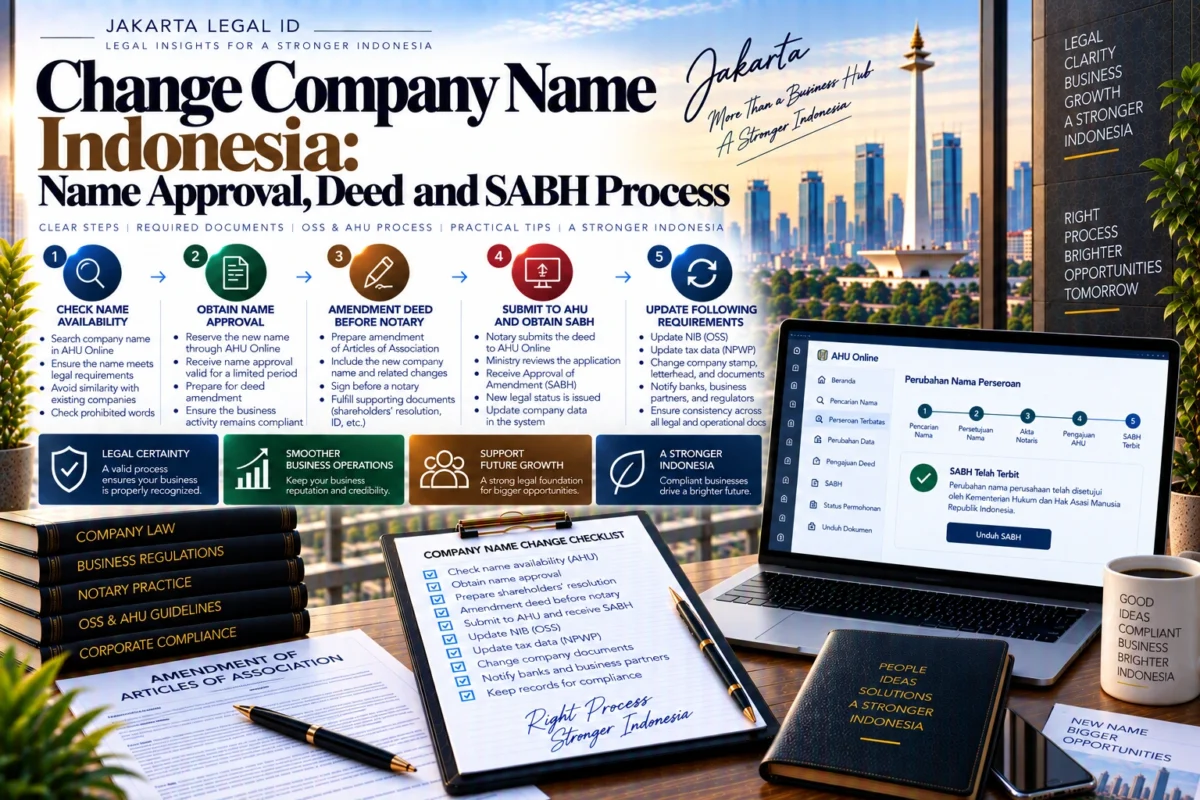
The practical sequence is therefore: screen the name, obtain name approval, approve the corporate amendment, execute the notarial deed, submit the amendment through SABH, and then reconcile the company’s external records.
Step 1: Check the Proposed New Company Name
Do not begin with printing new stationery or amending customer contracts. First determine whether the proposed legal name can satisfy Indonesia’s company-name rules.
The proposed replacement must satisfy Article 5’s naming criteria, including use of Latin letters, no lawful prior use or substantial similarity with another company name, no conflict with public order or morality, and the other restrictions listed in the regulation.
Article 5 also addresses names resembling government, state, or international institutions, meaningless strings of letters or numbers, wording that itself denotes another form of legal entity, names consisting only of the company’s purposes and business activities, and cases where business-activity wording is used as part of the name.
A sensible internal check is to prepare more than one commercially acceptable option before the corporate approval stage. A shareholder resolution approving only one unusable name can create unnecessary repeat work if that proposed name is rejected.
Check Ownership-Based Language Requirements
Ownership structure can affect the naming review.
Ownership also matters to the naming review because Article 11 requires a company whose shares are entirely owned by Indonesian citizens or Indonesian legal entities to use its company name in the Indonesian language.
That provision should be applied to the company’s actual shareholder structure rather than converted into a broad assumption that every Indonesian PT follows exactly the same language rule. PT PMA and mixed-ownership structures should be reviewed against the rules applicable to their proposed name and circumstances.
Step 2: Apply for the Replacement Name Before the Amendment
Once the preferred name has been screened, the replacement name is submitted through the company-name approval process before the articles amendment is completed.
For the name application itself, Article 6 provides that approval or rejection is delivered electronically within three business days after the complete application is received, with a rejection accompanied by its reason.
A three-business-day regulatory processing provision should not be converted into a promise that the entire name-change project will finish in three days. Shareholder approvals, notarial execution, supporting documents, corrections, ministerial processing, and downstream updates remain separate parts of the project.
Do Not Let the Approved Name Expire Before the Deed
Name approval also has its own implementation period.
Once the proposed name is approved, Article 7 requires it to be stated in the amendment deed within 60 days from ministerial approval; after that period, the name approval lapses by operation of law.
This means the company should coordinate the name application with shareholder and notarial readiness. Applying for the replacement name too early and then leaving the corporate decision unresolved can force the company to repeat the name process if the 60-day period expires.
Step 3: Approve the Articles of Association Amendment
A legal name is part of the company’s articles of association, so shareholders must approve the amendment through the appropriate corporate decision mechanism.
The shareholder step is formal: Article 9 of Permenkum 49/2025 permits the covered amendment to be established through a GMS or a binding shareholder decision outside the GMS and requires it to be contained or stated in an Indonesian-language notarial deed.
The approval route should be matched to the company’s shareholder structure, voting rights, articles of association, and the decision format actually being used. If the shareholders use an out-of-meeting written decision, the validity requirements for that type of shareholder decision should be checked separately rather than assuming an unsigned email exchange is sufficient.
The deed should consistently identify the existing legal name, the approved replacement name, the affected articles provision, the shareholder decision, and any authority granted for implementation.
For companies that need administrative coordination around the deed, Jakarta Legal ID’s verified Notary Services page describes its scope for organizing corporate approval records, drafting instructions, execution documents, and follow-up with the responsible licensed notary.
Step 4: Submit the Name Amendment Through SABH
The signed deed is not the end of the process because a company-name amendment requires ministerial approval.
For the ministerial application, Article 9(6)-(7) requires the amendment application to be filed within 30 days from the notarial deed and provides that an application submitted after that period cannot be filed with the Minister.
The filing itself is handled through the corporate administration system because Article 10 requires the amendment application to be submitted through a notary electronically via SABH, with the amendment deed and relevant supporting documents uploaded.
Companies should therefore plan the deed and filing as one coordinated workstream rather than signing the amendment and leaving the SABH step for an indefinite later date.
Keep the 60-Day and 30-Day Periods Separate
Two timing rules are easy to confuse.
The 60-day period under PP 43/2011 concerns using the approved replacement name in the amendment deed. The 30-day period under Permenkum 49/2025 concerns submitting the corporate amendment application after the notarial deed.
A useful transaction calendar should record both dates separately: the date of name approval and the date of the amendment deed. Missing either control can disrupt the process even if the shareholders have already agreed on the rebrand.
Step 5: Reconcile Records After the Legal Name Changes
Ministerial approval resolves the corporate name amendment, but operational records should then be reviewed for consistency.
Depending on the company’s actual activities and counterparties, the implementation checklist may include reviewing:
- OSS and business-licensing records
- tax and bookkeeping master data
- bank accounts and banking mandates
- invoices and accounting templates
- employment and commercial contracts
- permits, certificates, and sector registrations
- beneficial-ownership and corporate-record references where relevant
- insurance records
- leases and property-related documents
- customer and supplier master data
- websites, email signatures, letterheads, and branding materials
This is a reconciliation checklist, not a claim that every item requires the same government filing. Each system, contract, authority, bank, or counterparty may have its own update requirements and evidence standard.
The company should also distinguish the legal entity name from its trademarks, brands, domain names, and trading presentation. A corporate-name approval process should not be treated as an automatic clearance of every separate intellectual-property or branding issue.
Practical Company Name Change Checklist
Before treating the project as complete, review the corporate and implementation file end to end.
Check that:
- the proposed replacement name has been screened against PP 43/2011
- the ownership-based language rule has been reviewed
- the replacement name was applied for before the name amendment
- ministerial name approval has been received
- the 60-day name-approval period is being tracked
- shareholders approved the articles amendment through a valid decision mechanism
- the amendment is contained or stated in an Indonesian-language notarial deed
- the approved name is stated in the amendment deed within the required period
- the ministerial amendment application is filed within 30 days from the deed
- the filing is submitted through the notary via SABH
- supporting corporate documents are consistent with the approved decision
- downstream licences and official records have been reviewed for name consistency
- banks, customers, suppliers, employees, and contractual counterparties are notified where necessary
- historical records are retained so the company can connect the former and new legal names when required
The key control is sequencing. The new name should move consistently from name approval to shareholder approval, deed, ministerial filing, corporate records, and operational documents.
Conclusion
A company name change in Indonesia is an amendment to the company’s legal identity documents, not merely a marketing decision. The replacement name must first satisfy the applicable naming rules and be approved before the articles amendment is completed.
After name approval, shareholders approve the amendment, the decision is documented through the required Indonesian-language notarial deed, and the application is submitted through SABH for ministerial approval.
The two main timing controls should remain visible throughout the project: the approved name must be placed in the amendment deed within the PP 43/2011 period, and the resulting amendment application must then be submitted within the current Permenkum 49/2025 filing period. After the legal change, the company should reconcile the new name across licences, tax, banking, contracts, accounting, and other operational records that actually apply to its business.
Coordinate the Name Approval and Corporate Amendment in One Workflow
If your Jakarta company is planning a legal name change, Jakarta Legal ID can assist with a consultation to organize the name review, shareholder documents, notarial coordination, SABH amendment process, and related corporate or licensing records that should be checked.
The correct scope depends on the company’s ownership structure, proposed name, articles of association, shareholder decision, existing licences, and downstream records that use the current legal name.
For help coordinating corporate documents, signing requirements and any required deed preparation with the responsible licensed notary, review our Notary Services and agree the scope for the specific document or corporate action.
Read More: Notarial Documents in Indonesia: Company, Contract and Property Guide
FAQ Change Company Name Indonesia
Can an Indonesian PT simply start using a new company name?
No. A legal company-name change follows a formal process. PP 43/2011 requires the replacement name to be submitted before the name amendment, and current Permenkum 49/2025 treats the company-name change as an amendment to the articles of association requiring ministerial approval.
Does the new company name need approval before the amendment deed?
Yes. PP 43/2011 requires the proposed replacement name to be submitted before the articles of association are amended for the company name.
How long is an approved company name valid before it is used in the deed?
Article 7 of PP 43/2011 requires the approved name to be stated in the amendment deed within 60 days from ministerial approval. If that period expires, the name approval lapses by operation of law.
Does a company-name change require shareholder approval?
Yes. Under current Permenkum 49/2025, the articles amendment is established through a GMS or a binding shareholder decision outside the GMS and must be contained or stated in an Indonesian-language notarial deed.
How long does the company have to file the amendment after the notarial deed?
Permenkum 49/2025 requires the relevant amendment application to be submitted within 30 days from the notarial deed. The regulation provides that an application submitted after that period cannot be filed with the Minister.
Must an Indonesian-owned company use an Indonesian company name?
PP 43/2011 states that a company whose shares are entirely owned by Indonesian citizens or Indonesian legal entities must use its company name in the Indonesian language.
References & Sources
- Current Status of Government Regulation No. 43 of 2011 on Limited Liability Company Names — peraturan.bpk.go.id
- Official Text of Government Regulation No. 43 of 2011 on Limited Liability Company Names — peraturan.bpk.go.id
- Current Status of Ministry of Law Regulation No. 49 of 2025 — peraturan.bpk.go.id
- Official Text of Ministry of Law Regulation No. 49 of 2025 — peraturan.go.id
Recommended Next Articles
- corporate deed amendment and AHU update guide — jakartalegalid.com