
Indonesian shareholders do not always need to convene a physical General Meeting of Shareholders to adopt a binding corporate decision. A written decision outside the meeting can be valid, but the statutory threshold is strict: every shareholder with voting rights must approve the proposal in writing and sign it.
That rule makes a circular shareholder resolution in Indonesia useful for companies whose shareholders can reach complete agreement, including groups whose shareholders are located in different cities or countries. It is not, however, a shortcut around disagreement, decision-specific legal safeguards, or later corporate-registration requirements.
Circular Shareholder Resolution Indonesia: The Short Answer
A circular resolution can replace the physical meeting format for a binding shareholder decision when the Article 91 conditions are satisfied.
The same official explanation states that a binding decision adopted under Article 91 has the same legal force as a decision made by the GMS.
The important qualification is unanimity. If one shareholder with voting rights does not approve or sign the proposal, the Article 91 written-decision mechanism has not satisfied its statutory condition.
What Article 91 Requires
Article 91 creates a relatively simple rule, but each component matters.
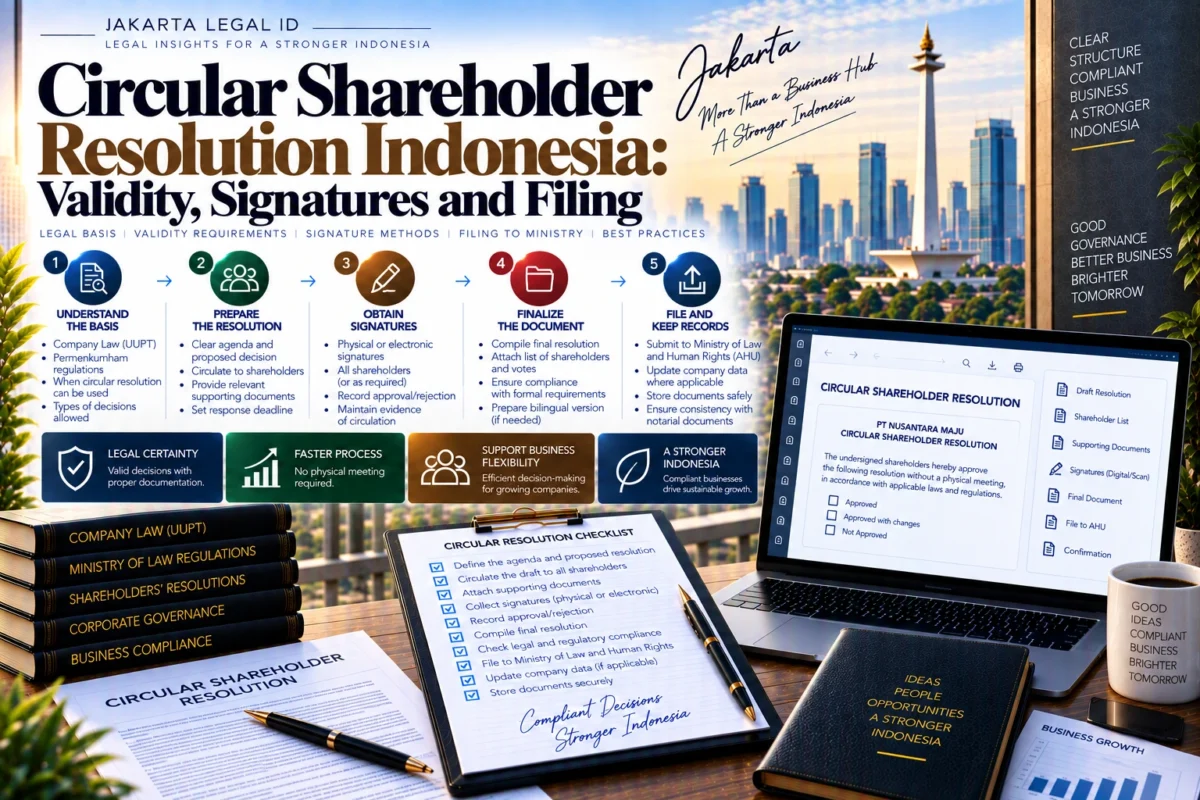
A compliant process should be built around four points:
- the proposed decision is written clearly
- the proposal is circulated to all shareholders whose shares carry voting rights
- every such shareholder approves the same proposal in writing
- every such shareholder signs the proposal
The law does not turn a collection of informal discussions into a circular resolution merely because all parties appear to agree commercially. The signed written proposal is central to the statutory mechanism.
Unanimity Is Different From an Ordinary GMS Majority
Do not apply an ordinary majority-voting assumption to a circular resolution.
At a convened GMS, the applicable quorum and voting threshold can depend on the type of decision, the Company Law, and the company’s articles of association. Article 91 uses a different condition for an out-of-meeting resolution: written approval by all shareholders with voting rights.
That distinction is particularly important in joint ventures and multi-shareholder companies. A shareholder holding a small percentage of voting shares cannot simply be ignored because the larger shareholders already control enough votes for a normal meeting decision.
How to Prepare a Circular Resolution
The drafting process should begin with the corporate action, not with a generic template.
First identify exactly what shareholders are being asked to approve. Examples can include management changes, corporate transactions, amendments, capital matters, or other decisions within shareholder authority, subject to the separate rules governing each action.
Then confirm the company’s current shareholder register, share classes, and voting rights. The Article 91 test concerns every shareholder with voting rights, so an outdated cap table can create a serious execution problem.
Identify the Decision and Every Voting Shareholder
A practical resolution document should ordinarily make the commercial decision unambiguous. Depending on the transaction, useful drafting elements can include:
- the company’s legal name and corporate details
- the legal basis for adopting the decision outside a GMS
- the exact proposal being approved
- the effective date of the decision
- any authorization given to the directors, notary, or another person to implement it
- the identity of every voting shareholder
- each shareholder’s written approval and signature
- supporting transaction documents where the decision depends on them
These are practical drafting controls rather than a claim that Article 91 prescribes one mandatory template. The document should be adapted to the actual corporate action and the company’s articles of association.
A Circular Resolution Does Not Remove Decision-Specific Safeguards
The fact that all shareholders sign does not necessarily eliminate procedures attached to the substance of the decision.
For example, when shareholders use an out-of-meeting decision to dismiss a director, Article 105 requires the director to be informed beforehand of the planned dismissal and given an opportunity to defend themselves before the dismissal decision is taken.
That is an important drafting lesson. Before circulating a resolution, identify not only who must sign it but also whether the proposed corporate action has its own notice, consent, creditor, regulatory, employee, contractual, or filing requirements.
The company’s articles of association should also be reviewed. Indonesian company law operates together with the company’s constitutional documents and other applicable regulations, so a circular resolution should not be drafted in isolation from the company’s current corporate records.
When a Notarial Deed and SABH Filing Still Follow
A valid shareholder decision and completion of the corporate filing are two different stages.
For company changes covered by the current corporate-administration rules, Article 9 of Permenkum 49/2025 expressly allows specified amendments to the articles of association and company data to be established through a GMS or a binding shareholder decision outside the GMS, and requires those changes to be contained or stated in an Indonesian-language notarial deed.
The regulation further provides that applications for the covered amendments to articles of association and company data are submitted through a notary electronically through SABH.
For supporting documentation, Permenkum 49/2025 specifically identifies a shareholder decision outside the GMS as one of the documents that may support the relevant company-amendment application.
This means a company should not assume that obtaining every shareholder signature completes the entire corporate action. If the resolution changes registered company data or the articles of association, determine immediately whether a notarial deed, ministerial approval, notification, or SABH submission follows.
Jakarta Legal ID’s verified Notary Services page explains its administrative coordination scope for corporate resolutions, eligible amendment deeds, drafting instructions, execution documents, and follow-up with the responsible licensed notary.
Practical Circular Resolution Checklist
Before circulating the document, confirm that the legal and execution file is internally consistent.
Check that:
- the matter is within shareholder authority
- the company’s current articles of association have been reviewed
- the current shareholder register is available
- every shareholder with voting rights has been identified
- the same written proposal is provided to all relevant shareholders
- every voting shareholder provides written approval
- every required shareholder signs the proposal
- any decision-specific procedural safeguards have been completed
- the effective date is stated clearly where useful
- implementation authority is clear
- any required notarial deed is prepared promptly
- any approval, notification, or SABH filing triggered by the decision is identified separately
- signed originals and supporting evidence are retained in the corporate records
The central control is consistency: the shareholder decision, signatures, notarial deed where required, corporate records, and government filing should all describe the same approved action.
Conclusion
A circular shareholder resolution in Indonesia can carry the same legal force as a GMS resolution, but Article 91 imposes a demanding condition: all shareholders with voting rights must approve the proposal in writing and sign it.
That makes the mechanism efficient where complete shareholder agreement already exists, but unsuitable as a way to overcome a dissenting voting shareholder.
Companies should apply three separate checks before treating the process as complete. First, verify unanimous written approval under Article 91. Second, identify any procedural safeguards attached to the specific decision. Third, determine whether the approved action must subsequently be documented in a notarial deed or submitted through SABH under the current corporate-administration rules.
Check the Resolution Before Collecting Shareholder Signatures
If your Jakarta company plans to approve a corporate action without convening a physical GMS, Jakarta Legal ID can assist with a consultation to map the required shareholder approval, corporate documents, notarial coordination, and follow-up company-registration steps.
The correct structure should be reviewed against the specific corporate action, voting rights, articles of association, shareholder records, and any post-resolution filing that may apply.
For help coordinating corporate documents, signing requirements and any required deed preparation with the responsible licensed notary, review our Notary Services and agree the scope for the specific document or corporate action.
Read More: Notarial Documents in Indonesia: Company, Contract and Property Guide
FAQ Circular Shareholder Resolution Indonesia
Is a circular shareholder resolution legally valid in Indonesia?
Yes, provided the requirements of Article 91 are satisfied. All shareholders with voting rights must approve the proposal in writing and sign it. The official explanation states that a valid decision under this mechanism has the same legal force as a GMS resolution.
Does a circular resolution require unanimous shareholder approval?
Article 91 requires written approval from all shareholders with voting rights. It is therefore different from many convened GMS decisions that may be passed using an applicable majority threshold.
Can shareholders sign a circular resolution without holding a physical meeting?
Yes. The official explanation to Article 91 expressly describes the mechanism as a written proposal circulated to all shareholders and approved in writing by all shareholders without conducting a physical GMS.
Can a circular resolution be used to dismiss a director?
The Company Law contemplates an out-of-meeting decision for director dismissal, but Article 105 requires the affected director to be informed beforehand of the proposed dismissal and given an opportunity to defend themselves before the decision is taken, unless the applicable statutory exception applies.
Does every circular resolution need a notarial deed?
Not every shareholder decision should be treated identically. However, under current Permenkum 49/2025, specified changes to articles of association and registered company data adopted through a binding decision outside the GMS must be contained or stated in an Indonesian-language notarial deed and processed through the applicable SABH route.
References & Sources
- Current Status of the Indonesian Company Law — peraturan.go.id
- Official Text of Law No. 40 of 2007 on Limited Liability Companies — peraturan.bpk.go.id
- Current Status of Ministry of Law Regulation No. 49 of 2025 — peraturan.bpk.go.id
- Official Text of Ministry of Law Regulation No. 49 of 2025 — peraturan.go.id