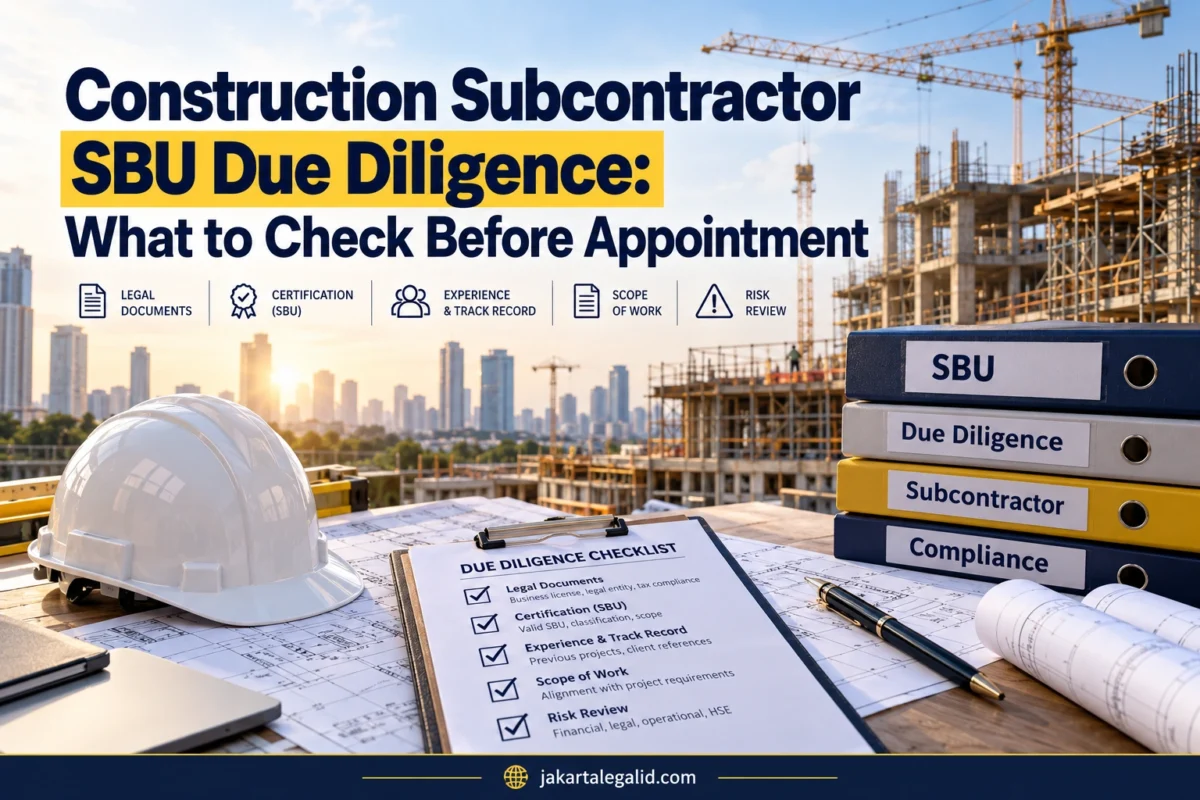
Construction subcontractor SBU due diligence should answer one practical question: does this exact subcontractor hold construction certification that matches the exact work package you plan to give it? A certificate should not be accepted merely because the company can produce an SBU PDF or because another company in the same group has construction certification.
Under the official text of Permen PUPR No. 8 of 2022, an SBU is evidence recognizing the classification and qualification of a construction-service business’s capability. The same Permen PUPR No. 8 of 2022 states that construction-service business actors must hold the applicable construction standard certificate and that a BUJK fulfils the business-certification requirement through an SBU obtained by certification.
The procedural certification regulation, Permen PUPR No. 8 of 2022, is listed in the official JDIH BPK database as in force. At the sector level, Permen PU No. 6 of 2025 is the current Ministry regulation covering business and product/service standards, supervision and sanctions in public-works risk-based licensing.
Construction Subcontractor SBU Due Diligence: Start With Scope Match
The strongest review works from the subcontract backwards. Define the work that will actually be delegated, identify the construction classification and subclassification relevant to that work, then compare those requirements with the subcontractor’s own certification record.
Do not begin with the assumption that any SBU is sufficient. The Ministry’s current SIJKT regular SBU portal organizes certificates by qualification, classification and subclassification and states that one regular SBU consists of one subclassification.
That makes subclassification a central due-diligence field. The hiring party should know which certified scope is being relied on and how that scope relates to the proposed subcontract.
1. Match the SBU to the Exact Legal Entity
Start with the company name and legal identity. The subcontractor named in the draft contract should be the business whose SBU is being reviewed.
Do not rely automatically on a certificate belonging to a parent company, sister company, joint-venture partner or another business with a similar trade name. Corporate affiliation may be commercially relevant, but it does not make separate legal entities interchangeable for certification purposes.
Compare at least the subcontractor’s legal name, NIB or other company identifiers available in the transaction file, current corporate documents and the identity shown in the construction-certification record.
If those identifiers do not align, resolve the discrepancy before moving to capability analysis.
2. Verify the Current SBU Record
The next step is to check the certification record against official construction-services data rather than relying only on a PDF supplied by the subcontractor.
The SIJKT portal publishes regular SBU information by business qualification, classification and subclassification. Use the current official record as part of the verification exercise and compare it with the certificate in the tender or due-diligence file.
Check whether the certificate being presented relates to the same company and the same scope that the bidder or subcontractor describes in its proposal.
A useful internal record should capture:
- legal entity reviewed
- SBU information relied on
- classification and subclassification
- qualification
- date of the verification
- proposed subcontracted scope
- any discrepancy requiring clarification
This creates an audit trail showing why the subcontractor was considered suitable for further commercial evaluation.
3. Check Classification, Subclassification and Qualification
Classification and subclassification answer what type of construction capability is recognized. Qualification addresses the level of business capability recognized through the certification framework.
The due-diligence task is therefore not to ask whether the subcontractor has “an SBU.” Ask whether it has the right SBU scope for the work package under review.
For example, a project may contain civil structures, mechanical installation, specialist works and supporting infrastructure. Those packages should not automatically be treated as one interchangeable construction activity. Map the proposed work to the relevant construction scope before deciding which certificate is material.
Qualification should also be considered in the commercial context. A subcontract package may be technically aligned with a particular subclassification while still requiring review of whether the subcontractor’s recognized business capability and actual resources are appropriate for the scale and complexity of the proposed work.
This is a due-diligence judgment, not a substitute for the certification body’s assessment or project-specific procurement rules.
4. Look Behind the Certificate at Capability Evidence
For certification, Permen PUPR No. 8 of 2022 identifies SBU data that include annual sales, financial capability or asset value, construction workforce availability, construction-equipment capability, anti-bribery management information and membership in a construction-business association registered with LPJK.
Those categories provide a useful structure for subcontractor due diligence. The hiring party does not need to repeat the LSBU certification process, but it can ask whether the capability represented by the SBU is still consistent with the project being awarded.
Annual sales and experience
For annual-sales evidence, the same regulation provides that construction-contract records used as BUJK experience are supported through data recorded in the integrated construction information system, and annual-sales assessment is based on work obtained during the SBU validity period.
For buyer-side due diligence, review the subcontractor’s relevant project references and determine whether the experience being presented is comparable to the proposed package. A large total turnover number is less informative if the referenced work is unrelated to the construction scope being subcontracted.
Construction personnel
Review the responsible construction personnel proposed for the project and compare them with the staffing assumptions behind the tender or subcontract. Confirm that key personnel offered during procurement are actually intended to be available for execution.
The aim is not merely to collect certificates. It is to identify whether the subcontractor has the personnel structure needed to deliver the work it is contracting to perform.
Equipment capability
For equipment capability, Permen PUPR No. 8 of 2022 requires the provision of at least the principal equipment quantity for each applicable subclassification, subject to the regulation’s exception for construction consultancy businesses.
For project due diligence, compare the equipment proposed in the subcontractor’s method statement or tender submission with the actual needs of the work package. Identify whether equipment is owned, leased or otherwise expected to be available and whether the deployment plan is credible for the project schedule.
5. Reconcile the SBU With the Subcontract
Certification review should ultimately affect the contract decision. Once the subcontractor’s SBU and capability have been checked, compare them with the wording of the proposed subcontract.
The contract scope should not be broader or materially different from the construction work used to justify the subcontractor’s suitability without a further review.
Pay particular attention to:
- the exact work package and technical deliverables
- exclusions and interface responsibilities
- whether specialist work is being passed further down the supply chain
- named key personnel
- equipment commitments
- schedule assumptions
- insurance, safety and quality requirements
- approval or consent requirements under the main contract
An SBU check should therefore sit beside technical and contractual due diligence rather than replace them.
6. Separate SBU Due Diligence From IUP Due Diligence
This distinction is important on mining projects. A construction subcontractor’s SBU supports its construction-service capability; it does not prove that the mine owner holds a valid mining licence or that the mining project is otherwise ready to operate.
Where the construction package is part of a mining acquisition, financing or development project, review the mine owner’s licence position separately. Jakarta Legal ID’s guide to IUP due diligence in Indonesia covers the separate review of the IUP holder, mining area, licence stage and project compliance records.
Keep the two workstreams distinct in the data room:
- Mine-owner review: IUP, project area, stage and mining compliance
- Construction-subcontractor review: SBU scope, qualification, personnel, equipment and subcontract capability
A strong project file should be able to show that both sides of that interface are properly documented.
Red Flags Before Appointment
Several findings justify deeper review before the subcontract is signed:
- the SBU belongs to a different legal entity
- the subcontracted work does not clearly match the SBU subclassification relied on
- certificate information differs from the current official record
- project experience is presented without a clear connection to the proposed work
- named key personnel are unavailable or change materially before award
- equipment commitments are unclear or inconsistent with the construction method
- the subcontract scope expands materially after certification due diligence is completed
- a mining-project contractor’s SBU is being presented as evidence of the mine owner’s IUP or mining compliance
A red flag does not automatically disqualify a contractor. It identifies an issue that should be clarified, corrected, conditioned or reflected in the contract before appointment.
Conclusion
Construction subcontractor SBU due diligence is strongest when it starts with the work package rather than the certificate. Identify the contractor that will actually sign the subcontract, verify its current SBU record, and confirm that the classification, subclassification and qualification correspond to the construction scope being delegated.
Then look behind the certificate at the capability relevant to delivery: experience and annual sales, personnel, equipment and other material project resources.
The decision rule is straightforward: the legal entity, certified construction scope and actual subcontracted work should align. Where the project is in the mining sector, keep this contractor-certification review separate from the mine owner’s IUP and mining-compliance due diligence.
Check the Subcontractor’s SBU Before Contract Award
If you are appointing a construction subcontractor and need to confirm whether its SBU scope, qualification and supporting records fit the proposed work package, Jakarta Legal ID can help review the construction-certification and document pathway.
Request a consultation for SBU scope and document review before award, especially where the subcontract includes multiple construction activities or the certificate information does not clearly match the proposed works.
For help checking the proposed construction scope and organising certification records, review our Business Certification (SBU) service before appointing the subcontractor.
Read More: Business Certification Indonesia: SBU, SKK, SLO, and Sector-Specific Approvals
FAQ Construction Subcontractor SBU Due Diligence
Is checking that a subcontractor has an SBU enough?
No. Due diligence should also confirm that the certificate belongs to the exact subcontracting entity and that its classification, subclassification and qualification are relevant to the work package being delegated.
How can I verify a construction subcontractor’s SBU?
Compare the certificate supplied by the contractor with the current official construction-services information available through SIJKT, including the legal entity, qualification, classification and subclassification.
Why should annual sales or project experience be reviewed?
Annual sales and construction experience form part of the SBU capability framework. For subcontractor due diligence, relevant experience helps test whether the certified contractor has a track record that is commercially comparable to the proposed package.
Should equipment and personnel be checked even if the SBU is valid?
Yes. A valid SBU is important, but project due diligence should separately confirm that the personnel and equipment proposed for the actual subcontract are available and suitable for the planned work.
Does a construction subcontractor’s SBU prove a mining project has the required IUP?
No. Construction SBU due diligence and mining-licence due diligence are separate workstreams. The subcontractor’s SBU addresses construction-service capability, while the mine owner’s IUP and mining compliance must be reviewed separately.
References & Sources
- Minister of Public Works and Housing Regulation No. 8 of 2022 on Construction Service Standard Certificates — peraturan.bpk.go.id
- Official Text of Minister of Public Works and Housing Regulation No. 8 of 2022 — peraturan.bpk.go.id
- Official SIJKT Regular Construction Business Certificate Data Portal — sijkt.pu.go.id
- Minister of Public Works Regulation No. 6 of 2025 on Risk-Based Public Works Business and Product/Service Standards — jdih.pu.go.id
Recommended Next Articles
- IUP due diligence for mining projects — jakartalegalid.com