
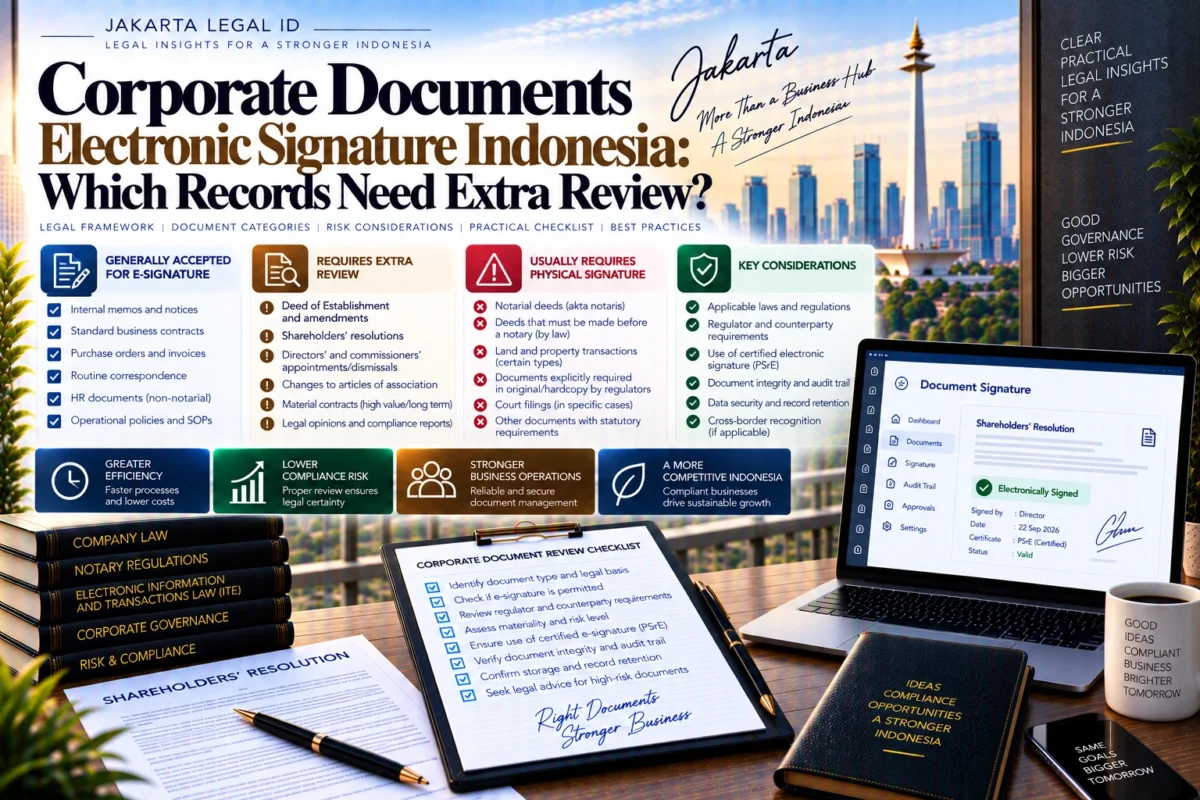
A company should not use one electronic-signature rule for every corporate document in Indonesia. Ordinary contracts, shareholder minutes, circular resolutions, powers of attorney, notarial deeds, and government filing documents can involve different form, authority, and evidentiary requirements.
That exception is the reason corporate-document review should start with the document type, not the signing platform.
Corporate Documents Electronic Signature Indonesia: The Short Answer
For corporate documents electronic signature Indonesia, use three categories.
Standard electronic-signature review: ordinary commercial agreements, acknowledgments, internal approvals, and similar documents where no separate statutory form controls execution.
Extra corporate-law review: shareholder resolutions, GMS minutes, board records, and powers of attorney where voting, authority, articles of association, or transaction-specific requirements matter.
Separate formality review: notarial deeds, regulated filings, and other instruments where another law or authority prescribes how the document must be executed or submitted.
Electronic signing may be legally possible in more than one category, but the evidence and formalities should be checked before signatures are collected.
Start With the General Electronic Signature Test
An electronic signature should first satisfy the general legal framework.
At the implementing level, Article 60 of PP 71/2019 distinguishes certified from uncertified Electronic Signatures.
Execution intent also matters because Article 62 requires the signer to know and understand the Electronic Information before signing and requires an affirmation or another mechanism showing the intention to be bound.
Before using any corporate e-sign workflow, therefore check identity, signatory authority, exclusive control of the signing method, document integrity, affirmative consent, and the audit trail retained after execution.
Lower-Risk Category: Ordinary Commercial and Internal Documents
Ordinary private documents can often be evaluated under the general ITE framework when no other statute requires a special form.
Examples may include routine commercial agreements, internal acknowledgments, procurement approvals, management correspondence, and other private records. The important qualification is that the signatory must still have authority to act for the company and the particular transaction must not be subject to a more specific legal form.
For material agreements, keep the final signed version together with identity evidence, authorization records, timestamps, signing logs, certificate information where used, and any corporate approval supporting the signatory’s authority.
Do not classify a document as low risk solely because it is short or commercially routine. A short guarantee, financing document, regulated filing, or power of attorney can involve more formal risk than a much longer ordinary services agreement.
Electronic GMS Minutes: Express Electronic Signature Recognition
The Company Law gives unusually clear guidance for an electronic General Meeting of Shareholders.
For electronic shareholder meetings, Article 77 of the Company Law permits a GMS through teleconference, videoconference, or another electronic medium that allows participants to see, hear, and participate directly, and requires the meeting minutes to be approved and signed by all participants.
That express clarification makes electronic GMS minutes different from corporate documents where the governing law merely says ‘signed’ without specifically addressing the electronic method.
Preserve Meeting Participation and Approval Evidence
Even where electronic signing is expressly contemplated, retain more than a final PDF.
A practical file should preserve participant identity, meeting invitations, attendance evidence, the platform used, voting results, the approved version of the minutes, the electronic-signature audit trail, and any corporate records showing that the participants had the relevant shareholder authority.
The objective is to prove both sides of the process: that the meeting itself satisfied the participation requirements and that the minutes signed afterward correspond to the decision actually adopted.
Circular Shareholder Resolutions Need Extra Review
Circular shareholder resolutions use a different statutory formulation.
Circular shareholder resolutions require separate attention because Article 91 makes an out-of-meeting decision binding only when all shareholders with voting rights approve the relevant proposal in writing and sign it.
The official explanation describes this as a circular resolution circulated in writing to all shareholders and approved in writing by all of them. Unlike the explanation to Article 77, Article 91 does not itself provide the same express statement that the required signature can be physical or electronic.
That does not justify saying that an electronic signature is automatically prohibited. Instead, treat an electronically signed circular resolution as a higher-review document: test the signature under the ITE framework, confirm unanimous approval, check the articles of association, and consider how the document will later be used by a notary, regulator, bank, investor, auditor, or court.
Board Resolutions and Internal Approvals
Board documents require a similar authority-first approach.
Before electronic execution, check the company’s articles of association, board procedures, delegation rules, sector regulations, financing covenants, shareholder agreements, and the actual purpose of the resolution.
A board approval that remains purely internal may present a different execution risk from a resolution that will be delivered to a bank, attached to a regulatory application, used to authorize a share transfer, or restated in a notarial deed.
For significant board decisions, the company should preserve the meeting or approval record, the final wording, signatory identity and authority, electronic signing evidence, and the downstream transaction documents that rely on the resolution.
Powers of Attorney Are Form-Sensitive
A power of attorney should not be assessed by asking only whether electronic signatures are generally valid.
First ask what the authority will be used for. A commercial authorization used internally is different from a power intended for litigation, a notarial process, banking, land matters, a government filing, a regulated transaction, or another procedure with its own acceptance rules.
Article 5(4) of the current ITE framework makes this document-specific review important: where another law prescribes a different form, the general electronic-document rule does not override it.
Before electronically signing a power of attorney, confirm the required form, the principal’s authority, the scope of powers, any substitution rights, whether notarization or legalization is expected, the receiving institution’s requirements, and whether an original or specially authenticated instrument is required.
Notarial Deeds Are a Separate Formality Category
Do not treat an authentic notarial deed as if it were an ordinary private contract uploaded to an e-sign platform.
A notarial deed belongs in a higher-review category because Article 44 of the amended Notary Law requires the deed, immediately after being read, to be signed by each appearer, the witnesses, and the Notary, subject to the statutory exception for an appearer who cannot sign and whose reason is stated.
The formality is material because Article 44(5) provides that violation of the specified reading and signing requirements can leave the deed with only the evidentiary force of a private deed and can support a claim for costs, damages, and interest against the Notary.
For a transaction that requires or will use a notarial deed, coordinate the execution method with the responsible licensed notary before parties sign preliminary documents. The existence of Indonesia’s general electronic-signature framework should not be treated as an automatic replacement for the statutory deed-making process.
Regulatory Filings: Separate the Portal From the Underlying Document
Many corporate and licensing systems are electronic, but an electronic portal and an electronically signable supporting document are two different questions.
A filing may be uploaded online while the underlying shareholder resolution, notarial deed, power of attorney, declaration, certificate, or supporting instrument remains subject to its own form and signature requirements.
Before filing, identify:
- what document the regulation actually requires
- who must sign it
- whether the filing authority accepts an electronic original or uploaded copy
- whether certification, notarization, legalization, or other authentication is required
- whether the filing platform generates its own electronic declaration
- whether the original evidence must be retained after upload
This prevents a common procedural mistake: assuming that because the government submission is digital, every supporting corporate document can be created using any electronic-signature method.
Corporate E-Signature Review Checklist
Before choosing an electronic execution process, classify the document first.
Check:
- What type of corporate document is being signed?
- Does another law prescribe a special form?
- Who must approve the underlying action?
- Who has authority to sign for the company?
- Does the articles of association impose additional requirements?
- Is unanimous shareholder consent required?
- Is electronic signing expressly recognized for this document type?
- Will a notary later use or restate the document?
- Will the document be submitted to a regulator, bank, court, land office, licensing authority, or other third party?
- Does that recipient impose its own form or authentication requirements?
- Does the signing method satisfy the Article 11 validity requirements?
- Is the signature certified or uncertified?
- Can the exact document version and later changes be verified?
- Is there clear evidence of the signer’s affirmative consent?
- Is the signing audit trail preserved with the corporate records?
For material corporate actions, create a short execution note before signing that records the document type, legal form, approving body, authorized signatories, chosen signature method, downstream recipient, and retained evidence.
Conclusion
Corporate documents and electronic signatures in Indonesia should be reviewed document by document rather than through one blanket rule.
The ITE framework gives electronic signatures legal effect when its validity requirements are met, but other legislation can prescribe additional form requirements. The Company Law expressly permits electronic signatures for minutes of an electronic GMS, while circular shareholder resolutions require unanimous written approval and signatures and deserve an additional execution review.
Powers of attorney, notarial deeds, and regulatory filing documents require even closer attention because their effectiveness can depend on the underlying transaction, recipient, statutory form, and authentication procedure. The safest corporate workflow is therefore to identify the document category first, then select the electronic-signature method that fits both the general ITE rules and the document-specific legal process.
Review the Corporate Document Before Choosing the Signature Method
If your Jakarta company is preparing shareholder resolutions, board documents, powers of attorney, contracts, amendment records, or regulatory submissions for electronic execution, Jakarta Legal ID can assist with a consultation to map the corporate, notarial, licensing, and document requirements that should be reviewed before signing.
The appropriate approach depends on the document type, approving corporate organ, signatory authority, intended recipient, statutory form, electronic-signature method, and any later notarial or government filing.
For help coordinating corporate documents, signing requirements and any required deed preparation with the responsible licensed notary, review our Notary Services and agree the scope for the specific document or corporate action.
Read More: Notarial Documents in Indonesia: Company, Contract and Property Guide
FAQ Corporate Documents Electronic Signature Indonesia
Can company contracts be signed electronically in Indonesia?
Electronic signatures can have legal force when the Article 11 requirements are satisfied, but the particular contract should still be checked for signatory authority and any statute that requires a different document form.
Can electronic GMS minutes be electronically signed?
Yes. Article 77 requires minutes of an electronic GMS to be approved and signed by all participants, and the official explanation expressly states that the approval and signing can be physical or electronic.
Can a circular shareholder resolution use electronic signatures?
Article 91 requires all voting shareholders to approve the proposal in writing and sign it. Unlike Article 77’s explanation for electronic GMS minutes, Article 91 does not expressly state the physical-or-electronic distinction, so the electronic execution method should be reviewed under the ITE framework, the company’s articles, and the document’s intended use.
Can a power of attorney be electronically signed?
There is no safe universal answer for every power of attorney. The form should be checked against the underlying transaction, applicable law, receiving institution, authority of the principal, and any notarization, legalization, original-document, or filing requirement.
Can a notarial deed simply be signed through an ordinary e-sign platform?
It should not be assumed. The Notary Law imposes separate deed-making and signing formalities, including the Article 44 execution requirements. The signing process should therefore be coordinated with the responsible licensed notary.
If a government filing is online, can every supporting document also be electronically signed?
Not necessarily. Electronic submission and the legal form of the supporting document are separate questions. Check the governing regulation and the filing authority’s requirements for each resolution, power of attorney, deed, declaration, or certificate.
References & Sources
- Original ITE Law Electronic Signature Provisions — jdih.komdigi.go.id
- Second Amendment to Indonesia’s Electronic Information and Transactions Law — jdih.komdigi.go.id
- Current Status of Government Regulation No. 71 of 2019 on Electronic Systems and Transactions — peraturan.bpk.go.id
- Official Electronic Signature Provisions in Government Regulation No. 71 of 2019 — peraturan.bpk.go.id
- Current Status of Law No. 40 of 2007 on Limited Liability Companies — peraturan.bpk.go.id
- Official Company Law Provisions on Electronic GMS and Circular Resolutions — peraturan.bpk.go.id
- Current Status of the 2014 Amendment to Indonesia’s Notary Law — peraturan.bpk.go.id
- Official Notarial Deed Execution Provisions in Law No. 2 of 2014 — peraturan.bpk.go.id