
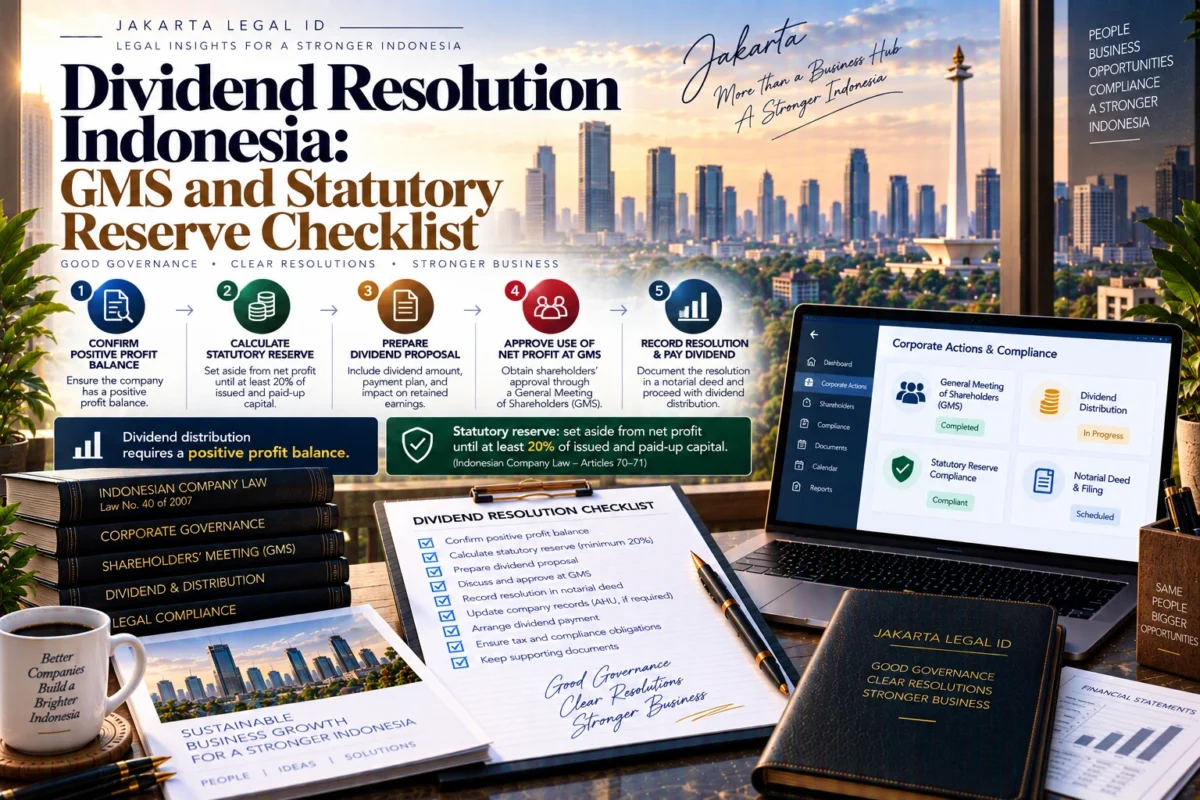
A dividend resolution in Indonesia should start with one question: does the company legally have profit available for distribution? A desired cash payment or a profitable current year is not enough by itself. The company must first check accumulated losses, the statutory reserve and the approval route required under its corporate documents.
The principal company-law framework is Law No. 40 of 2007 on Limited Liability Companies, which the BPK regulations database lists as in force and amended, including by Law No. 6 of 2023.
This guide focuses on ordinary Indonesian limited liability companies, including PT PMDN and PT PMA structures. Sector-specific, public-company and recipient-specific tax rules may add separate requirements.
When Can an Indonesian Company Approve a Dividend?
The company should test retained earnings and the statutory reserve before shareholders decide an amount to distribute.
Check the Retained-Profit Balance First
Article 71 provides that the use of net profit, including the amount allocated to the statutory reserve, is decided by the GMS.
The same Article 71 states that dividends may be distributed only when the company has a positive retained-profit balance.
That condition is more important than simply asking whether the company made a profit this year. The official explanation clarifies that a positive retained-profit balance means current-year net profit after accumulated losses from earlier financial years have been covered.
For example, a company can report a profit for the current financial year but still be unable to distribute a final dividend if earlier accumulated losses leave the retained-profit balance negative. The resolution file should therefore be built from the full retained-earnings position shown in the financial statements, not from current-year profit in isolation.
Calculate the Statutory Reserve Before the Dividend
The law does not say that 20 percent of every year’s profit must automatically be reserved. The statutory target is a reserve equal to at least 20 percent of issued and paid-up capital, built through annual allocations while the obligation applies.
Until the statutory reserve reaches the required threshold, Article 70 restricts its use to covering losses that cannot be covered by other reserves.
A useful dividend working paper should therefore show the issued and paid-up capital, existing statutory reserve, current profit, accumulated losses and the proposed reserve allocation before calculating the amount proposed for distribution.
What Should a Dividend Resolution in Indonesia Decide?
The Companies Law establishes who decides the use of profit and the conditions for distribution, but companies still need a resolution that translates the approved financial position into an implementable decision.
Profit Allocation and Dividend Amount
The resolution should clearly identify the financial year and the profit figure being allocated. It should then distinguish the amount placed into the statutory reserve from the amount distributed as dividends and any amount retained for other corporate purposes.
Do not draft the dividend amount independently from the financial statements. The retained-profit balance, accumulated losses and reserve position should reconcile to the figures used in the shareholder resolution.
Where the company has several share classes or special rights, check the articles of association before assuming every share participates in the distribution on identical terms.
Payment Terms and Implementation Authority
As a practical drafting matter, the resolution should make the payment decision sufficiently clear for management and accounting teams to implement it. That normally means recording the approved aggregate dividend, the basis for allocating it among entitled shareholders, the intended payment timing and the person or corporate organ authorized to complete the administrative steps.
Before funds are transferred, confirm the current shareholder records, bank details and applicable tax treatment for each recipient. Jakarta Legal ID’s verified financial and tax consulting page describes its bookkeeping, financial-report and tax-administration support, which may be relevant once the corporate resolution has been approved.
GMS or Circular Resolution?
A final profit allocation will commonly be approved through shareholder action. If a physical or convened GMS is used, the ordinary quorum and voting rules must be checked together with the company’s articles of association.
For an ordinary resolution, Article 86 provides that the first GMS may proceed when more than one-half of all voting shares are present or represented, unless the law or the articles of association require a larger quorum.
Article 87 states that GMS decisions are first sought by deliberation for consensus and, where consensus is not reached, the default rule requires approval by more than one-half of the votes cast unless a higher threshold applies.
A physical meeting is not the only possible route. Article 91 also allows shareholders to adopt a binding resolution outside a physical GMS when every shareholder with voting rights approves the proposal in writing and signs it.
That written route is commonly described as a circular resolution. Its unanimity requirement is important: it should not be treated as a shortcut to the ordinary majority-vote rule used at a validly convened GMS.
Where the dividend is approved at a meeting, Article 90 requires GMS minutes signed by the meeting chair and at least one shareholder appointed by the participants, unless the minutes are made as a notarial deed.
A routine dividend decision does not automatically mean that every company needs a notarial deed. The appropriate documentation depends on the form of shareholder decision, the articles of association and whether other corporate actions are being approved at the same time. Jakarta Legal ID’s verified notary-services page covers coordination for corporate resolutions and eligible corporate deeds where professional notarial involvement is needed.
Interim Dividends Follow Different Rules
Do not apply the final-dividend GMS checklist mechanically to a dividend paid before the financial year closes.
For an interim distribution, the decision is made by the directors after obtaining approval from the board of commissioners.
The financial risk is also different. Article 72 further provides that if the company ends the financial year with a loss, the interim dividend must be returned, and directors and commissioners can be jointly liable for the company’s loss if shareholders cannot return it.
An interim dividend should therefore have its own solvency and accounting review rather than being treated as an early payment of a final dividend that shareholders will automatically approve later.
Dividend Resolution Checklist for PT PMA and PT PMDN
Before approving a final dividend, use this sequence:
- Confirm the financial statements for the relevant financial year
- Calculate the current retained-profit balance after accumulated losses
- Confirm the issued and paid-up capital
- Check the existing statutory reserve balance
- Calculate the reserve allocation still required under Article 70
- Determine the amount of profit available for shareholder allocation
- Review the articles of association for share rights and meeting rules
- Choose the GMS or unanimous written-resolution route
- Draft the profit-allocation and dividend resolutions using the reconciled figures
- Confirm the entitled shareholders and allocation basis
- Record payment timing and implementation authority
- Complete the required meeting minutes or written shareholder resolution
- Confirm recipient-specific tax treatment before payment
- Record the dividend payable and subsequent payment correctly in the company’s accounts
- Retain the financial statements, calculation, shareholder approval and payment evidence together
This sequence separates three issues that are often mixed together: whether profit is legally distributable, whether shareholders have validly approved its use, and whether the payment has been implemented correctly.
Common Dividend Resolution Mistakes
One common mistake is treating current-year profit as automatically distributable without checking accumulated losses. Another is using the 20 percent reserve threshold as if it were a fixed annual percentage of profit rather than a target measured against issued and paid-up capital.
A third mistake is approving a dividend figure before reconciling the shareholder register and share rights. A fourth is using an unsigned draft or informal shareholder agreement as if it were the completed corporate resolution.
Interim dividends create a separate risk: management may focus on available cash while overlooking the statutory net-asset, creditor and year-end repayment tests.
Finally, do not combine the corporate-law decision and tax analysis into a single assumption. A dividend can satisfy the company-law distribution test while still requiring a separate recipient-specific tax and reporting review before payment.
Conclusion
A compliant dividend resolution starts with the financial position, not the desired payout. Confirm that accumulated losses have been absorbed, calculate the statutory reserve requirement, and determine the amount genuinely available for allocation.
Then use the correct shareholder-decision route, document the amount and implementation terms clearly, and complete the accounting and tax checks before money is transferred. For interim dividends, apply the separate Article 72 conditions and repayment-risk analysis rather than treating the payment as an ordinary final dividend.
Review the Dividend File Before Shareholders Approve the Payment
If your Jakarta company needs help coordinating a dividend resolution with its financial statements, corporate records or shareholder documentation, Jakarta Legal ID can be consulted before the resolution is finalized.
Corporate-resolution coordination, notary support, bookkeeping and tax-administration assistance can then be scoped according to the company’s actual shareholder structure and financial records.
For help coordinating shareholder resolutions and any related corporate deeds, review our Notary Services and agree the scope according to the company’s documents and proposed actions.
Read More: Notarial Documents in Indonesia: Company, Contract and Property Guide
Where the dividend is approved together with the annual report of a capital-based PT, also follow Article 16 of Permenkum 49/2025: annual-report approval is recorded in a notarial deed and submitted through the notary via SABH within 30 days after the deed is signed. A standalone dividend decision and the annual-report approval process should be assessed separately.
FAQ Dividend Resolution Indonesia
Can an Indonesian company pay dividends if it made a profit this year but still has accumulated losses?
Not if the accumulated losses mean the company does not yet have a positive retained-profit balance. The Companies Law permits dividend distribution only when that positive balance exists.
Does an Indonesian company have to reserve 20 percent of every year’s profit?
No. The statutory rule requires annual allocations while applicable until the statutory reserve reaches at least 20 percent of issued and paid-up capital. The 20 percent figure is the reserve target, not automatically the percentage of each year’s profit that must be allocated.
Can shareholders approve a dividend without holding a physical GMS?
Yes. Article 91 permits a binding written decision outside a GMS when every shareholder with voting rights approves and signs the proposal.
Who approves an interim dividend in Indonesia?
An interim dividend follows Article 72 rather than the ordinary final-dividend process. It is decided by the directors after approval from the board of commissioners and is subject to additional financial and creditor-protection conditions.
Does every dividend resolution need a notarial deed?
No. The Companies Law recognizes ordinary GMS minutes and written shareholder resolutions. Notarial documentation may be appropriate depending on the form of the decision, the articles of association or other corporate actions being handled at the same time.
References & Sources
- BPK Regulations Database — Law No. 40 of 2007 on Limited Liability Companies — peraturan.bpk.go.id
- Directorate General of Taxes — Limited Liability Companies Law Text — pajak.go.id
- BPK Regulations Database — Law No. 6 of 2023 on Job Creation — peraturan.bpk.go.id