
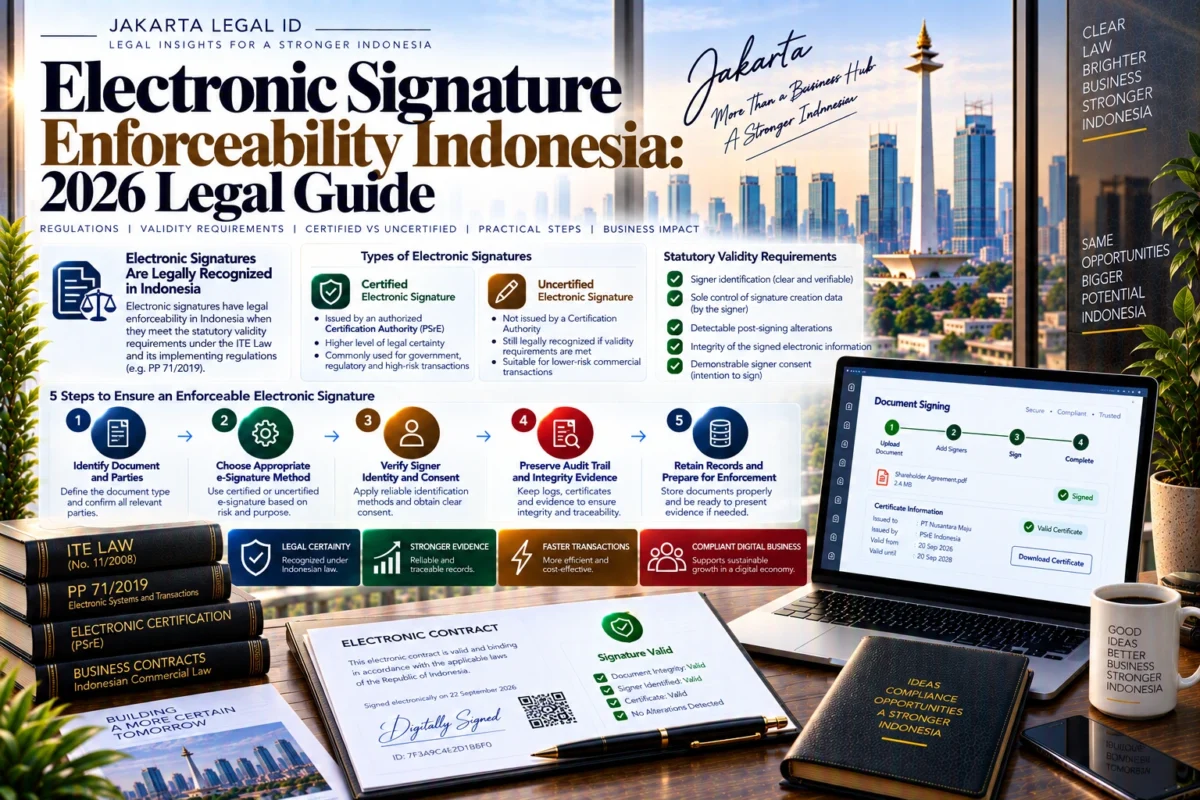
Electronic signatures can have legal force in Indonesia, but enforceability does not depend merely on placing a digital image of a signature onto a PDF. The central questions are whether the signing method can identify the signer, show that the signer controlled the signing process, detect later changes, preserve document integrity, and demonstrate the signer’s consent.
Electronic Signature Enforceability Indonesia: The Short Answer
For electronic signature enforceability Indonesia, use a four-part test: confirm that electronic execution is permitted for the document, verify the Article 11 requirements, determine whether certification is required or materially improves the evidence, and preserve enough signing data to prove identity, integrity, authority, and consent later.
An electronic signature is therefore not automatically strong evidence simply because a software platform displays the words ‘signed electronically.’ The underlying signing process matters.
For contracts, Article 18(1) of the ITE Law states that Electronic Transactions embodied in Electronic Contracts bind the parties.
That does not remove the need to check the validity of the agreement itself, the authority of the signatory, mandatory form requirements, or the evidence supporting the electronic signature.
The Article 11 Enforceability Test
Article 11 can be converted into four practical questions.
1. Is the signature linked only to the signer?
The signing credentials or signature-creation data should relate to the person identified as the signer rather than a shared or uncontrolled account.
2. Was the signing process under the signer’s control?
If another person could freely use the signing credentials, proving execution becomes more difficult. Businesses should avoid uncontrolled shared logins or informal signature files that anyone can paste into a document.
3. Can later changes be detected?
The system should make it possible to determine whether the electronic signature or the associated electronic information changed after signing.
4. Can identity and consent be demonstrated?
The evidence should show both who signed and that the person intended to approve the specific electronic information.
These questions are more useful than asking only whether a document contains a visible signature image.
Legal Validity Is Not the Same as Evidentiary Strength
A business should distinguish meeting the legal requirements from being able to prove those requirements efficiently during a dispute, audit, financing, acquisition, or due-diligence review.
At the implementing-regulation level, Article 60 of PP 71/2019 divides Electronic Signatures into certified and uncertified signatures.
That distinction is important. The regulation does not justify a blanket statement that every uncertified electronic signature is invalid. Instead, businesses should ask how convincingly the particular signing process proves the Article 11 and PP 71 requirements.
Certified vs Uncertified Electronic Signatures
A certified signature has additional infrastructure behind the execution process.
For routine commercial documents, the correct choice should be based on the transaction, expected evidentiary risk, counterparty requirements, internal policy, and any applicable sector rule. For significant documents, a stronger identity and integrity framework may be commercially sensible even when the business is not dealing with a specifically regulated high-risk transaction.
When Certification Becomes Especially Important
The 2024 ITE amendment introduced an express rule for high-risk transactions.
For higher-risk use cases, Article 17(2a), introduced by Law No. 1 of 2024, requires high-risk Electronic Transactions to use an Electronic Signature secured by an Electronic Certificate.
Businesses should therefore avoid assuming that an informal click-to-sign or scanned-signature workflow is suitable for every electronic transaction. First determine whether the transaction falls within a high-risk or sector-specific category that requires stronger electronic certification or authentication.
Electronic Documents as Legal Evidence
Electronic-signature enforceability also depends on the evidentiary status of the document itself.
The 2024 formulation is important because it means businesses should not use an outdated assumption that one fixed list of document categories always determines whether electronic execution is available. Instead, check whether another applicable statute prescribes a different legal form for the particular transaction or document.
Examples of transactions that deserve additional review include documents requiring notarial involvement, government or regulatory filings, regulated financial documentation, land-related instruments, or other documents whose form is prescribed by a separate law. The correct conclusion depends on the specific instrument, not merely the convenience of the signing platform.
Signer Intent and Authority Still Matter
A technically valid electronic-signature mechanism cannot cure a lack of authority.
For a company document, confirm that the individual signing for the company is authorized under the company’s constitutional documents, board or shareholder approvals, power of attorney, internal delegation, contract, or other applicable authority framework.
Signer intent also matters because Article 62 requires the signer to know and understand the Electronic Information before signing and requires an affirmation or another mechanism showing the signer’s intention to be bound in the Electronic Transaction.
A well-designed execution workflow should therefore make the final document visible before signature, identify the signer, require an affirmative action, and preserve evidence linking that action to the exact version signed.
Preserve the Audit Trail
Do not retain only the final PDF if stronger execution evidence is available.
For material transactions, preserve the evidence produced by the signing process, which may include:
- the final signed document
- signer identity information
- electronic certificate information where applicable
- timestamps
- authentication records
- the document hash or integrity-verification information where available
- signing-session records
- confirmation of the email address or telephone number used
- evidence of multi-factor authentication where used
- version history
- completion certificates or platform audit logs
- the corporate approval authorizing the signatory
These items are practical evidence controls rather than a universal statutory checklist. Their value is that they help reconstruct who signed, what was signed, when it was signed, and whether the document changed afterward.
Business Checklist Before Electronic Signing
Before executing a material document electronically, ask:
- Is electronic execution permitted for this particular document under all applicable laws?
- Does another statute require a different form or process?
- Who is the intended signer?
- Does that person have authority to bind the company?
- Can the signing data be linked only to that signer?
- Does the signer control the signing credentials?
- Can changes after signature be detected?
- Can the system prove which exact document version was approved?
- Is there clear evidence of the signer’s affirmative consent?
- Is the transaction classified as high risk or otherwise subject to a certificate requirement?
- Would a certified Electronic Signature materially strengthen the evidence?
- Is the audit trail retained for the expected life of the transaction?
- Do the contract, counterparty, bank, regulator, or internal policy impose additional signing requirements?
The objective is not to select the most sophisticated signing technology for every document. It is to use a method proportionate to the legal form, transaction risk, evidentiary importance, and dispute exposure.
Conclusion
Electronic signature enforceability in Indonesia depends on the quality of the execution process, not merely the appearance of a digital signature on a document.
Article 11 focuses on signer linkage, control, detectable changes, identity, and consent. PP 71/2019 distinguishes certified and uncertified Electronic Signatures and makes certification relevant to evidentiary strength, while the 2024 ITE amendment expressly requires an Electronic Signature secured by an Electronic Certificate for high-risk Electronic Transactions.
Businesses should therefore review three layers before signing: whether electronic execution is legally available for the document, whether the signing method satisfies the electronic-signature requirements, and whether the evidence trail will be strong enough to prove execution if the document is later challenged.
Review the Signing Method Before Executing a Material Contract
If your Jakarta business is preparing contracts, shareholder documents, corporate approvals, or other records for electronic execution, Jakarta Legal ID can assist with a consultation to organize the document, signing-authority, corporate, notarial, and compliance issues that should be reviewed before execution.
The appropriate signing approach depends on the document type, transaction risk, signatory authority, applicable form requirements, electronic-signature method, and evidence the business needs to preserve.
For help coordinating corporate documents, signing requirements and any required deed preparation with the responsible licensed notary, review our Notary Services and agree the scope for the specific document or corporate action.
Read More: Notarial Documents in Indonesia: Company, Contract and Property Guide
FAQ Electronic Signature Enforceability Indonesia
Are electronic signatures legally valid in Indonesia?
Yes, when the requirements in Article 11 of the ITE Law are satisfied. Those requirements concern signer linkage and control, detection of later changes, identification of the signer, and evidence that the signer consented to the electronic information.
Is an uncertified electronic signature automatically invalid?
No. PP 71/2019 recognizes both certified and uncertified Electronic Signatures. However, the official explanation states that certification status affects evidentiary strength, so the ability to prove identity, consent, control, and document integrity remains important.
What is a certified electronic signature in Indonesia?
Under PP 71/2019, a certified Electronic Signature must meet the legal-validity requirements, use an Electronic Certificate issued through an Indonesian Electronic Certification Provider, and be created using a certified Electronic Signature creation device.
When is an Electronic Certificate required?
The 2024 ITE Law amendment requires high-risk Electronic Transactions to use an Electronic Signature secured by an Electronic Certificate. The statutory explanation gives non-face-to-face financial transactions as an example of a high-risk Electronic Transaction.
Is a scanned handwritten signature the same as a certified electronic signature?
No. A scanned signature image does not by itself satisfy the requirements for a certified Electronic Signature. Its legal and evidentiary position should be assessed by examining how identity, signer control, consent, and document integrity can be proven.
Can every Indonesian legal document be signed electronically?
Not automatically. Article 5 of the ITE Law recognizes electronic documents as lawful evidence but states that the rule does not apply where another law provides otherwise. The particular transaction and any statute prescribing a specific form must therefore be checked.
References & Sources
- Original ITE Law Electronic Signature and Electronic Contract Provisions — jdih.komdigi.go.id
- Second Amendment to Indonesia’s Electronic Information and Transactions Law — jdih.komdigi.go.id
- Current Status of Government Regulation No. 71 of 2019 on Electronic Systems and Transactions — peraturan.bpk.go.id
- Official Electronic Signature Provisions in Government Regulation No. 71 of 2019 — jdih.komdigi.go.id