
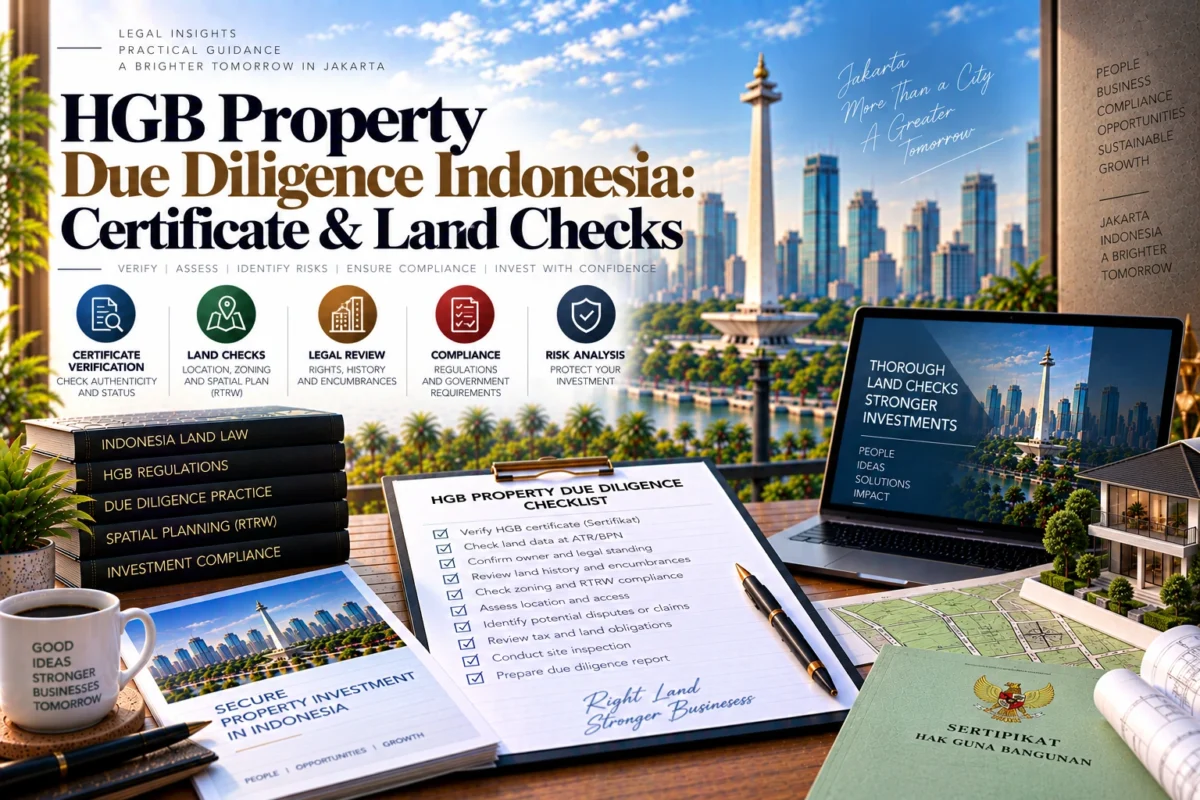
HGB Property Due Diligence Indonesia: An HGB certificate is important evidence of a registered land right, but HGB property due diligence should answer a broader question: can the buyer safely acquire, finance, develop, and use the property for the intended purpose? A proper review therefore needs to examine current registration data, encumbrances, the remaining HGB period, the land beneath the HGB, spatial-use rules, and relevant building documentation.
For readers moving from preliminary review to transaction support in Jakarta, the Jakarta Legal ID website provides the broader service context, while its Notary Services in Jakarta page specifically includes land certificate checking and property sale-and-purchase deed support.
The national framework begins with the Basic Agrarian Law, Law No. 5 of 1960, which the ATR/BPN legal database lists as effective and which provides the legal foundation for Indonesian land rights including HGB.
What HGB Property Due Diligence Should Establish
The objective is not simply to determine whether a certificate exists. Due diligence should establish whether the registered information and the proposed transaction are consistent with each other.
Under Government Regulation No. 18 of 2021, HGB may be granted over State Land, Hak Pengelolaan land, or Hak Milik land, so identifying the land beneath the HGB is a core due-diligence question rather than a technical footnote.
That distinction matters because the certificate term, renewal structure, relationships with another rights holder, financing arrangements, and the intended use of the property may all need separate review. A buyer should therefore avoid treating one document as proof that every relevant legal issue has been resolved.
HGB Property Due Diligence Indonesia: Six Checks Before Closing
1. Verify the Certificate Against Current Land-Registration Data
Start by reconciling the certificate presented for the transaction with current land-registration information. Review the registered holder, certificate number, land area, location, type of right, issuance details, and relevant recorded changes. Any discrepancy should be resolved before money is committed or transaction documents become unconditional.
Land-registration records should be treated as a live verification source rather than relying only on a copy supplied by the seller, particularly because Minister of ATR/BPN Regulation No. 3 of 2023 regulates the use of electronic systems in land-registration activities.
As of the review date, the ATR/BPN legal database lists Minister of ATR/BPN Regulation No. 3 of 2023 as effective and records that it revoked Minister of ATR/BPN Regulation No. 1 of 2021 on electronic certificates.
For transaction purposes, the practical question is whether the certificate shown to the buyer matches the current registered position, not merely whether the document appears visually authentic. Foreign investors who also need broader context on deeds, corporate documentation, powers of attorney, and property-related legal documentation can refer to Jakarta Legal ID’s guide to notary services for foreign investors.
2. Check for Hak Tanggungan and Other Recorded Issues
An HGB certificate should also be checked for security interests because Law No. 4 of 1996 on Hak Tanggungan identifies HGB as one of the land rights that may be encumbered by Hak Tanggungan.
A registered Hak Tanggungan does not automatically mean the property cannot be transacted, but it changes the closing analysis. The parties need to understand the secured obligation, the creditor’s position, and the mechanism required to release or otherwise deal with the security before or as part of completion.
The same principle applies to any other discrepancy or registered condition discovered during review: identify it early, determine who must resolve it, and make resolution a clear transaction condition where appropriate.
3. Calculate the Remaining HGB Term
Do not evaluate an HGB merely by its original issuance date. Calculate the remaining period as of the expected transaction and project timeline.
Government Regulation No. 18 of 2021 provides that HGB over State Land or Hak Pengelolaan may be granted for up to 30 years, extended for up to 20 years, and renewed for up to 30 years.
By contrast, Government Regulation No. 18 of 2021 states that HGB over Hak Milik is granted for up to 30 years and may be renewed through a deed granting HGB over Hak Milik.
For an investor, the important number is therefore not a theoretical maximum but the remaining registered term and the legal path available after it. A short remaining term can affect financing, project economics, lease commitments, redevelopment timing, and exit planning even where the current certificate remains valid.
4. Identify the Land Beneath the HGB
An investor should establish whether the HGB sits over State Land, Hak Pengelolaan, or Hak Milik and then review the documents governing that underlying relationship.
This is particularly important for HGB over Hak Pengelolaan. The investor should understand the identity of the Hak Pengelolaan holder, relevant land-utilization arrangements, transaction conditions, and any approvals or recommendations that may become relevant to the planned legal action. The due-diligence file should explain these relationships clearly enough that the buyer understands what continues after closing.
For HGB over Hak Milik, the deed and underlying Hak Milik relationship deserve equivalent attention. The goal is to identify rights or obligations that are not obvious from reading only the headline HGB term.
5. Test the Intended Use Against Jakarta Spatial Rules
A valid land right and a permitted business use are different questions. A buyer planning an office, factory, warehouse, hospitality project, retail activity, or other commercial use should verify that the proposed activity is spatially compatible with the site.
For property in Jakarta, intended use should be checked against the applicable spatial plan because DKI Jakarta Governor Regulation No. 31 of 2022 establishes the Detailed Spatial Plan and is listed as effective by the DKI Jakarta legal database.
For business projects, the national OSS system also publishes a KKPR and RDTR spatial-planning workflow, which is relevant when testing whether the planned business activity and site are spatially compatible.
The investor should therefore compare the exact parcel and proposed activity rather than relying on broad descriptions such as “commercial area” or the property’s existing use by a previous occupant.
6. Review Building Documentation Separately
A land-right review should be paired with a building review when the transaction includes an existing structure or development project.
Where an existing building is part of the transaction, due diligence should extend beyond the land certificate because Government Regulation No. 16 of 2021 remains listed as effective and is the implementing regulation for Indonesia’s building regime; it revoked Government Regulation No. 36 of 2005.
The practical file should compare the building’s actual condition and use with the applicable approvals and records available for that property. Material alterations, changes of use, additional floors, redevelopment, or a mismatch between the proposed business and the approved building condition should be investigated before closing.
A Practical Red-Flag Matrix
The following table summarizes the main points to compare before choosing the next step.
| Finding | Why It Matters | Practical Response |
|---|---|---|
| Seller’s certificate data does not match current registration information | The transaction may be based on outdated or inconsistent data | Resolve the discrepancy before signing or closing |
| Hak Tanggungan remains registered | A creditor’s security interest may affect completion | Confirm the release or agreed closing mechanism |
| HGB has a short remaining period | Project life, financing and exit assumptions may be affected | Model the transaction using the actual remaining term |
| HGB sits over Hak Pengelolaan | Another legal relationship may affect extension, renewal or other actions | Review the Hak Pengelolaan documents and relevant conditions |
| Proposed use conflicts with applicable spatial rules | Ownership of the right does not itself authorize every activity | Verify the parcel and activity against current spatial requirements |
| Building records do not align with actual use or condition | Operational or redevelopment plans may face additional compliance work | Resolve the building-document gap before relying on the asset |
The value of this matrix is sequencing. A buyer can identify which issues are merely documentary, which require a third-party action, which can be made conditions precedent, and which may change the economics of the deal.
Conclusion
HGB due diligence is strongest when it treats the property as several connected legal layers rather than one certificate. Verify the current registered right, investigate Hak Tanggungan, calculate the actual remaining term, identify the underlying land, test the intended use against Jakarta spatial rules, and review the building position separately.
That approach gives an owner or investor a clearer basis for deciding whether to proceed, renegotiate transaction conditions, require corrective action, or conduct a deeper legal review before closing.
Review an HGB Property Before You Commit
If you are assessing an HGB property in Jakarta for acquisition, investment, financing, or business use, Jakarta Legal ID can be consulted regarding the transaction’s notarial, property-document, corporate, and licensing context.
A consultation can be used to identify which certificate, encumbrance, underlying-land, spatial, and building checks should be resolved before the transaction proceeds.
FAQ – HGB Property Due Diligence Indonesia
Is checking an HGB certificate enough before buying property in Indonesia?
No. The certificate is one part of the review. A transaction-level due-diligence process should also examine current registration data, Hak Tanggungan or other recorded issues, the remaining HGB period, the underlying land, spatial-use compatibility, and relevant building documentation.
Can HGB property be subject to a mortgage or security right?
Yes. HGB is one of the land rights that may be encumbered by Hak Tanggungan under Law No. 4 of 1996. If one is registered, its treatment should be established before completion.
Why does the remaining HGB term matter to an investor?
The remaining term can affect project duration, financing assumptions, long-term leases, redevelopment plans and exit value. Due diligence should use the actual registered remaining period rather than assuming a new maximum term will automatically be available.
Does valid HGB automatically allow any commercial use of the land?
No. Land-right status and spatial-use permission are separate issues. In Jakarta, the proposed activity should be checked against the applicable DKI Jakarta spatial plan and any relevant OSS spatial-planning requirements.
References & Sources
- Basic Agrarian Law — Law No. 5 of 1960 — jdih.atrbpn.go.id
- Government Regulation No. 18 of 2021 on Land Management Rights, Land Rights, Apartment Units and Land Registration — jdih.atrbpn.go.id
- Law No. 4 of 1996 on Hak Tanggungan over Land and Land-Related Objects — peraturan.bpk.go.id
- Minister of ATR/BPN Regulation No. 3 of 2023 on Electronic Documents in Land Registration — jdih.atrbpn.go.id
- Government Regulation No. 16 of 2021 on the Implementation of the Building Law — peraturan.go.id
- DKI Jakarta Governor Regulation No. 31 of 2022 on the Detailed Spatial Plan — jdih.jakarta.go.id
- OSS Guide to KKPR Confirmation Based on Detailed Spatial Planning — oss.go.id
Recommended Next Articles
- guide to notary services for foreign investors — jakartalegalid.com
- notary costs for property buyers and investors — jakartalegalid.com