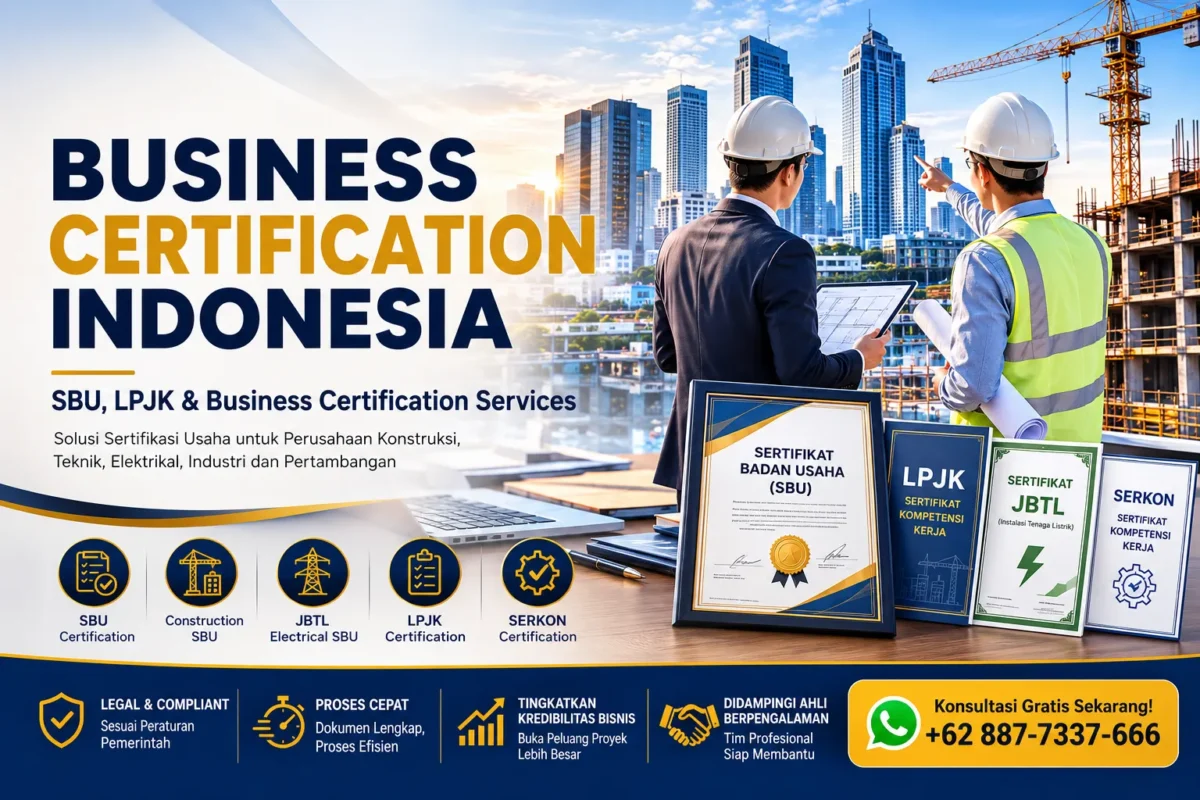
Business Certification Indonesia is not one universal certificate that applies to every company. The document a business needs depends on its KBLI activity, sector, risk level, business qualification, technical personnel, project location, and—where electricity is involved—the installation itself.
This guide separates the credentials that are often mixed together. Jakarta Legal ID provides document preparation and application coordination. Certification and regulatory approval remain subject to assessment by the relevant government authority or authorized certification body.
Choose your certification guide
Start with the credential needed for your actual work. The guides below separate business qualifications, workforce competency and installation-related documents.
- Construction certification framework: understanding the roles of SBU, SKK and authorised bodies
- SBU classification: reviewing the requested construction scope
- SKK personnel requirements: matching workforce credentials to the business application
- SBU renewal checklist: preparing current company and personnel records
- Renewal or qualification upgrade: choosing the workstream that fits the proposed change
- Electricity-support certification: distinguishing SBUJPTL business certification from an installation SLO
For document preparation and application coordination, review our business certification service scope.
Business Certification Indonesia: Start With the Activity
Before preparing an application, identify the company’s actual business activity and the corresponding KBLI code. A construction contractor, an electricity-support service company, a mining-service company, and a manufacturer may all need different licenses or certificates even when they work on the same project.
The OSS system is the starting point for risk-based business licensing, but an NIB does not automatically replace every sectoral approval. Additional certificates, verified standards, or licenses may apply according to the activity and risk classification.
Construction Business SBU
A construction-service business may require a Sertifikat Badan Usaha, or SBU, for the classification, subclassification, and qualification in which it operates. The application is assessed through an authorized construction business certification body (LSBU) within the applicable PUPR and LPJK framework.
An SBU should not be described as a general certificate issued directly by a consultant. The company must satisfy the requirements applicable to its requested scope, and the authorized body decides whether the certificate can be issued.
For a more focused explanation, see our construction SBU classification guide.
Construction Workforce SKK
SKK is a competency credential for construction personnel, not a substitute for the company’s SBU. The personnel and competency levels required depend on the business classification, qualification, and responsible roles used in the application.
A company should therefore map its business scope first and then check whether the proposed personnel credentials match that scope. See the SKK requirements for SBU guide.
Electricity-Support Business Certification Is Different From SLO
An electricity-support service business may require business certification under the ESDM electricity framework. This concerns the capability and classification of the business entity providing electricity-support services.
An SLO, or Sertifikat Laik Operasi, has a different function: it is formal evidence concerning the operational worthiness of a particular electrical installation. A business-entity credential and an installation SLO should not be presented as the same document.
The distinction is reflected in Minister of Energy and Mineral Resources Regulation No. 6 of 2023, which separately defines business certification for electricity-support services and SLO for electrical installations.
Other Sectors Have Their Own Approval Paths
Mining, manufacturing, environmental, healthcare, food, transportation, telecommunications, and other regulated activities may require sector-specific licenses or technical approvals. These documents should not automatically be grouped under construction SBU or electricity certification.
The correct approach is to map:
- the actual activity and KBLI code;
- the OSS risk classification;
- the responsible ministry or authority;
- the business-entity and personnel requirements;
- the project location and environmental requirements; and
- the validity, renewal, and reporting obligations.
Typical Application Workflow
- Scope review: confirm the activity, KBLI, sector, and intended project scope.
- Credential mapping: identify whether the requirement concerns the business entity, individual personnel, or a specific installation.
- Document gap review: compare company records, OSS data, personnel credentials, and technical documents.
- Submission: file through the applicable official system or authorized certification body.
- Verification: respond to document, technical, or personnel findings.
- Issuance and maintenance: monitor validity and any renewal, reporting, or change obligations.
Complete preparation can reduce avoidable administrative errors, but it does not guarantee approval or a fixed processing time.
Common Certification Mistakes
- Using “SBU,” “LPJK certification,” “JBTL,” and “SLO” as interchangeable terms.
- Selecting a certificate before confirming the KBLI and actual service scope.
- Using personnel credentials that do not match the requested business classification.
- Treating an NIB as the only authorization required for a regulated activity.
- Assuming a consultant can issue or guarantee a government or certification-body decision.
How Jakarta Legal ID Can Assist
Jakarta Legal ID can help review the proposed activity, identify the likely certification pathway, prepare documents, and coordinate the application with the relevant authorized body. Start with our Business Certification service page.
Frequently Asked Questions
Is there one Business Certification Indonesia certificate?
No. The required credential depends on the activity and regulatory framework.
Is LPJK itself an SBU?
No. LPJK is part of the construction-services institutional framework. Construction business certification is assessed through an authorized LSBU, while SKK concerns construction personnel.
Is electricity-business certification the same as SLO?
No. Business certification concerns the electricity-support service business; SLO concerns the operational worthiness of an electrical installation.
Can Jakarta Legal ID guarantee issuance?
No. We can support preparation and coordination, but the authorized authority or certification body makes the decision.