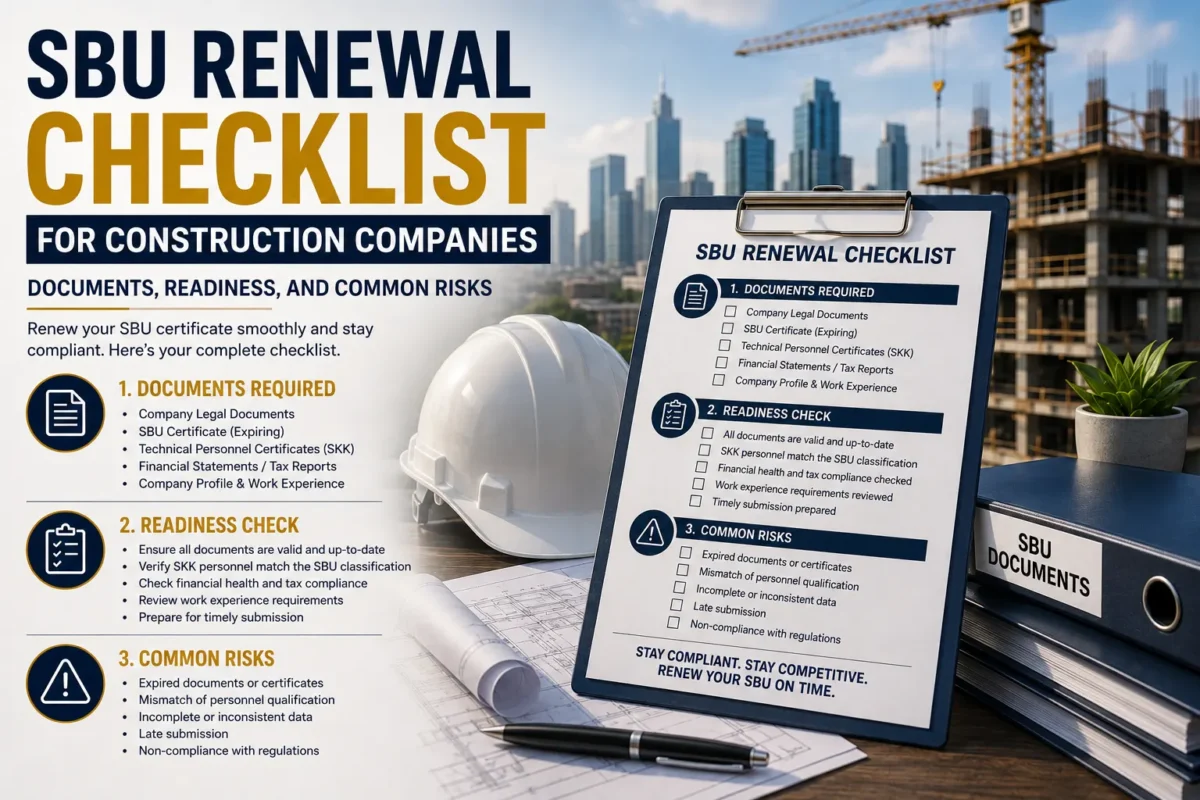
SBU renewal should be treated as a fresh certification-readiness review, not simply as re-uploading documents from the previous application. A construction company should confirm that its certified scope still matches its actual business, and that the evidence supporting its qualification remains current and consistent across the relevant systems.
Use this SBU Renewal Checklist for Construction Companies before starting the renewal process. It focuses on the areas most likely to require revalidation: classification and subclassification, annual sales, financial capacity, construction personnel, equipment, anti-bribery management, association membership, and OSS/SIJK data.
For renewal preparation, reconcile the existing certification file with current company data and the applicable sector standard. Check Minister of Public Works Regulation No. 6 of 2025 and the current certification instructions before filing. Jakarta Legal ID provides administrative preparation and coordination support; the authorized body assesses the application.
SBU Renewal Checklist for Construction Companies: Documents, Readiness, and Common Risks
Before renewal, answer three questions:
- Is the company keeping the same certified business scope
- Has any corporate, personnel, equipment, financial, or association information changed
- Does the company want to change its qualification or certified subclassifications
Those answers determine whether the application is best treated as a straightforward renewal or whether additional certification changes need to be addressed.
Jakarta Legal ID’s Business Certification SBU service separately lists SBU renewal and qualification upgrade, which reflects the practical need to distinguish maintaining an existing certification from changing its capacity or scope.
Confirm the Application Type Before Preparing Documents
Identify whether the company is continuing the same certification, correcting changed data, or requesting a different qualification or scope. Record that choice at the top of the renewal file so the supporting documents can be checked against the intended outcome.
For the detailed decision, use our SBU renewal versus qualification-upgrade guide. This checklist focuses on preparing and reconciling evidence after that decision.
Documents and Evidence to Revalidate Before Renewal
Under Permen PUPR No. 8 of 2022, SBU certification evidence includes six core data categories:
- Annual sales
- Financial capacity or asset value
- Availability of construction workforce
- Ability to provide construction equipment
- Implementation of an anti-bribery management system
- Membership in a BUJK association registered with LPJK
The regulation also connects several of these data sets with integrated construction information systems. A pre-renewal audit should therefore check both the documents themselves and whether the corresponding system data is accurate.
Annual Sales and Financial Capacity
Annual sales evidence is particularly important because the 2022 procedure provides that, for renewal, assessment of annual sales is based on accumulated annual sales for the same subclassification.
Before filing, reconcile:
- Construction contracts used as experience evidence
- The subclassification associated with the work
- Experience already recorded in the applicable construction information system
- Financial statements or asset information relevant to the company’s qualification
- Any material difference between internal accounting records and certification data
Do not assume that total company revenue automatically supports every subclassification. The evidence should be reviewed against the certified construction scope.
Construction Workforce and SKK Data
Construction personnel are another core certification input. Before renewal, review whether the personnel relied upon for the SBU still support the relevant scope.
Check:
- Current personnel assigned to the business
- Relevant SKK competency information
- Personnel roles used for certification
- Consistency of names and identification data
- Whether personnel changes have already been reflected in the appropriate system
- Whether the intended subclassification or qualification changes the competency review
For broader context, Jakarta Legal ID’s LPJK Certification guide explains the relationship between SBU, construction competency, and technical personnel.
Construction Equipment, SMAP, and Association Membership
Equipment records should reflect equipment that can genuinely support the certified construction activity. Review ownership, control, availability, registration, and supporting records applicable to the equipment being relied upon.
Anti-bribery management documentation should also be checked for the current certification application instead of assuming that an old document remains sufficient. The same applies to BUJK association membership: confirm that the company’s membership information remains current and consistent with certification records.
The objective is not to collect more documents than necessary. It is to eliminate mismatches before an assessor identifies them.
OSS, SIJK, and LSBU Readiness
Before starting the application, compare the company’s current certification data with its business registration and construction information records. Review at least:
- NIB and company identity
- Relevant KBLI
- Existing SBU classification and subclassification
- Business qualification
- Personnel data
- Annual sales or experience information
- Construction equipment data
- Current association information
If the company’s actual business has changed substantially since the previous SBU was issued, resolve that inconsistency before assuming renewal alone will correct it.
Check LSBU Availability Before the Application Advances
SBU certification is performed through an LSBU. The Ministry of Public Works issued Circular Letter No. 1/SE/M/2025 specifically to address certification-service continuity when an LSBU cannot operate because of its license status.
That makes LSBU status a practical pre-filing check. A company should know which certification body will process the application and whether that LSBU is able to provide the required service under the current system.
Common SBU Renewal Risks
Waiting Until the Certificate Is About to Lapse
Starting readiness work late leaves less time to resolve missing project experience, personnel, equipment, corporate-data, or system issues. This is a practical risk-management point, not a claim that one universal statutory lead time applies to every renewal.
Reusing Old Documents Without Revalidation
Documents previously accepted for certification may no longer describe the company’s current condition. Recheck the underlying facts, not only the file names.
Annual Sales Evidence Does Not Support the Subclassification
Project experience should be reconciled with the subclassification being renewed. Revenue from unrelated activities should not be assumed to satisfy construction-experience criteria for another scope.
Personnel or SKK Information Is Out of Sync
Changes to certified personnel can create inconsistencies between company records and certification data. Verify personnel before the renewal application reaches assessment.
Equipment Records Are Incomplete or Outdated
Equipment data should support the relevant construction activity and be consistent with the records used in certification.
SMAP or Association Information Is Not Current
Anti-bribery management and association membership form part of the certification evidence categories identified in the procedure. Treat them as renewal-readiness items rather than end-stage paperwork.
Using Renewal When the Company Actually Needs a Change or Upgrade
If the business has added subclassifications, changed qualification, or materially changed certification data, first determine the correct process instead of assuming renewal will automatically incorporate every change.
Ignoring Current Regulatory Transition
Permen PUPR No. 8 of 2022 remains an important procedural source for renewal, while the current Public Works business standards are governed within the newer risk-based framework, including Permen PU No. 6 of 2025. Avoid relying on old online checklists for fixed thresholds without checking the standards applicable at filing time.
Pre-Filing SBU Renewal Readiness Checklist
Before submitting the renewal, confirm:
- Current SBU details and expiry information
- Intended classification and subclassification after renewal
- Whether the company wants the same qualification or an upgrade
- Current company, shareholder, and management information
- NIB and relevant KBLI consistency
- Annual sales and construction experience supporting the relevant subclassification
- Current financial capacity or asset evidence
- Construction workforce and SKK information
- Personnel roles used for certification
- Construction equipment records
- Current SMAP evidence
- Current BUJK association membership
- OSS and construction information system consistency
- Whether any formal data-change application is required
- Whether subclassifications should be added or removed
- Whether the selected LSBU can currently process the certification
- Whether unresolved corrections from earlier certification or monitoring remain open
Conclusion
SBU renewal is most reliable when treated as a readiness audit rather than an administrative repeat of the previous application. First determine whether the company needs renewal only, a data change, or a qualification or scope adjustment. Then reconcile the evidence supporting annual sales, financial capability, personnel, equipment, SMAP, and association membership with the company’s current OSS and construction certification records.
Starting from accurate current data makes it easier to identify renewal risks before the application reaches LSBU assessment and avoids using an old checklist that may no longer reflect the company’s present certification scope or the current regulatory framework.
Review Your SBU Readiness Before Starting the Renewal
Renewal problems often appear before the application itself: the company may have changed personnel, equipment, project experience, qualification, subclassifications, or corporate data without first reconciling the certification records. A pre-renewal review can identify which information needs updating and whether the company is seeking a standard renewal, data change, or qualification adjustment.
Jakarta Legal ID can assist construction companies with reviewing SBU renewal readiness and certification scope. The service covers renewal readiness and qualification-review coordination. Issuance and assessment remain with the relevant authorized body.
FAQ – SBU Renewal Checklist for Construction Companies
Is SBU renewal the same as applying for a new SBU?
No. Permen PUPR No. 8 of 2022 expressly distinguishes new, renewal, and data-change applications. However, the regulation provides that the new-application workflow applies with necessary adjustments to renewal applications that require LSBU assessment.
What should a construction company prepare before SBU renewal?
Key readiness areas include current company data, annual sales and construction experience, financial capacity or asset information, construction workforce, relevant SKK data, equipment, anti-bribery management documentation, association membership, classification, subclassification, and OSS or construction information system consistency.
Does annual sales evidence matter for SBU renewal?
Yes. The certification procedure specifically provides for annual-sales assessment in renewal and links that assessment to accumulated sales for the same subclassification. Companies should reconcile project experience with the scope being renewed.
Do SKK and construction personnel need to be checked again before renewal?
Yes. Construction workforce availability is one of the certification evidence categories. A company should confirm that the personnel and competency information supporting its SBU remain current and relevant to the intended certification scope.
Can I add a new SBU subclassification during a normal renewal?
Do not assume a routine renewal automatically covers a scope expansion. Adding or removing subclassifications can require a separate assessment of business activity, qualification, experience, personnel, equipment, and the correct certification process.
What if the company wants to increase its SBU qualification?
A qualification increase should be identified before filing because the assessment is not identical to merely continuing the existing qualification. The company’s annual sales, financial capacity, technical capability, and other applicable requirements should be reviewed against the current standards.
Does SBU renewal use OSS?
SBU Konstruksi is currently listed by OSS as a PB UMKU, and OSS provides a dedicated PB UMKU renewal guide. The construction certification process also interfaces with the relevant construction information system and LSBU.
What happens if company data changed after the previous SBU was issued?
Identify the changed information before renewal and determine whether a formal data-change process is required. Personnel, company, equipment, financial, or other certification data should not simply be left inconsistent with the current business.
Should a company renew its SBU a fixed number of months before expiry?
This article does not state one universal statutory lead time because the current official sources reviewed do not support a single timing rule that should be applied to every company. As a practical risk-control measure, begin the readiness review early enough to resolve data, personnel, experience, equipment, or LSBU issues before the current certificate lapses.
What if the LSBU handling the company cannot operate?
The Ministry of Public Works issued Circular Letter No. 1/SE/M/2025 specifically addressing continuity of SBU certification services when an LSBU cannot operate because of its license status. Companies facing that situation should follow the current Ministry and system procedure rather than assuming the application is permanently blocked.
References & Sources
- JDIH Kementerian Pekerjaan Umum — Permen PUPR No. 8 of 2022 on Construction Standard Certificate Procedures
- Direktorat Jenderal Bina Konstruksi — Minister of Public Works Regulation No. 6 of 2025
- OSS Indonesia — PB UMKU Renewal Guide
- OSS Indonesia — Construction Business Entity Certificate (SBU)
- JDIH Kementerian Pekerjaan Umum — Circular Letter No. 1/SE/M/2025 on Continuity of SBU Certification Services