
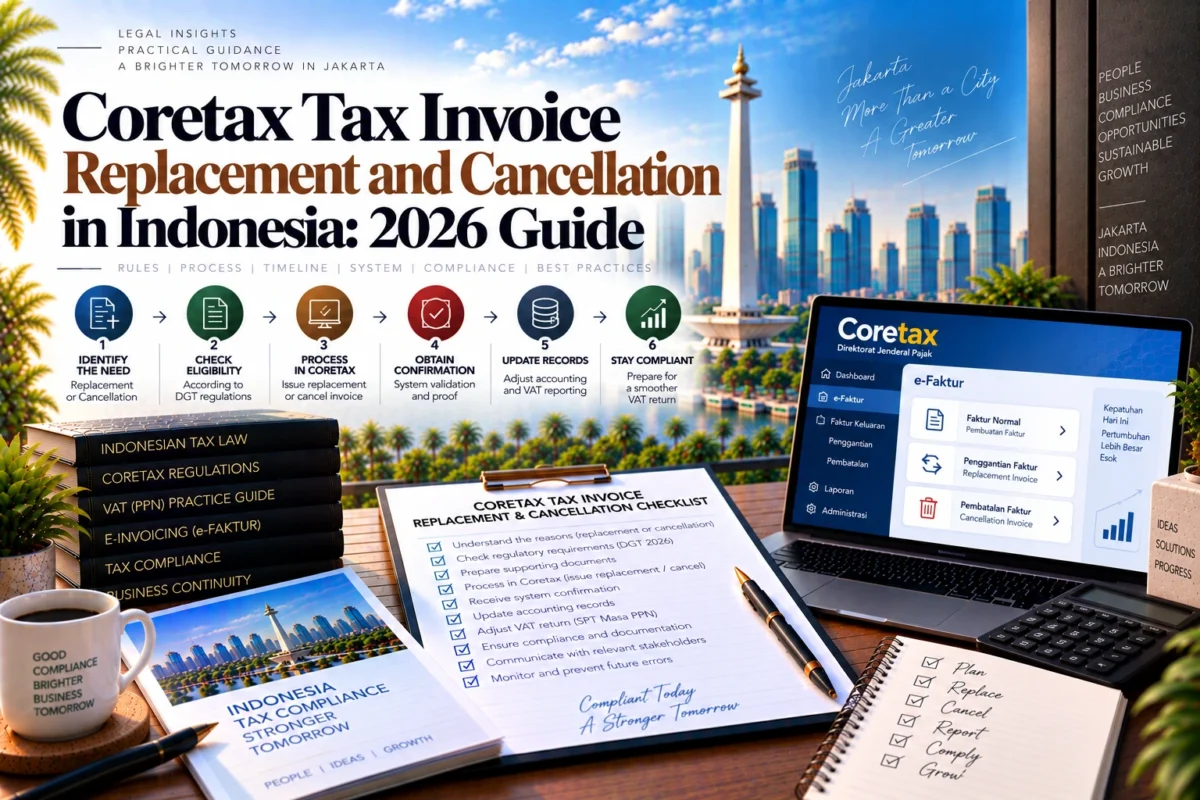
Replacing and cancelling a tax invoice are not interchangeable actions in Coretax. The correct route depends on what is wrong with the original document and whether the underlying transaction still exists.
For businesses researching coretax tax invoice cancellation indonesia, the most important first step is to classify the problem before changing the invoice. A normal data-entry error can fall within the replacement process, while a cancelled transaction or an incorrect buyer identity can require cancellation instead.
The legal framework is PER-11/PJ/2025, read together with PER-12/PJ/2026, effective from 1 October 2026. The 2026 amendment adds VAT-return correction and overpayment-balance rules, so finance teams should check those reporting consequences alongside the invoice replacement and cancellation rules.
For broader implementation support, Jakarta Legal ID’s Financial & Tax Consulting service covers tax processing, bookkeeping and financial reporting, while its Accounting Services for SMEs guide provides additional context on VAT reporting and financial records.
Coretax Tax Invoice Cancellation Indonesia: Replace or Cancel?
Use replacement when the transaction itself remains valid but the invoice contains a correctable entry or writing error. Use cancellation when the underlying transaction is cancelled, when an invoice should not have been issued, or when the error concerns the identity of the actual buyer or service recipient.
That distinction matters because cancelling a valid transaction document and replacing a document that should have been cancelled can create different downstream effects for the seller, the buyer and the VAT return.
When to Use a Replacement Tax Invoice
Replacement is the correction route for an invoice that still represents a real transaction but contains incorrect information within the scope allowed by the regulation.
Under Article 48 of PER-11/PJ/2025, a PKP may correct an invoice that contains an entry or writing error and therefore does not contain correct, complete and clear information by issuing a replacement tax invoice.
Examples can include an incorrect transaction description, amount or other invoice information where the underlying supply remains valid, subject to the specific facts and applicable tax treatment.
Replacement Does Not Cover Buyer-Identity Errors
One of the most important current distinctions is buyer identity.
The same Article 48 expressly excludes errors in the identity of the buyer of taxable goods or recipient of taxable services from that ordinary replacement-invoice rule.
This means a finance team should not automatically choose “replacement” merely because the error looks like a typing mistake. If the mistake changes who the legally identified buyer or recipient is, the cancellation rules need to be reviewed instead.
Replacement Stays in the Original VAT Period
Creating the replacement later does not move the transaction into a new reporting period.
PER-11/PJ/2025 also requires the replacement invoice to be reported in the same VAT tax period as the invoice being replaced, using the corrected information.
Article 50 of PER-11/PJ/2025 states that a replacement invoice can be made only while the VAT return for the period in which the original invoice was reported can still be submitted or amended under the applicable tax rules.
Operationally, this is why the team should identify the original invoice period before making the correction. A replacement can require reconciliation back to an earlier reporting period rather than simply being treated as a current-month adjustment.
When a Tax Invoice Must Be Cancelled
Cancellation applies when the original invoice should no longer represent a valid invoiced transaction in its existing form.
Under Article 49 of PER-11/PJ/2025, a PKP must cancel a tax invoice where the underlying taxable-goods or taxable-services transaction is cancelled or where the goods or services should not have been invoiced in the first place.
Cancelled Transactions
If the supply itself is cancelled after the tax invoice has already been made, the document should not continue to stand as though the transaction occurred unchanged.
Before processing the cancellation, finance should reconcile the commercial evidence: purchase cancellation, contract termination, refund or reversal documentation, delivery status and any related accounting entries. This helps establish that the Coretax action matches what actually happened commercially.
A cancellation should not be used merely to correct an ordinary typo while leaving the transaction intact. That type of case should first be assessed against the replacement rules.
Wrong Buyer Identity
Buyer-identity errors follow a stricter path than ordinary invoice-entry errors.
For an invoice with an incorrect buyer or service-recipient identity, Article 49 requires cancellation and then creation of a new invoice containing the actual buyer or recipient identity.
This distinction is especially important where two related companies, branches or entities have similar names. The invoice should identify the party that actually received the taxable supply rather than the party that happened to be selected in a master-data list.
What Happens If the Invoice Was Already Reported?
Cancellation can affect more than the seller’s invoice list once the original document has entered VAT reporting.
Article 50 of PER-11/PJ/2025 confirms that when a cancelled invoice has already been reported by both seller and buyer, each party must amend the VAT return for the original tax period.
That is an important control point. The seller should not treat the Coretax cancellation as automatically completing every reporting consequence, and the buyer should not continue relying on input tax connected with a document that has been cancelled without reviewing the applicable correction.
The same principle applies to replacement invoices. If the correction changes amounts or other data that have already flowed into the VAT return, the finance team should reconcile the original reporting period and determine whether an amendment is required.
VAT-Return Corrections from 1 October 2026
PER-12/PJ/2026 adds Article 29B, which permits VAT-return corrections subject to the conditions on examinations and open preliminary-evidence examinations. Article 29C addresses the effect on carried-forward VAT overpayment balances. Where a corrected return changes an overpayment carried forward, the resulting balance adjustment is taken into account in the first normal VAT return that has not yet been submitted after the corrected period. Check both the original return and the later overpayment balance when reconciling a replacement or cancellation.
Practical Coretax Workflow Before You Change an Invoice
A disciplined exception workflow can reduce avoidable second corrections.
First, identify the original invoice and the tax period in which it belongs. Second, determine whether the underlying transaction still exists. Third, classify the error: ordinary invoice information, buyer identity, transaction cancellation or invoice issued for something that should not have been invoiced. Fourth, check whether the seller and buyer have already included the invoice in their VAT reporting. Fifth, choose replacement or cancellation according to the applicable rule. Sixth, complete the Coretax action and verify the resulting document status. Finally, reconcile the change to the sales ledger, accounts receivable, customer documentation and VAT return.
For current system-level guidance, DJP maintains Coretaxpedia, including topics on invoice approval, input-tax crediting and the status of invoices waiting for amendment or cancellation.
The system step should come after the tax analysis, not before it. Clicking the wrong exception route can make reconciliation harder if the underlying reason for the change has not been documented.
Accounting and Counterparty Controls
Replacement and cancellation should be visible in both tax and accounting records.
The seller should retain the reason for the correction, evidence supporting the changed transaction status, the original document reference and the resulting replacement or cancellation record. Where amounts change, the accounting adjustment should be traceable to the VAT adjustment.
The buyer should also be notified where the change affects its invoice record or input-tax position. This is particularly important when the buyer has already closed its monthly accounts or filed its VAT return.
For businesses with recurring invoice corrections, the underlying cause should also be reviewed. Frequent buyer-identity errors may point to weak customer master data. Repeated amount corrections may indicate a problem between sales, billing and tax systems. Frequent transaction cancellations may require better cut-off controls before tax invoices are approved.
The practical goal is not only to fix one invoice. It is to reduce the likelihood that the same exception will occur in the next reporting period.
Conclusion
Coretax tax-invoice replacement and cancellation solve different problems. Replacement generally applies when a real transaction remains valid but the invoice contains a correctable entry or writing error. Cancellation applies when the transaction itself is cancelled, the invoice should not have existed, or the buyer identity is wrong.
Before changing an approved invoice, confirm what happened commercially, identify the original VAT period, check whether seller and buyer have already reported the document, and then use the route required by PER-11/PJ/2025. The strongest workflow ends with accounting and VAT-return reconciliation rather than with the Coretax status change alone.
Review the VAT Impact Before Correcting a Coretax Invoice
If your business needs to correct or cancel a Coretax tax invoice and determine the resulting VAT-reporting impact, Jakarta Legal ID can be consulted to review the broader tax and accounting position.
For help organising invoice records, VAT reconciliations and supporting documents, review our Financial & Tax Consulting service and agree the required scope before any filing or correction. Where formal taxpayer representation is needed, confirm that an appropriately authorised professional handles it.
read more: Business Finance in Indonesia: Accounting, Tax and Reporting Guide
FAQ Coretax Tax Invoice Cancellation Indonesia
What is the difference between a replacement and a cancelled tax invoice in Coretax?
A replacement generally corrects an invoice for a valid underlying transaction where permitted information is wrong. Cancellation is used where the transaction is cancelled, the invoice should not have been issued, or the buyer or service-recipient identity is incorrect.
Can an incorrect buyer name or identity be fixed with a replacement invoice?
PER-11/PJ/2025 excludes buyer or service-recipient identity errors from the ordinary replacement route. Article 49 requires the incorrect invoice to be cancelled and a new invoice to be issued with the actual buyer or recipient identity.
Does a replacement tax invoice move the transaction into the month in which the replacement is created?
No. PER-11/PJ/2025 requires the replacement invoice to be reported in the same VAT tax period as the original invoice, using the corrected information.
What happens if a cancelled invoice has already been reported in the VAT return?
Article 50 of PER-11/PJ/2025 confirms that if seller and buyer have already reported the invoice, both parties must amend the VAT return for the original tax period as applicable.
Should the Coretax cancellation be processed before checking accounting records?
The safer operational approach is to first confirm the commercial reason for the change, original tax period, buyer identity and reporting status. The Coretax action should then be reconciled with the sales ledger, customer records and VAT return.
References & Sources
- PER-11/PJ/2025 — Current VAT and Tax-Invoice Reporting Rules — jdih.kemenkeu.go.id
- PER-11/PJ/2025 Full Text — Replacement and Cancellation Articles — jdih.kemenkeu.go.id
- PER-12/PJ/2026 — VAT-Return Corrections and Overpayment Balances — pajak.go.id
- Coretaxpedia — Official DJP Operational Guidance — pajak.go.id
Recommended Next Articles
- accounting and VAT reporting for SMEs — jakartalegalid.com