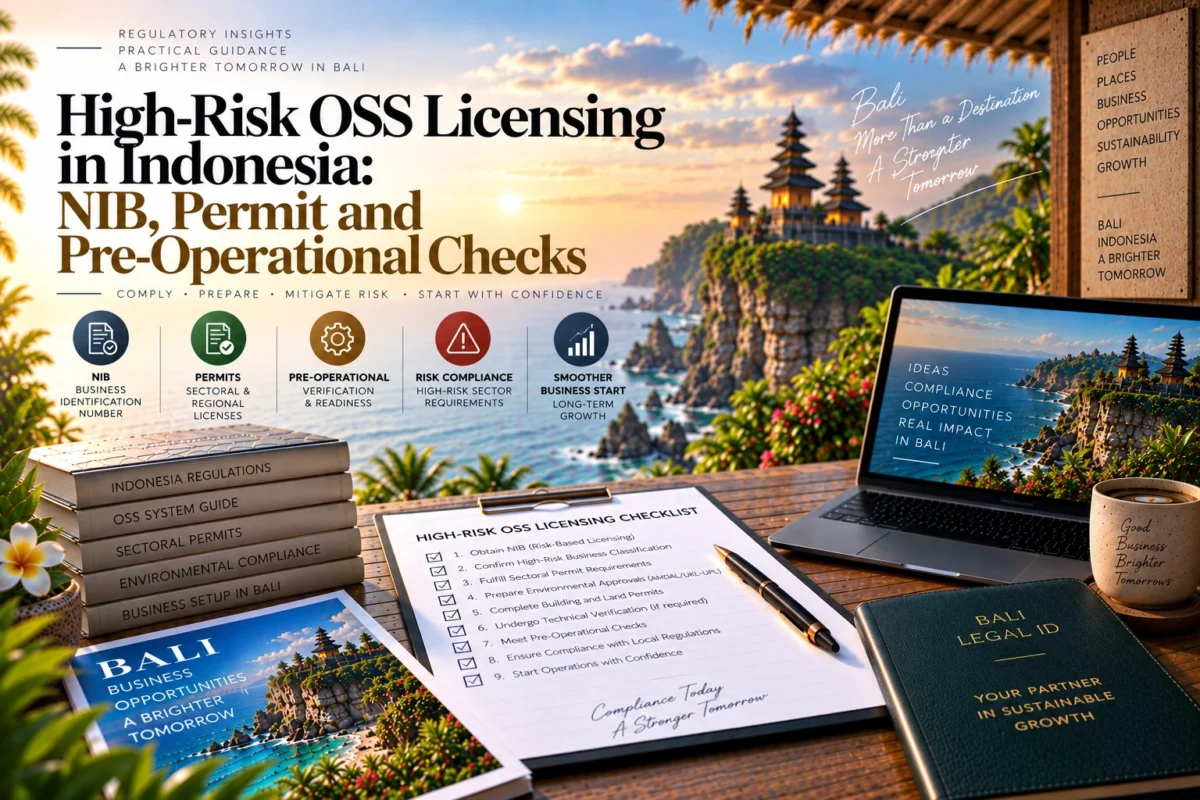
For high risk OSS licensing Indonesia, an NIB alone is not the full operational licence. The current framework requires NIB + Permit, and the NIB issued during the ordinary high-risk pathway provides only limited legality for preparation until the applicable Permit requirements are fulfilled.
The official BKPM legal database lists Government Regulation No. 28 of 2025 as in force from 5 June 2025 and as the current overarching framework for Risk-Based Business Licensing.
High Risk OSS Licensing Indonesia: The Core Rule
Under Article 186 of Minister of Investment and Downstream Industry/Head of BKPM Regulation No. 5 of 2025, high-risk Business Licensing consists of an NIB and a Permit.
That two-part structure is the starting point for project planning. The NIB identifies and registers the business, but the high-risk pathway has an additional Permit stage before the ordinary operational or commercial phase.
The official BKPM JDIH lists Minister of Investment and Downstream Industry/Head of BKPM Regulation No. 5 of 2025 as in force and records that it revoked BKPM Regulations Nos. 3, 4 and 5 of 2021.
Why an NIB Alone Is Not Operational Approval
The most important distinction in high-risk licensing is between preparation legality and operational or commercial legality.
For the ordinary high-risk pathway, Article 201 provides that a business actor that has fulfilled the applicable basic requirements applies for an NIB and Permit as its Business Licensing.
At the initial OSS stage, the business actor also submits the required declarations concerning K3L, SPPL and willingness to satisfy the Permit requirements and obligations applicable under the risk-based licensing framework.
Critically, Article 201 states that this NIB provides limited legality for business-preparation activities and cannot be used to conduct operational and/or commercial activities.
That means a company should not set its operational-readiness date merely from the date on which the NIB appears in OSS. The licensing plan should follow the Permit through to the stage that legally supports operations.
Step 1 — Complete the Applicable Basic Requirements
The ordinary high-risk Permit pathway starts after the applicable basic requirements have been fulfilled.
Which basic requirements apply depends on the actual project and location. Instead of assuming that one generic checklist applies to every high-risk business, the company should review the current OSS output and project-specific dependencies before major site, construction or operating commitments are fixed.
This is particularly important for industrial, infrastructure, mining and other regulated projects because a licensing schedule can be affected by location, environmental and technical matters that exist alongside the core OSS Permit workflow.
Step 2 — Submit the Permit Requirements Through OSS
Receiving the preparation-stage NIB does not automatically complete the Permit application.
To move from preparation into the Permit stage, Article 202 requires the business actor to submit the applicable Permit requirements through the OSS system.
The regulation also provides for OSS notifications concerning the fulfilment of those requirements. From a project-management perspective, the safer approach is to prepare the substantive Permit file early rather than waiting until the intended commercial-start date is close.
A high-risk project budget should therefore separate company establishment, NIB issuance, basic requirements, Permit requirements and supporting licensing instead of treating them as one administrative milestone.
Step 3 — Complete Verification and Any Required Corrections
High-risk Permit requirements are subject to substantive review by the competent authority.
Once the Permit requirements are considered complete and correct, Article 202 directs the competent ministry, regional authority or other designated authority to carry out verification.
Under Article 203, verification can result in approval, a request for correction or rejection of the Permit requirements.
Where correction is requested, Article 203 generally allows the business actor to correct the Permit requirements up to two times, with 10 days for each correction.
This makes document quality a scheduling issue, not merely an administrative issue. A project that assumes immediate approval without allowing time for authority comments or correction can create avoidable pressure on procurement, leases, construction or launch dates.
Step 4 — Resolve Applicable Payments and Technical Attachments
Not every Permit has the same supporting requirements. The current framework expressly accommodates additional conditions where the relevant Permit requires them.
If the Permit requirements include PNBP or a regional levy under the applicable legislation, Article 204 requires that payment requirement to be fulfilled.
Where the Permit requires a technical attachment, Article 205 states that the technical attachment forms an inseparable part of the Permit.
The practical implication is that investors should not budget only for the OSS filing itself. Before fixing the total licensing budget, identify whether the activity’s Permit requires official charges, technical documentation, professional studies or other activity-specific evidence.
Step 5 — Obtain the Permit Before Operations or Commercial Activity
The key operational milestone is the issued Permit, not merely the preparation-stage NIB.
After the required approval process, Article 206 provides that OSS issues the Permit and updates the NIB, and the issued Permit becomes the legality for carrying out operational and/or commercial activities.
This creates a clear internal control for high-risk projects: before the business moves from preparation into ordinary operations or commercial activity, confirm that the Permit status and any relevant supporting requirements have reached the necessary stage in OSS.
Do not rely only on screenshots, draft applications or an NIB number when approving a commercial launch. Review the live licensing output for the specific activity.
Check PB UMKU and Sector-Specific Licensing Separately
The core high-risk Permit does not necessarily answer every licensing question associated with a regulated business.
The same regulation also provides that PB UMKU must be obtained where it is required to support the business at the operational and/or commercial stage, so a completed core Permit does not automatically eliminate every supporting licence.
For example, construction, mining and industrial projects may involve additional sector-specific instruments whose applicability depends on the exact activity and regulatory framework. These should be mapped separately instead of assuming that the words ‘high risk’ identify every document the company will need.
Jakarta Legal ID’s existing NIB and OSS registration guide provides the broader four-tier OSS context, while this page focuses specifically on the high-risk Permit stage.
For businesses that need implementation support, Jakarta Legal ID currently lists PT PMA/PMDN setup, SBU certification, mining licences and industrial licences among its business licensing services.
High-Risk Pre-Operational Checklist
Use the following table as a decision check before a high-risk project is treated as ready for launch. It is a planning tool rather than a substitute for the activity-specific OSS output.
| Check | Ready when | Warning sign |
|---|---|---|
| Business activity | Actual commercial activity is clearly defined | Project relies on a generic or borrowed activity description |
| Risk classification | Current OSS result confirms high risk | Risk level is assumed from an old project or another company |
| Basic requirements | Applicable requirements have been addressed | Permit work starts while major dependencies remain unresolved |
| NIB status | NIB is understood as preparation-stage legality where applicable | NIB is being treated as permission for commercial operations |
| Permit requirements | Complete substantive requirements are ready in OSS | The team expects Permit issuance without preparing the underlying evidence |
| Verification | Authority review is included in the timeline | Launch assumes no correction or verification stage |
| Corrections | Internal team can respond within the applicable correction process | Missing technical information must still be created after comments arrive |
| Charges | Applicable PNBP or regional levy has been checked | Budget assumes all government processing is cost-free |
| Technical attachments | Required technical attachments are complete | Project treats technical evidence as optional |
| Permit issuance | Current OSS output shows the required Permit status | Only an NIB or draft application is available |
| PB UMKU | Supporting operational licences have been mapped where required | Core Permit is assumed to replace every sector requirement |
| Launch decision | Legal and operational teams agree the licensing milestones are complete | Commercial commencement is driven only by construction or sales timing |
If any warning sign remains unresolved, verify the relevant OSS and sector-specific requirement before fixing the operational or commercial start date.
Conclusion
High risk OSS licensing in Indonesia is not complete when an NIB is issued. Under the current framework, the core Business Licensing consists of an NIB and a Permit, and the ordinary high-risk NIB provides limited legality for preparation rather than authorization for operational or commercial activity.
A sound pre-operational plan therefore tracks the process through basic requirements, Permit submission, verification, corrections where necessary, applicable payments or technical attachments, Permit issuance and any required PB UMKU or sector-specific licensing. For industrial, mining and other regulated projects, that distinction can materially affect the realistic launch schedule.
Review the High-Risk Licensing Path Before Launch
If your Jakarta project involves a regulated industrial, mining, construction or other high-risk activity, Jakarta Legal ID provides PT PMA/PMDN setup, SBU certification, mining licence and industrial licence services within its current service scope.
Request a consultation to map the NIB, Permit and activity-specific licensing stages before the operational or commercial launch date is finalized.
FAQ – High Risk OSS Licensing Indonesia
What licences are required for a high-risk OSS activity?
Under the current core risk-based licensing framework, a high-risk activity requires an NIB and a Permit. Additional basic requirements, PB UMKU or sector-specific requirements may also apply depending on the activity.
Can a high-risk business operate after receiving only an NIB?
In the ordinary high-risk pathway, the NIB issued at the preparation stage provides limited legality for preparation and cannot be used for operational or commercial activities. The relevant Permit process must be completed.
How is a high-risk Permit obtained through OSS?
After the applicable basic requirements, the business submits the Permit requirements through OSS. The competent authority verifies the requirements, after which they can be approved, returned for correction or rejected.
Can a high-risk Permit application be corrected after verification comments?
The current implementation regulation generally allows up to two corrections where correction is requested, with 10 days for each correction, subject to the specific regulatory framework applicable to the activity.
Can a high-risk Permit require government fees or technical documents?
Yes, where applicable legislation makes PNBP or a regional levy a Permit requirement, that payment must be fulfilled. A Permit may also require a technical attachment, which becomes part of the Permit.
Does the high-risk Permit replace PB UMKU?
Not automatically. Where PB UMKU is required to support the activity at the operational or commercial stage, it must be obtained separately under the applicable requirements.
References & Sources
- Government Regulation No. 28 of 2025 on Risk-Based Business Licensing — jdih.bkpm.go.id
- Minister of Investment and Downstream Industry/Head of BKPM Regulation No. 5 of 2025 — Official JDIH Record — jdih.bkpm.go.id
- Minister of Investment and Downstream Industry/Head of BKPM Regulation No. 5 of 2025 — Official Full Text — jdih-storage.bkpm.go.id
- Jakarta Legal ID NIB and OSS Registration Guide — jakartalegalid.com
- Jakarta Legal ID Business Licensing Services — jakartalegalid.com
Recommended Next Articles
- NIB and OSS registration guide for Indonesian businesses — jakartalegalid.com