A low-risk business in Indonesia can generally begin operating once its NIB has been issued, but NIB-only licensing does not mean the company has no further compliance obligations. The business must continue to follow the commitments, sector obligations, reporting duties and supporting approvals that apply to its actual activity.
Indonesia’s current risk-based licensing framework is Government Regulation No. 28 of 2025, which the official BKPM legal database lists as in force.
Low Risk Business Obligations After NIB: The Short Answer
For a genuinely low-risk activity, the NIB is the core Business Licensing document. There is no Standard Certificate or separate core business permit simply because the activity has been classified as low risk.
Under Article 186 of Minister of Investment and Downstream Industry/Head of BKPM Regulation No. 5 of 2025, low-risk Business Licensing consists of an NIB.
That answers only the core licensing question. After issuance, the business still needs to ask:
- Are the K3L commitments being followed?
- Are the SPPL commitments reflected in actual operations?
- Does the specific KBLI carry continuing obligations?
- Does an operational activity require PB UMKU?
- Does the company have an LKPM reporting obligation?
- Have the business activity, location, scale or operating facts changed?
This is the difference between obtaining a licence and maintaining a compliant business.
What a Low-Risk NIB Actually Authorizes
For a low-risk activity, Article 220 of Government Regulation No. 28 of 2025 provides that the NIB is issued automatically after the applicable OSS requirements are fulfilled and serves as the legality for conducting the business activity while also functioning as the SPPL.
The same Article 187 states that a low-risk business actor that has obtained its NIB has the legality to undertake preparation, operational and/or commercial activities.
This is an important distinction from medium-high or high-risk activities, where further verification or a separate permit can be required before full operations.
For a correctly classified low-risk activity, the NIB is therefore not merely a preliminary registration document. It is the applicable Business Licensing instrument for that activity.
But the business should not read that statement as permission to ignore obligations embedded in the OSS process or rules outside the core Business Licensing document.
The NIB Comes With Compliance Commitments
The low-risk issuance process itself shows why compliance does not end when the NIB appears in OSS.
Before the NIB is issued, Article 187 of the current OSS implementing regulation requires the low-risk business actor to declare its commitment to K3L, SPPL and the business-activity obligations prescribed under the risk-based licensing framework.
OSS then issues the NIB together with the relevant SPPL and commitment statements.
The practical consequence is that a company should keep those declarations in its compliance file and translate them into actual operating controls. Do not archive the NIB while ignoring the documents and obligations generated alongside it.
K3L Commitments
K3L covers security, safety, health and preservation of environmental functions. The exact operational impact depends on the activity.
For an office-based service company, the practical controls can differ significantly from those of a business operating equipment, handling products or using a customer-facing facility. The correct approach is to review the obligations generated for the actual KBLI and operating model rather than applying a generic checklist.
SPPL Commitments
SPPL should also be treated as an ongoing environmental commitment rather than as a document that matters only at registration.
Even where the low-risk NIB functions as the relevant SPPL, actual operations should remain consistent with the assumptions and commitments underlying the registered activity.
If the operation later becomes materially different—for example because of a new site, new production activity or a change in the environmental footprint—the business should reassess whether the existing licensing and environmental position is still appropriate.
NIB-Only Licensing Does Not Always Mean No PB UMKU
One of the most useful distinctions is between Business Licensing and Business Licensing to Support Business Activities, or PB UMKU.
Low risk also does not eliminate every supporting approval: Article 186 paragraph (5) requires PB UMKU where supporting legality is needed for the operational and/or commercial stage.
This does not mean every low-risk company automatically needs PB UMKU. It means that the phrase ‘low risk = NIB only’ describes the core risk-based Business Licensing instrument, not necessarily every supporting legality that could become relevant to the business model.
For example, a company’s core service activity can be low risk while a separate supporting activity, product, facility or regulated operational feature creates another approval requirement.
The safest method is to inspect the live OSS output for the exact five-digit KBLI and actual scope rather than relying on a general statement that low-risk companies never need anything beyond the NIB.
Check Whether LKPM Applies to Your Business
Investment reporting is another obligation that should be reviewed independently from the licensing risk category.
For investment reporting, Article 285 of Regulation No. 5 of 2025 requires LKPM for each business activity and location after the business actor obtains an NIB, subject to the exemptions and reporting frequencies in the following article.
Under Article 286, micro-scale businesses are exempt from this LKPM obligation, small businesses report every six months, and medium and large businesses report every three months.
This means risk level and reporting scale are separate questions. A business activity can be low risk for licensing purposes while the company still has an LKPM obligation because of its business scale.
The following table is useful for the initial reporting check.
| Business scale | General LKPM position under Article 286 |
|---|---|
| Micro | Exempt from the investment-realization LKPM obligation discussed here |
| Small | Reporting every six months |
| Medium | Reporting every three months |
| Large | Reporting every three months |
The practical implication is that receiving a low-risk NIB should trigger a separate reporting review. Do not infer LKPM status from the word ‘low risk’ alone.
Government Supervision Continues After NIB Issuance
Risk-based licensing reduces unnecessary pre-operation licensing for lower-risk activities, but it does not remove government oversight.
Post-NIB compliance remains subject to supervision because Article 284 of Regulation No. 5 of 2025 provides for review of compliance with basic requirements, Business Licensing, PB UMKU and investment obligations.
The official BKPM legal database lists Minister of Investment and Downstream Industry/Head of BKPM Regulation No. 5 of 2025 as in force and records that it repealed BKPM Regulations Nos. 3, 4 and 5 of 2021.
A business should therefore be able to demonstrate more than possession of an NIB. Its current operations, OSS data, supporting approvals and reporting should still match the licensed activity.
Review OSS When the Business Changes
An NIB that was correct on the incorporation date can become incomplete if the business itself changes.
Useful review triggers include:
- adding a materially different business activity
- opening another project or operating location
- introducing a regulated product or service
- increasing operations in a way that changes the relevant licensing assumptions
- adding a facility requiring its own supporting approval
- changing important business data recorded in OSS
Not every operational adjustment requires a new NIB. The point is to reassess the licensing profile when the facts used to obtain the existing Business Licensing no longer describe the real business.
The review should start from the current KBLI, location and OSS-generated requirements rather than from the company’s marketing description.
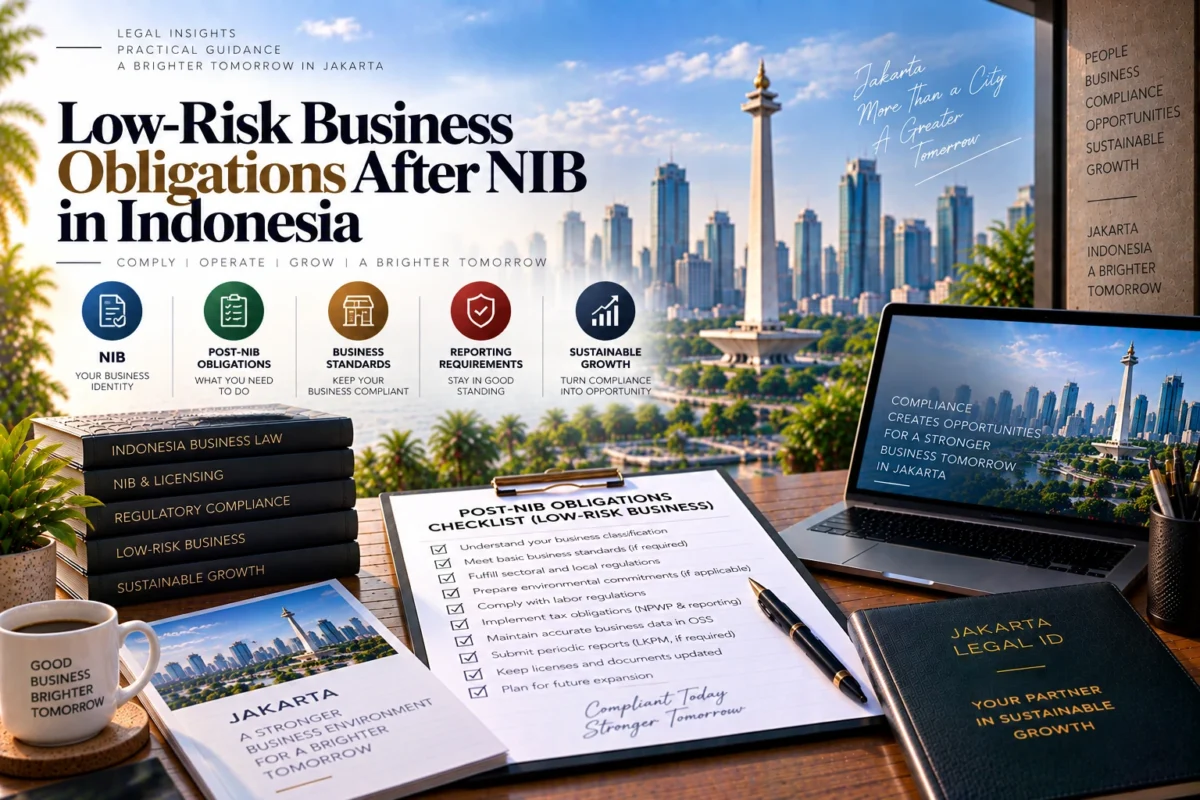
Post-NIB Compliance Checklist
The checklist below helps a low-risk business distinguish completed registration from ongoing compliance.
| Check | Post-NIB question |
|---|---|
| NIB | Does the NIB still describe the current business actor and activity? |
| KBLI | Does the registered activity still match the service or product actually sold? |
| K3L | Are the declared safety, health and environmental commitments being followed? |
| SPPL | Are actual operations consistent with the environmental commitments generated through OSS? |
| Business obligations | Have the obligations attached to the exact activity been reviewed? |
| PB UMKU | Does any supporting operational or commercial activity require separate legality? |
| LKPM | Is the business exempt, semiannual or quarterly based on its current scale? |
| Locations | Are all relevant business or project locations correctly reflected? |
| Operational changes | Has any expansion or new activity changed the licensing position? |
| Records | Can the business produce the current NIB, commitment documents, supporting approvals and reporting evidence? |
A business that can answer those questions clearly is in a stronger position than one that treats the downloaded NIB PDF as the entire compliance program.
Jakarta Legal ID’s NIB and OSS registration guide provides broader context on the initial risk-based licensing process.
For businesses that need implementation support, Jakarta Legal ID currently lists PT PMDN/PMA setup, NIB OSS, business licensing, tax and bookkeeping within its service scope.
Conclusion
For a low-risk business, the NIB is the core Business Licensing instrument and can provide legality for operational and commercial activity. That is why the low-risk path is simpler than the licensing route for higher-risk activities.
The simplicity of the licence should not be confused with the absence of ongoing obligations. K3L, SPPL, activity-specific commitments, conditional PB UMKU, investment reporting and supervision can remain relevant after issuance.
The practical rule is to treat the NIB as the starting document for ongoing compliance, not the final item in the company’s regulatory file. Review the live OSS activity, maintain the commitments generated with the NIB and reassess the licence whenever the business model materially changes.
Check What Still Applies After Your NIB Is Issued
If your company already has an NIB but you need to confirm its current OSS activities, supporting licences or reporting position, Jakarta Legal ID provides NIB OSS, business licensing, tax and bookkeeping services within its current service scope.
Request a consultation to review the existing licensing profile against the company’s current activities, locations and business scale.
FAQ – Low Risk Business Obligations After NIB
Can a low-risk business operate immediately after receiving its NIB?
Under the current risk-based licensing framework, a low-risk NIB provides legality for preparation, operational and commercial activity once the applicable OSS requirements have been fulfilled.
Does a low-risk business need a Standard Certificate?
The core Business Licensing instrument for a low-risk activity is the NIB. A Standard Certificate is part of the medium-risk licensing structure rather than the low-risk core licence.
Does NIB-only mean there are no other obligations?
No. Low-risk issuance includes commitments concerning K3L, SPPL and applicable business obligations. Supporting PB UMKU, investment reporting and other requirements can also apply depending on the business facts.
Can a low-risk business still need PB UMKU?
Yes, where supporting legality is required for an operational or commercial activity. The need should be checked against the exact activity and OSS output rather than assumed solely from the core low-risk classification.
Do low-risk companies have to file LKPM?
Risk level alone does not determine the answer. Under the current reporting rules, micro businesses are exempt from the investment-realization LKPM obligation discussed here, small businesses report every six months, and medium and large businesses report quarterly.
When should an existing NIB be reviewed?
Review the licensing profile when the company changes its actual activities, project locations, scale, facilities or other facts that may affect the registered OSS requirements.
References & Sources
- Government Regulation No. 28 of 2025 on Risk-Based Business Licensing — jdih.bkpm.go.id
- Government Regulation No. 28 of 2025 — Official Full Text — peraturan.go.id
- Minister of Investment and Downstream Industry/Head of BKPM Regulation No. 5 of 2025 — jdih.bkpm.go.id
- Minister of Investment and Downstream Industry/Head of BKPM Regulation No. 5 of 2025 — Official Full Text — peraturan.go.id
- OSS Guide — Low-Risk and Medium-Low-Risk Business Licensing Application — oss.go.id
- Jakarta Legal ID NIB and OSS Registration Guide — jakartalegalid.com
- Jakarta Legal ID High-Risk OSS Licensing Guide — jakartalegalid.com
- Jakarta Legal ID Company Setup and Licensing Services — jakartalegalid.com
Recommended Next Articles
- NIB and OSS registration guide for Indonesian businesses — jakartalegalid.com
- high-risk OSS licensing requirements in Indonesia — jakartalegalid.com