Indonesia’s business licensing system does not apply exactly the same licensing document to every business activity. The required pathway depends on the activity, its risk classification, applicable standards, business location, and other regulatory parameters.
For business owners and foreign investors researching OSS RBA licensing Jakarta, this distinction is important because obtaining an NIB does not automatically mean every company has completed all requirements needed to begin operational or commercial activities.
Indonesia’s current central framework is Government Regulation No. 28 of 2025 on Risk-Based Business Licensing. The regulation replaced Government Regulation No. 5 of 2021 and defines Risk-Based Business Licensing as licensing based on the risk analysis of each business activity.
OSS RBA Licensing Jakarta Under the Current Regulatory Framework
OSS, or Online Single Submission, is the electronically integrated system used to process Indonesia’s risk-based business licensing framework. The official OSS Indonesia portal currently states that business activities are grouped into four risk levels that determine the licensing documents and obligations a business must fulfill.
Government Regulation No. 28 of 2025 also provides that basic requirements, Business Licensing, and Business Licensing to Support Business Activities can be processed electronically through OSS and integrated with relevant ministries and agencies.
The detailed administrative procedures are further regulated through Minister of Investment and Downstreaming/Head of BKPM Regulation No. 5 of 2025.
For companies in Jakarta, the practical lesson is that OSS should be treated as a licensing workflow rather than simply an NIB-generation portal.
How the Four OSS RBA Risk Levels Work
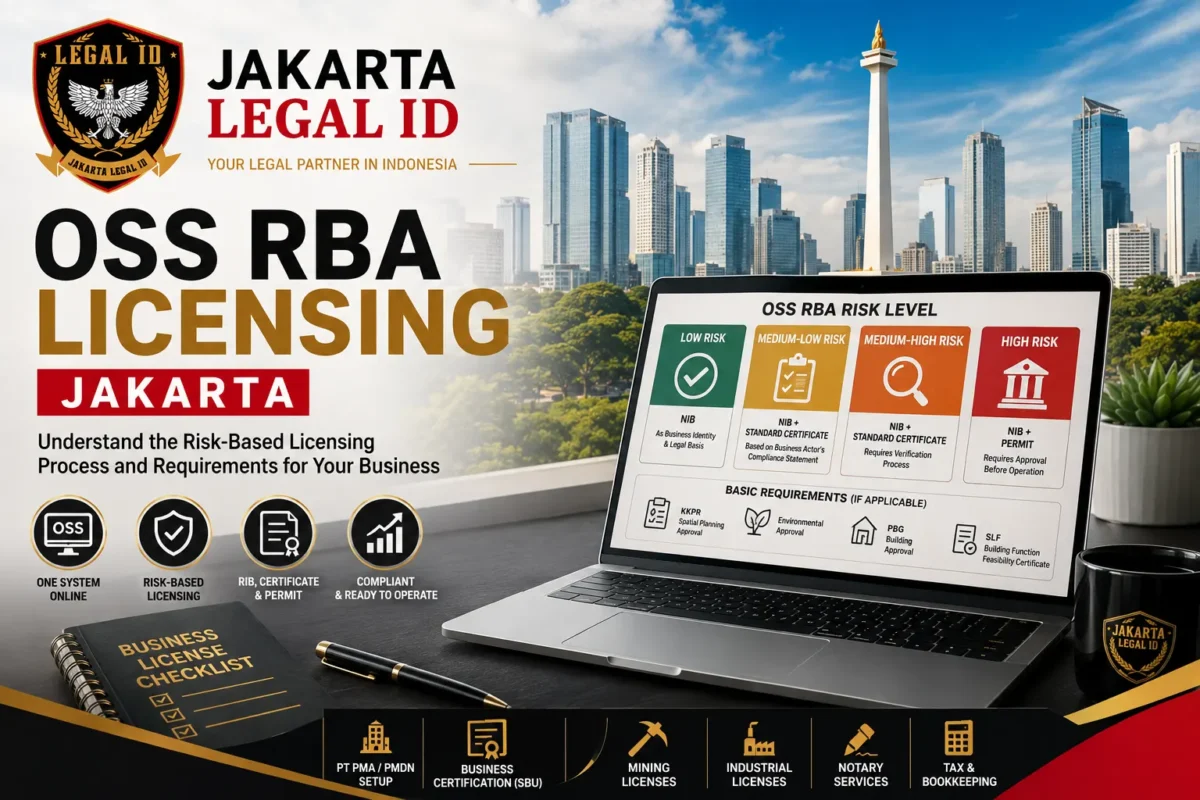
Government Regulation No. 28 of 2025 identifies four practical risk categories:
| Risk level | Principal Business Licensing form |
|---|---|
| Low | NIB |
| Medium-low | NIB and Standard Certificate |
| Medium-high | NIB and Standard Certificate requiring verification |
| High | NIB and Permit |
The relevant risk level is determined from regulatory risk analysis associated with the business activity. The regulation states that identification of the business activity refers to the scope of activity in the KBLI classification.
This means a company should not select a risk category manually based on how dangerous or simple the founders personally consider the business to be. The regulatory classification associated with the activity is what matters.
OSS RBA Licensing Jakarta for Low and Medium-Low Risk Activities
For low-risk activities, Government Regulation No. 28 of 2025 provides that the NIB functions as both the identity of the business actor and the legal basis for conducting the relevant business activity.
For medium-low-risk activities, Business Licensing consists of an NIB and a Standard Certificate. The Standard Certificate represents the business actor’s statement that the applicable business standards will be fulfilled.
The current regulation also distinguishes the processing model. Low and medium-low risk licensing can generally be secured through the OSS process without the verification stage applied to medium-high and high-risk activities.
However, businesses should still examine other obligations associated with the activity. A medium-low-risk business may also have standards, environmental requirements, or Business Licensing to Support Business Activities that must be addressed depending on the applicable regulatory parameters.
Medium-High and High-Risk Activities Require Additional Verification
The process becomes more demanding as the regulatory risk level increases.
For medium-high-risk activities, the Business Licensing consists of an NIB and a Standard Certificate. Unlike the medium-low category, the Standard Certificate is subject to verification under the current framework before the relevant operational or commercial stage can proceed as permitted by the regulation.
For high-risk activities, Business Licensing consists of an NIB and a Permit. After obtaining the NIB, the business actor must fulfill the Permit requirements according to the applicable norms, standards, procedures, and criteria before conducting operational or commercial activities.
This distinction is particularly relevant to regulated sectors where technical standards, environmental requirements, or approvals from competent authorities can be part of the licensing path.
NIB Does Not Always Mean the Licensing Process Is Complete
One of the most important concepts in OSS RBA is the difference between obtaining an NIB and completing the licensing requirements for the specific activity.
An NIB is the registration identity of the business actor within the OSS framework. For low-risk activity, it can also constitute the Business Licensing required for the activity. For medium and high-risk activities, however, additional licensing components apply.
Businesses should therefore verify the status of each registered activity instead of assuming that an issued NIB authorizes every listed KBLI activity to operate immediately.
Jakarta Legal ID’s existing NIB and OSS registration guide provides broader background on company registration, NIB issuance, KBLI selection, and the OSS process. This article focuses more narrowly on how the current risk-based licensing framework determines what comes after business registration.
KBLI, Business Scale, and Location Affect the OSS Result
The licensing result begins with accurate business data.
Government Regulation No. 28 of 2025 connects sector licensing requirements with factors that include:
- KBLI code and activity scope
- Business scale
- Risk level
- Business Licensing requirements
- Licensing authority
- Business Licensing to Support Business Activities where applicable
- Standards and obligations associated with the sector
For this reason, a company should define its real commercial activities before completing the OSS filing.
Using a broad or inaccurate KBLI can create a mismatch between what the company actually intends to do and the licensing requirements generated for that activity.
Companies planning several activities should review each material activity separately because different KBLI codes within one company can lead to different risk levels and licensing requirements.
Basic Requirements Can Apply Before or During the Licensing Process
Government Regulation No. 28 of 2025 identifies basic requirements that can include:
- Spatial Utilization Activity Suitability or KKPR
- Environmental Approval
- Building Approval or PBG
- Certificate of Feasibility for Building Function or SLF
These requirements do not mean that every Jakarta company automatically needs every document listed above. Applicability depends on matters such as business location, activity, environmental characteristics, building use, and the regulatory requirements associated with the project.
For example, a business using an existing commercial location may face a different basic-requirement analysis from a company developing a factory or other new facility.
OSS RBA Licensing Jakarta Pre-Filing Checklist
Before submitting an OSS RBA licensing Jakarta application, business owners should confirm:
- The company’s actual revenue-generating activities
- The appropriate KBLI classification for each material activity
- The business scale recorded in OSS
- The correct project or operating location
- The risk level generated for each activity
- Whether the licensing output is NIB, Standard Certificate, or Permit
- Whether verification is required before operations begin
- Whether KKPR or environmental requirements apply
- Whether PBG or SLF is relevant to the premises or development
- Whether additional PB UMKU or sector-specific approvals are required
This review is especially useful before capital is committed to premises, construction, equipment, or a business activity that may require additional approvals.
OSS RBA Considerations for PT PMA and Foreign Investors
Foreign investors must consider more than risk classification alone.
A PT PMA should first confirm that its actual business activity is reflected in the correct KBLI. The same activity should then be reviewed for foreign-investment eligibility, investment requirements, project location, and OSS licensing consequences.
Jakarta Legal ID’s PT PMA versus local PT comparison explains the ownership and investment-status distinction in more detail.
The practical sequence for foreign investors is therefore:
- Define the intended business activities
- Identify the relevant KBLI classifications
- Review foreign ownership and investment conditions
- Establish the appropriate Indonesian company structure
- Enter the correct business and project data into OSS
- Review the risk classification and licensing output
- Fulfill verification, Permit, basic-requirement, and supporting-license obligations where applicable
Jakarta Legal ID’s verified business setup service covers PT PMDN, PT PMA, NIB, OSS RBA, and corporate setup support for businesses preparing this process.
Common OSS RBA Licensing Mistakes
Businesses can reduce avoidable licensing problems by checking several issues before filing.
Treating NIB as universal permission to operate
The correct licensing outcome depends on the risk level of each activity. Medium-high and high-risk activities involve additional requirements beyond simply obtaining the NIB.
Selecting a KBLI because the title sounds similar
The actual scope of the activity should be reviewed, not only the wording of the KBLI title.
Ignoring verification status
For medium-high-risk activities, obtaining an NIB does not remove the requirement to complete the applicable Standard Certificate verification process.
Overlooking business location requirements
Spatial, environmental, building, and location-related requirements can affect the ability to proceed with a project.
Adding unrelated business activities without checking their consequences
Each material KBLI can introduce a different risk classification, licensing requirement, or supporting obligation.
Using an outdated regulatory assumption
Government Regulation No. 28 of 2025 replaced the previous Government Regulation No. 5 of 2021 framework. Businesses reviewing older incorporation documents, online guides, or legacy OSS projects should confirm how their data is treated under the current system.
For businesses operating in Jakarta, effective OSS planning starts before the application is submitted. The strongest sequence is to verify the activity, KBLI, ownership structure, business location, risk level, and resulting licensing requirements before assuming the company is ready for commercial operations.
Review Your OSS Licensing Path Before Starting Operations
If your Jakarta company has already obtained an NIB but you are unsure whether a Standard Certificate, Permit, basic requirement, or additional supporting license is still required, review the status of each business activity before beginning operations.
Jakarta Legal ID can review the proposed KBLI activities, company structure, risk classification, and OSS licensing path through its verified business setup and OSS RBA service, helping you identify the regulatory steps that apply to the activities you intend to conduct.
FAQ – OSS RBA Licensing Jakarta A Practical Guide to Risk-Based Business Licensing
What is OSS RBA licensing in Indonesia?
OSS RBA is Indonesia’s electronically integrated risk-based business licensing framework. Under Government Regulation No. 28 of 2025, the licensing requirements for a business activity are determined according to its regulatory risk level and other applicable parameters.
What are the four OSS RBA risk levels?
The four practical categories are low risk, medium-low risk, medium-high risk, and high risk. The licensing form becomes progressively more demanding as the regulatory risk level increases.
What does a low-risk business need under OSS RBA?
Under Government Regulation No. 28 of 2025, Business Licensing for a low-risk activity is an NIB, which serves as the business actor’s identity and the legal basis for conducting that low-risk activity.
What is required for a medium-low-risk business?
Medium-low-risk Business Licensing consists of an NIB and a Standard Certificate. The Standard Certificate is based on the business actor’s statement to fulfill the applicable business standards, subject to the requirements governing the activity.
What is required for a medium-high-risk business?
Medium-high-risk Business Licensing consists of an NIB and a Standard Certificate. The Standard Certificate must go through the applicable verification process before the business proceeds as permitted under the current regulatory framework.
What is required for a high-risk business?
High-risk Business Licensing consists of an NIB and a Permit. After obtaining the NIB, the business must fulfill the Permit requirements under the relevant norms, standards, procedures, and criteria before conducting the regulated operational or commercial activity.
Does receiving an NIB mean my company can immediately operate?
Not in every case. An NIB can be sufficient Business Licensing for low-risk activities, but medium and high-risk activities have additional requirements. The company should check the licensing status for each registered activity.
How does KBLI affect OSS RBA licensing?
The risk analysis identifies the business activity by reference to its KBLI scope. Selecting the appropriate KBLI is therefore important because different activities can produce different risk classifications, licensing requirements, standards, and competent authorities.
Does every Jakarta company need KKPR, environmental approval, PBG, and SLF?
No universal requirement should be assumed. Government Regulation No. 28 of 2025 identifies these as basic requirements within the licensing framework, but their applicability depends on factors such as the business activity, project location, environmental characteristics, premises, and development plan.
Do PT PMA companies also use OSS RBA?
Yes. PT PMA companies use the OSS licensing framework for their Indonesian business activities. Foreign investors should review the KBLI, foreign ownership eligibility, investment requirements, project location, and the resulting OSS risk-based licensing requirements together.
References & Sources
- BKPM JDIH — Government Regulation No. 28 of 2025 on Risk-Based Business Licensing
- BKPM JDIH — Minister of Investment and Downstreaming/Head of BKPM Regulation No. 5 of 2025
- OSS Indonesia — Official Risk-Based Business Licensing Portal
- OSS Indonesia — Official NIB Creation Guide
- NIB and OSS registration guide
- PT PMA vs local PT for foreign and domestic investors