
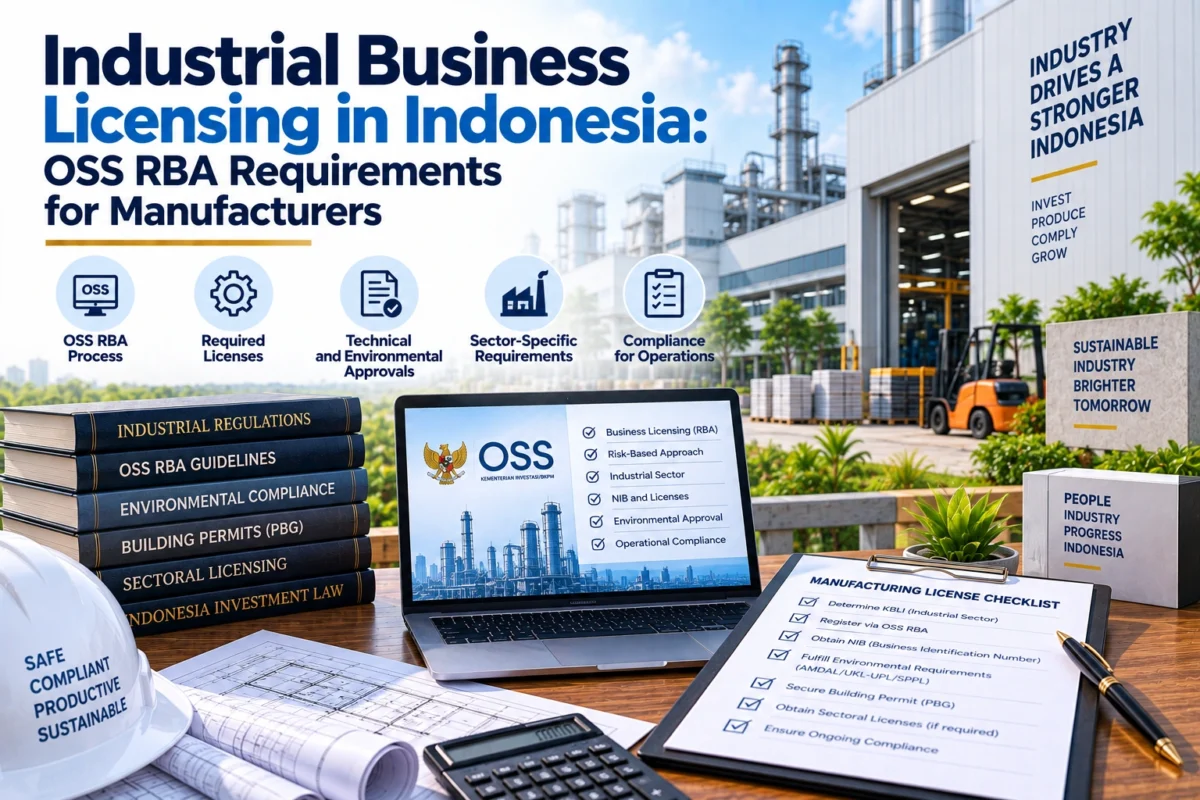
Industrial Business Licensing Indonesia requires companies to align their business activities, KBLI classification, OSS registration, risk level, industrial standards, and any additional approvals required for their manufacturing operations.
Before starting or expanding industrial activities, companies should verify whether their current NIB, Standard Certificate, Permit, industrial-sector requirements, location, environmental approvals, and operational data remain consistent with the actual business activity.
Industrial business licensing Indonesia is not a single-document exercise. A manufacturer may need an Indonesian business entity, the correct industrial activity classification, an OSS record for the actual project location, applicable basic requirements, and sector-specific evidence before commercial operations begin. The exact route depends on what the factory produces, the production process, business scale, location, environmental impact, building use, and other regulated features.
This guide explains how to structure that workstream. It is written for investors and operating companies that need to assess an industrial project before submitting or changing an application in the Online Single Submission Risk-Based Approach system (OSS RBA).
Choose your industrial project guide
Review the manufacturing project as a whole before focusing on a single licence. The following guides address location, expansion, industrial reporting and the underlying OSS process.
- Factory location requirements: reviewing spatial, environmental and building considerations
- Factory expansion: identifying records affected by a changed operation
- SIINas registration and reporting: organising industrial data and periodic reporting
- OSS risk-based licensing: understanding the general application sequence
- Activity classification: reviewing how the production activity should be described
For document preparation and application coordination, review our industrial licenses service scope.
Industrial Business Licensing Indonesia: Start with the real manufacturing activity
The first step is to describe the planned activity in operational terms: input materials, production stages, output products, installed capacity, machinery, storage, utilities, waste streams, and sales model. That description is then compared with the applicable Indonesian Standard Industrial Classification, or KBLI.
A company should not select a KBLI merely because its title sounds commercially attractive. The selected code should correspond to the activities that will actually take place. A mismatch can affect the calculated risk level, business-licensing requirements, foreign-investment analysis, location review, environmental documents, customs facilities, and subsequent inspections. See our KBLI selection guide for issues that should be resolved before filing.
The OSS portal provides an official KBLI search facility. Because classifications, implementing guidance, and the OSS interface can change, the result should be checked against the project facts at the time of submission.
Understand the risk-based licensing result
Indonesia’s current risk-based licensing framework is governed principally by Government Regulation No. 28 of 2025. It replaced Government Regulation No. 5 of 2021. The current regulation is available through the official BPK legal database.
The OSS output depends on the risk classification attached to the chosen activity and project data. Depending on the applicable result, the business may receive or require a Business Identification Number (NIB), a standard certificate, a licence, and supporting approvals or verifications. An NIB should not be treated as universal proof that every manufacturing activity may immediately operate. The status and effectiveness of each required item must be checked.
For an overview of the general workflow, read our OSS RBA licensing guide. Manufacturers should then add a sector-specific review because industrial operations commonly involve additional location, environmental, building, technical, labour, import, distribution, or product obligations.
Map the requirements in parallel
A practical industrial-licensing plan normally has several linked tracks:
- Corporate readiness: confirm that the deed, approvals, shareholder structure, investment status, tax records, and OSS account are consistent.
- Activity and project data: align the KBLI, products, capacity, capital, workforce, address, and coordinates across applications.
- Spatial conformity: verify that the intended industrial use is compatible with the applicable spatial plan and location process.
- Environmental approval: identify whether the project requires an environmental management statement, UKL-UPL, AMDAL, or another applicable instrument.
- Building readiness: confirm whether the factory, warehouse, utilities, and supporting structures have the required building approval and function certification.
- Sector and product requirements: check technical standards, registrations, certifications, distribution controls, and other obligations for the particular product or process.
These tracks should not be handled as isolated checklists. Changing the capacity, process, building footprint, or project location can alter more than one approval at the same time.
Prepare an evidence matrix before submission
Before entering data in OSS, prepare a matrix that identifies each requirement, responsible party, evidence owner, dependency, current status, and expiry date. The matrix may include corporate documents, land or lease evidence, location coordinates, site plans, production-flow diagrams, machinery lists, utility needs, environmental studies, building records, technical personnel, and product information.
This approach reduces inconsistent entries and makes it easier to distinguish an administrative gap from a technical issue that must be handled by an environmental consultant, engineer, architect, or other competent professional.
Common causes of delay
Industrial applications often slow down because the company begins filing before the project facts are stable. Common examples include selecting a generic KBLI, using an address that is not ready for the proposed use, understating production capacity, treating a warehouse and a factory as interchangeable, or assuming that a pre-existing building automatically covers the new operation.
Another frequent problem is relying on a screenshot or issued number without checking the current status of the underlying requirement. For compliance planning, the company should record what was issued, for which activity and location, whether verification is pending, and what operating conditions apply.
Coordinate licensing with company setup
If the Indonesian entity has not yet been established, the industrial-licensing analysis should inform the incorporation documents rather than begin only after incorporation. The planned business activities, foreign ownership, capital, location, and management structure can affect the setup. Our business setup service explains the entity-establishment workstream.
Jakarta Legal ID can coordinate the corporate and administrative side of an industrial project, identify missing records, and help organise the application sequence. Technical studies and authority decisions remain the responsibility of the relevant licensed professionals and government bodies. See our industrial licensing service or contact us with the proposed product, process, capacity, location, and target operating date.
Official references
- Government Regulation No. 28 of 2025
- Law No. 3 of 2014 on Industry, as amended
- Official OSS RBA portal
Related industrial guides
This article provides general information and is not a legal opinion or a guarantee of approval. Requirements must be verified against the current rules, OSS configuration, project facts, and competent authority guidance.