
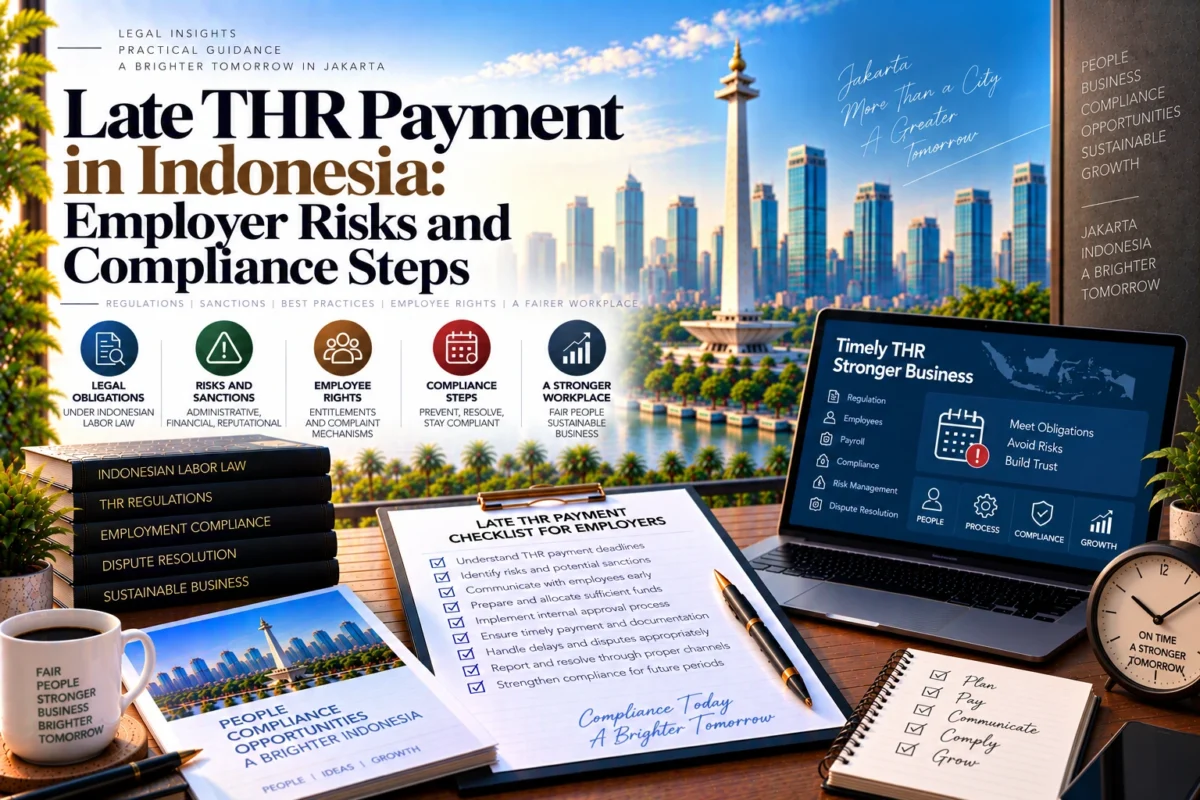
Missing the THR deadline creates more than a payroll timing problem. An employer can remain liable for the full THR, face a statutory late-payment fine, and be exposed to administrative enforcement.
The Ministry of Manpower continues to list Minister of Manpower Regulation No. 6 of 2016 as active, and the regulation requires religious THR to be paid no later than seven days before the relevant religious holiday.
For 2026, the Ministry of Manpower circular reiterates that THR must be paid in full, may not be paid in installments, and is due no later than seven days before the applicable religious holiday.
Late THR Payment Indonesia: What Happens After the Deadline?
For an employer researching late THR payment Indonesia, the immediate consequences can be summarized in three parts: the THR remains payable, a statutory 5% late-payment fine applies, and violations can also enter the administrative-enforcement framework.
The broader wage framework in Article 9 of Government Regulation No. 36 of 2021 also requires employers to provide religious THR and pay it no later than seven days before the religious holiday.
The Ministry’s legal database shows that Government Regulation No. 36 of 2021 remains in force as amended, with Government Regulation No. 49 of 2025 recorded as its second amendment.
For employers, the practical implication is that waiting for a complaint does not cure the missed deadline. The compliance response should begin as soon as the delay is identified.
When Is THR Considered Late?
The deadline is measured against the employee’s relevant religious holiday, not against the company’s ordinary salary date.
If the statutory deadline has passed and the required THR has not been fully paid, the employer should treat the obligation as overdue. The 2026 circular also removes an obvious workaround by stating that THR must be paid in full rather than in installments.
This makes payroll planning important. A company that initiates an internal payment process before the deadline but transfers the employee’s THR only after the deadline still needs to assess the actual timing of payment rather than relying on the date of internal approval.
The 5% Late-Payment Fine
The clearest direct financial consequence appears in Permenaker 6/2016.
Under Article 10 of Permenaker 6/2016, an employer that pays THR late is subject to a fine equal to 5% of the total THR that should have been paid, calculated from the expiry of the employer’s payment deadline.
If the total THR obligation for the affected employee population is IDR 200,000,000, a 5% statutory fine corresponds to IDR 10,000,000. The example is arithmetic only; the employer should first verify the actual THR amount owed to each employee.
The Fine Does Not Replace THR
The 5% amount is an additional consequence, not a discounted settlement of the original obligation.
The same Article 10 states that imposing the 5% fine does not eliminate the employer’s obligation to pay the THR itself.
An employer therefore should not choose between paying THR and paying the penalty. The underlying THR remains due, and the late-payment consequence is assessed on top of that obligation.
Where the Fine Is Used
The regulation also addresses the treatment of the fine rather than leaving it as an undefined charge.
Permenaker 6/2016 further provides that the late-payment fine is managed and used for worker welfare in accordance with the company regulation or collective labor agreement.
Employers should therefore document the treatment of the fine consistently with the applicable internal employment instrument rather than simply recording it as an unexplained payroll adjustment.
Administrative Sanctions Are a Separate Risk
The 5% fine is not the only regulatory exposure associated with failure to meet the THR obligation.
For violations of those THR obligations, Article 79 of Government Regulation No. 36 of 2021 provides staged administrative sanctions consisting of a written warning, restriction of business activities, temporary suspension of part or all production equipment, and freezing of business activities.
Because the regulation provides for staged enforcement, the exact administrative response depends on the enforcement process and facts of the violation. Employers should therefore avoid presenting the 5% payment as automatically ending every regulatory consequence.
This distinction is important internally: payroll may calculate the financial exposure, but management should also consider whether the delay has triggered a complaint, labor inspection or formal administrative process.
What an Employer Should Do Immediately After Missing the Deadline
The fastest useful response is to establish the facts and correct the payment rather than waiting to see whether employees complain.
Calculate and Pay the Outstanding Amount
First, identify every qualifying employee whose THR remains unpaid or underpaid. Recheck service periods and the applicable wage basis, then calculate the outstanding THR and the late-payment fine.
Payment should be completed as promptly as possible. The employer should preserve evidence of the actual transfer date, payment amount and employee population covered so that the remediation can later be reconciled with payroll records.
If only part of the workforce was affected, isolate those employees rather than rerunning the entire payroll without a clear audit trail.
Reconcile Payroll and Supporting Records
Second, document why the payment was late and how it was corrected. Useful records include the original THR calculation, payroll approval, bank-transfer evidence, corrected payment schedule, employee master data and the calculation of the 5% fine.
For employers already using outsourced accounting or payroll support, Jakarta Legal ID’s Accounting Services for SMEs guide provides broader context on payroll administration, bookkeeping and financial reporting.
A written internal chronology can also help management distinguish a one-off banking failure from a recurring payroll-control problem. That distinction matters when designing the prevention steps for the next THR cycle.
Worker Complaints and 2026 Enforcement Channels
Workers do not have to rely only on an internal HR complaint when a THR issue remains unresolved.
For the 2026 payment period, the Ministry circular instructed provincial and regency or city governments to establish THR consultation and enforcement command posts integrated through the Ministry’s THR portal.
The Ministry’s current THR complaint portal states that the dedicated 2026 consultation and complaint window closed on 27 March 2026 and directs later complaints to Lapor Menaker or the relevant local labor office.
For an employer responding to a complaint, the useful preparation is factual rather than defensive: have the employment status, service period, wage basis, THR calculation, scheduled due date, actual payment date, bank evidence and any subsequent correction readily available.
Where a complaint involves disagreement over eligibility or calculation rather than a simple missed transfer, the company should verify the applicable employment documents and current THR rules before making representations to the employee or authority.
How Employers Can Reduce Repeat THR Delays
Late THR is often preventable through a payroll calendar built around the legal deadline rather than the normal salary cycle.
Start the employee-population review early. Separate employees requiring proportional calculation or daily-wage averaging. Resolve unclear employment status before payroll is approved. Lock the calculation several business days before the legal deadline, while still keeping a controlled exception process for legitimate last-minute changes.
Finance should also confirm funding and banking cut-off times before HR treats payroll approval as complete. An approved payroll file is not the same as money reaching employees.
Finally, assign one person to verify completion after payment. The verification should reconcile the approved employee list, total amount, bank output and any rejected transfers. If a transfer fails, the company then has time to correct it before the statutory deadline rather than discovering the problem after employees report nonpayment.
Conclusion
Late THR exposes an employer to more than the original unpaid benefit. Permenaker 6/2016 imposes a 5% fine on late payment while preserving the obligation to pay the THR itself, and the wider wage framework also provides administrative enforcement for THR violations.
Once a deadline is missed, the employer’s priority should be to calculate the full outstanding amount and fine, pay promptly, preserve evidence, reconcile payroll and address any employee complaint or labor-office process. The longer-term control is equally important: schedule THR around the statutory deadline, not the company’s ordinary payroll routine, so the same issue does not recur in the next payment cycle.
Review a Late THR Payment Before It Becomes a Larger Compliance Issue
If your company in Jakarta has missed a THR deadline and needs to reconcile the payment, payroll records and related compliance documentation, Jakarta Legal ID can be consulted to review the administrative position.
Payroll, bookkeeping and corporate-compliance support can also be considered where the late payment affects employee records, cash reporting or internal control documentation.
FAQ
What is the penalty for paying THR late in Indonesia?
Permenaker 6/2016 provides a fine equal to 5% of the total THR that should have been paid, calculated from expiry of the payment deadline.
Does paying the 5% fine remove the employer’s THR obligation?
No. The regulation expressly states that the late-payment fine does not remove the employer’s obligation to pay the underlying THR.
Can late THR also lead to administrative sanctions?
Yes. Government Regulation No. 36 of 2021 provides staged administrative sanctions for violations of the THR obligations in Article 9, including written warning and potentially stronger business restrictions through the enforcement process.
Can an employer pay THR in installments after missing the deadline?
The 2026 Ministry of Manpower circular states that THR must be paid in full and may not be paid in installments. An employer that has already missed the deadline should therefore prioritize full remediation rather than creating a new installment schedule.
Where can workers report unpaid THR after the 2026 THR complaint portal closed?
The Ministry’s THR portal states that its dedicated 2026 complaint window closed on 27 March 2026 and directs later complaints to Lapor Menaker or the relevant local labor office.
What should an employer document after making a late THR payment?
Keep the employee eligibility and calculation records, original due date, actual payment date, bank evidence, calculation of the statutory fine, any employee communications and the internal record explaining how the delay was corrected.
References & Sources
- Minister of Manpower Regulation No. 6 of 2016 — Religious THR for Workers in Companies — jdih.kemnaker.go.id
- Official Full Text of Minister of Manpower Regulation No. 6 of 2016 — jdih.kemnaker.go.id
- Government Regulation No. 36 of 2021 — Wage Regulation Status — jdih.kemnaker.go.id
- Official Full Text of Government Regulation No. 36 of 2021 — jdih.kemnaker.go.id
- Government Regulation No. 49 of 2025 — Second Amendment to the Wage Regulation — jdih.kemnaker.go.id
- 2026 Ministry of Manpower Circular on Religious THR — jdih.kemnaker.go.id
- Official Full Text of the 2026 THR Circular — jdih.kemnaker.go.id
- 2026 THR Consultation and Complaint Portal — poskothr.kemnaker.go.id
Recommended Next Articles
- payroll, accounting and financial reporting for SMEs — jakartalegalid.com