
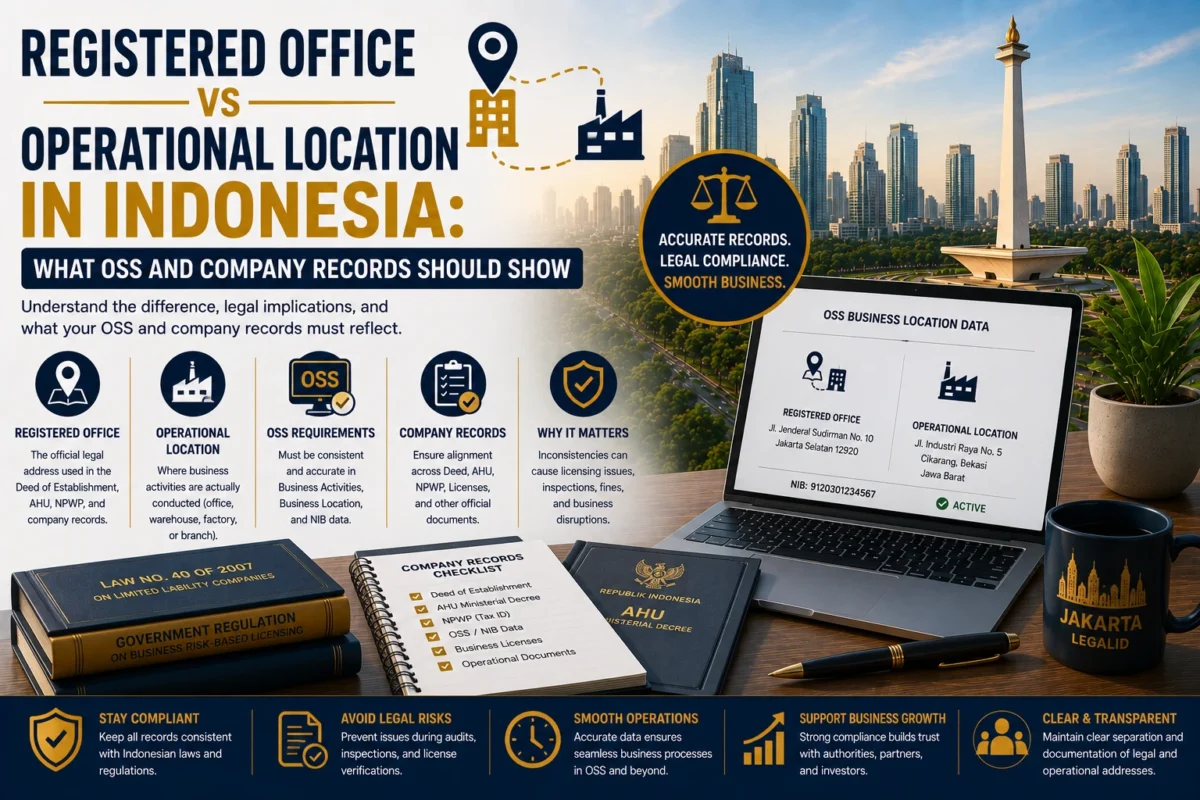
A company’s registered office and its operational location are not automatically the same thing. The registered office identifies the company at the corporate level, while OSS can also require location data for the specific business activity or project being licensed.
For founders and investors researching Registered Office vs Operational Location in Indonesia, the useful question is not whether one address must always appear everywhere. The correct question is which address belongs to the company itself and which location belongs to the activity actually being carried out.
Indonesia’s current risk-based business licensing framework is governed by Government Regulation No. 28 of 2025, with the current OSS procedures further regulated under Minister of Investment and Downstreaming/Head of BKPM Regulation No. 5 of 2025.
Registered Office vs Operational Location in Indonesia: What OSS and Company Records Should Show
The registered office is company-level information. It is the address associated with the legal entity and its corporate records.
The operational location or business activity location is where a particular commercial activity or project is carried out and can be recorded separately in OSS when the licensing process requires project or location information.
A company can therefore have:
- One registered corporate address
- One or more business activities
- Several project or operating locations
- Separate factories, warehouses, construction sites, outlets, or other facilities where relevant
These records should be consistent with reality, but they do not have to be identical in every business model.
The Registered Office Belongs to the Company’s Legal Identity
The registered company address forms part of the company’s corporate administration. During incorporation, the company establishes its domicile and address and then uses corresponding company information in later government registrations.
Jakarta Legal ID’s verified Business Setup and Licensing service lists a registered business domicile address for PT PMDN setup and a corporate-office domicile in Indonesia for PT PMA setup.
The registered office is commonly relevant to:
- Corporate establishment records
- Notarial corporate documents where applicable
- Ministry company information
- Tax administration
- OSS business-entity data
- Official correspondence
It should therefore be an address that the company is legitimately entitled to use and that can be supported by the appropriate documentation for the intended registration process.
Corporate Address Changes Should Be Treated as Corporate Changes
If the company changes its registered office, the issue is broader than changing one project pin inside OSS.
The company should first determine whether the move changes corporate data or provisions in its articles of association and then complete the applicable corporate amendment or notification process before ensuring that related government systems reflect the new information.
The official OSS system separately provides a Business Address Correction Guide, confirming that business-address information can require its own correction procedure within OSS.
The practical rule is simple: do not use an OSS project-location edit as a substitute for a corporate address amendment when the legal company’s address itself has changed.
Operational Location Is Activity-Specific
OSS risk-based licensing is organized around business activities, and location can be one of the data points attached to a particular activity or project.
Official OSS licensing guidance asks business actors to enter detailed business-field data including the business address, province, regency or city, district, village, and other activity-specific information. Where more than one business activity exists, OSS can also ask whether a subsequent activity is at the same location as the previous one.
This illustrates why the company’s legal address and each project’s operating location should be mapped separately.
One Company Can Have More Than One Business Activity Location
A company may legitimately have multiple activity locations when its business model requires them.
Examples include:
- A consulting company registered at one Jakarta office with project teams working temporarily at client sites
- A trading company with a head office and a separate warehouse
- A manufacturer with a corporate office and a factory in another city
- A construction contractor with one registered office and multiple project sites
- A hospitality company operating separate properties
The correct OSS treatment depends on how each activity and location is configured within the applicable licensing framework.
This is why Jakarta Legal ID’s KBLI Selection Jakarta guide recommends considering the location of the relevant project or operation when reviewing the licensing implications of a business activity.
Location Can Affect Licensing and Basic Requirements
Location is not just administrative information. Under the current risk-based licensing framework, business location can affect basic requirements and other licensing considerations.
The official OSS portal provides dedicated Business Location Information covering matters such as industrial zones, special economic zones, free-trade zones, national strategic projects, and spatial planning.
Depending on the activity, location can therefore affect questions such as:
- Spatial conformity
- Industrial-zone requirements
- Environmental requirements
- Project-specific licensing
- Sector-specific operational conditions
A company should not assume that an activity is licensed simply because the corporate head office is legally registered elsewhere.
When Registered Office and Operational Location Can Differ
The two locations can differ where the company has a legitimate corporate office but conducts particular activities at separate project or operating sites.
This can be logical for businesses such as:
- Professional and advisory companies
- Project-based construction businesses
- Companies operating several outlets or branches
- Companies with separate logistics or storage facilities
- Industrial businesses with management offices away from the plant
- Property or hospitality operators with multiple locations
The key control is that each government record should describe the correct function of the location.
The registered office should describe the company-level address. OSS activity information should reflect the place where the relevant licensed activity or project is actually located when that data is required.
When the Two Locations Need Closer Alignment
Some business models make the operational premises central to the licensing analysis.
A factory, warehouse, clinic, hotel, restaurant, workshop, mining project, or other location-dependent activity cannot normally be evaluated purely from the corporate-office address. The actual site may determine basic requirements, approvals, environmental treatment, sector licensing, or other conditions.
Likewise, if a company claims that its registered address is also its only place of business, its records should not contradict that representation by showing a materially different operating reality.
The issue is consistency rather than a universal one-address rule.
Jakarta Legal ID’s existing OSS RBA Licensing Jakarta guide provides broader context on how business activity, risk level, location, and applicable requirements interact within OSS licensing.
Registered Office vs Operational Location Pre-Filing Checklist
Before incorporation, a corporate amendment, or an OSS location update, confirm:
- The company’s registered legal address
- Whether the company has authority to use that address
- The actual activities performed at that address
- Every material KBLI activity
- The physical location of each activity or project
- Whether several activities share one location
- Whether an activity requires dedicated operational premises
- Whether spatial or environmental requirements attach to the project location
- Whether a factory, warehouse, store, construction site, mine, hotel, or other facility needs separate location data
- Whether the corporate address itself has changed
- Whether OSS needs an address correction, project update, or another licensing action
- Whether the company deed or Ministry record also requires amendment
Mapping these items before submission is easier than correcting inconsistent records after licenses have already been issued.
Common Address and Location Record Mistakes
Treating Every Address as the Same Data Field
A registered corporate address and a project location perform different administrative functions. Enter each location according to the purpose of the relevant record.
Using the Head Office as a Placeholder for a Physical Project
If a regulated activity occurs at a factory, warehouse, mine, construction site, hotel, or other premises, the actual activity location may be material to the licensing process.
Changing OSS Without Updating Corporate Records
When the registered company address changes, determine whether the corporate record must be amended before or together with the OSS update.
Changing Corporate Records but Leaving Old OSS Data
The opposite problem can also occur. Once a corporate address amendment is completed, related OSS information should be reviewed for consistency.
Ignoring Multi-Location Activities
Companies with several projects or locations should not automatically combine them into one address simply because they belong to the same legal entity.
Choosing Location Before Confirming the KBLI
Location requirements can depend on what the business actually does. Confirm the activity and licensing pathway before assuming a property is suitable.
Conclusion
A registered office identifies the company, while an operational or project location identifies where a particular activity occurs. They can be the same, but Indonesian corporate and OSS records should not be designed around the assumption that they always must be.
The strongest approach is to map the legal company address first, list each real business activity and project location, verify location-dependent requirements, and then ensure corporate, OSS, and licensing records each show the information appropriate to their function.
Review Your Company Address and OSS Locations Before Filing
Address problems often arise because the corporate office, project location, and operational premises are entered as though they were the same thing. Reviewing the company’s activities and locations before incorporation or an OSS amendment can identify which records need to change and which should remain separate.
Jakarta Legal ID assists business owners and investors with company setup, corporate amendments, and OSS licensing reviews. For company establishment and licensing support, its Business Setup service page is a relevant starting point for consultation.
FAQ – Registered Office vs Operational Location in Indonesia
What is a registered office in Indonesia?
A registered office is the company-level address associated with the legal entity and its corporate administration. It is distinct from a project or operational location that may be recorded for a specific business activity.
What is an operational location in OSS?
An operational or business activity location is the place associated with a particular commercial activity or project in the OSS licensing process. The required location data depends on the activity and licensing workflow.
Does the registered office have to be the same as every operational location?
No universal rule requires every project or operating location to be identical to the company’s registered office. A company can operate multiple activities or projects at different locations, but each record should accurately reflect the function of that location.
Can a Jakarta company have a factory outside Jakarta?
A company can have its corporate office in one location and conduct a manufacturing project elsewhere, subject to the applicable corporate, OSS, spatial, environmental, industrial, and other licensing requirements for the factory location.
Can one company have multiple project locations in OSS?
OSS licensing guidance accommodates business activity and location data at project level, including situations involving more than one activity. The exact setup should match the company’s actual projects and licensing requirements.
What should I do if the registered company address changes?
Determine first whether the change requires a corporate amendment or company-data notification, then update related government systems as applicable. An OSS address correction should not be treated as a substitute for a required corporate amendment.
What if only a project location changes but the head office stays the same?
If the corporate registered address is unchanged, the required action may be limited to the relevant OSS activity, project, or licensing data. The exact procedure should be checked for the affected business activity.
Does business location affect OSS licensing?
Yes. Under Indonesia’s risk-based licensing framework, project location can be relevant to basic requirements, spatial planning, environmental requirements, industrial-zone rules, and other activity-specific conditions.
Should a PT PMA use the same address for its head office and all projects?
Not necessarily. A PT PMA can have a corporate office and separate project or operating locations where its business model requires them. Foreign-investment, OSS, and sector-specific requirements should be reviewed for each relevant activity and location.
What records should be checked when a company moves?
Review the corporate deed and company data, Ministry records, tax information, OSS business-entity data, NIB and activity records, project locations, licenses, and any sector-specific registrations affected by the move.
Rujukan & Referensi
- BKPM JDIH — Government Regulation No. 28 of 2025 on Risk-Based Business Licensing
- BKPM JDIH — Minister of Investment and Downstreaming/Head of BKPM Regulation No. 5 of 2025
- OSS Indonesia — Business Address Correction Guide
- OSS Indonesia — Business Location Information