
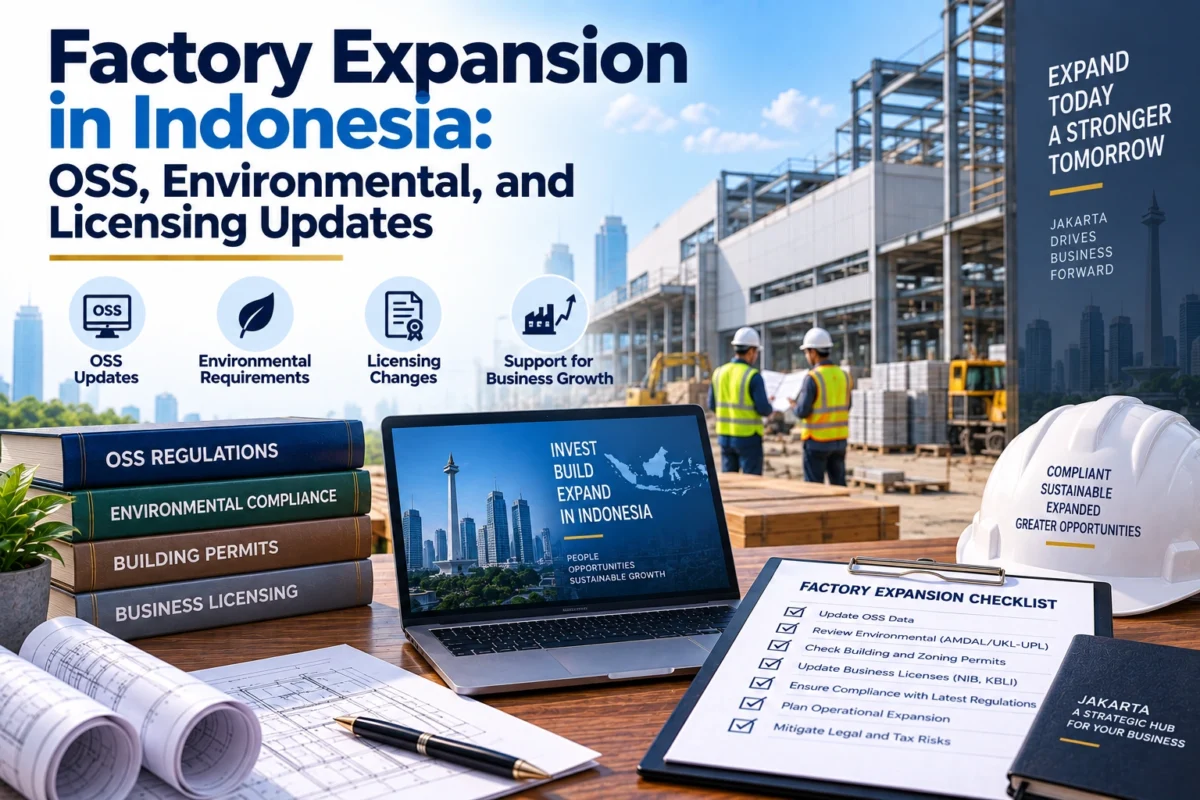
Factory Expansion Indonesia requires more than increasing production capacity or adding new machinery. Before expanding, manufacturers should review whether the project affects OSS business licensing, Environmental Approval, industrial licensing, factory land, production capacity, PBG, SLF, or other regulatory records.
Under Indonesia’s current risk-based licensing framework, an expansion should be reviewed before the company changes its OSS data or begins major construction. The correct compliance path depends on exactly what is changing in the existing factory operation.
A factory expansion Indonesia can trigger more than a construction project. Adding a production line, increasing capacity, introducing a new product, extending a building, leasing an adjacent site, or changing utilities may require updates across the company’s corporate records, OSS project data, environmental approval, building documents, sector licences, and operational reporting.
The correct response depends on what changes compared with the approved baseline. A company should therefore conduct a change-impact assessment before ordering machinery or beginning construction.
Factory Expansion Indonesia: What Must Be Updated?
A factory expansion can affect several regulatory records at the same time. The company should first compare its currently licensed operation with the proposed expansion and identify whether production capacity, machinery, land area, buildings, products, KBLI activities, or environmental impacts will change.
Define the expansion against the approved baseline
Create a table with two columns: the current approved condition and the proposed condition. Compare at least the products, KBLI, production process, annual capacity, machinery, raw materials, utilities, workforce, land area, building area, coordinates, storage, emissions, wastewater, waste, and logistics.
This baseline should be supported by actual documents, not only operational memory. Review the latest deed and approvals, NIB, standard certificate or licence status, OSS project data, environmental documents, PBG, SLF, site plan, technical approvals, and periodic reports.
If the records are inconsistent, resolve which data is legally operative before assessing the expansion. Updating one field without addressing connected approvals can create a new mismatch.
Check whether the activity classification changes
An expansion may remain within an existing KBLI, add a new KBLI, or reveal that the original classification no longer describes the operation. A new product does not automatically require a new code, and using the same factory does not automatically mean that the existing code is sufficient.
Compare the proposed products and production stages with the current Indonesian classification and OSS result. Our KBLI selection guide explains why the operational facts should lead the classification decision.
If a new activity is added, assess its ownership, capital, risk level, sector requirements, and location compatibility before entering it into OSS.
Review the OSS project and licensing status
Government Regulation No. 28 of 2025 is the current principal framework for risk-based business licensing and replaced Government Regulation No. 5 of 2021. The regulation is published in the official BPK legal database.
The company should determine whether the change requires an amendment to project data, an additional business activity, fulfilment of a standard certificate, a licence update, further verification, or another action. Check both the issued identifiers and their current status. Our OSS RBA licensing guide provides the general framework.
For legacy records, review the transition guidance available through the official OSS guidance library. Do not create duplicate projects merely to bypass an unresolved data issue without first understanding the consequences.
Reassess environmental approval
Capacity, raw materials, process, emissions, wastewater, waste, site area, or supporting infrastructure may change the environmental assessment. Compare the expansion against the scope and commitments in the current environmental document and approval.
Government Regulation No. 22 of 2021 governs environmental protection and management. Its official text is available through the BPK legal database. A competent environmental professional should determine whether the proposed change is covered, requires an amendment, or requires another process.
Do this review before finalising equipment and layout. The environmental work may affect the design of wastewater treatment, storage, chimneys, monitoring points, drainage, buffers, and emergency systems.
Update building and function documentation
A new building, extension, mezzanine, structural change, utility building, or conversion of warehouse space may affect the PBG and SLF. Government Regulation No. 16 of 2021 provides the building-regulation framework and is available in the official BPK legal database.
Confirm whether the current documents cover the proposed footprint, use, and technical specifications. Engineering design, fire safety, structural adequacy, accessibility, and function certification should be assessed by the relevant qualified professionals.
Check sector, product, and operational obligations
Depending on the industry, an expansion may affect product registration, Indonesian National Standard requirements, technical personnel, import approvals, bonded or customs facilities, storage controls, distribution licences, halal obligations, health or safety requirements, and sector reporting. The applicable list depends on the products and process.
Also check whether existing contracts, insurance, financing, landlord approvals, industrial-estate rules, and utility allocations permit the change. An OSS update does not replace private approvals or technical compliance.
Coordinate corporate and investment data
Increasing machinery, inventory, buildings, or working capital may change the investment plan recorded in OSS. New activities can also require amendments to the company’s deed or corporate approvals. Foreign-investment companies should review whether the proposed activities and ownership structure remain compatible with the current rules.
If the expansion involves a new entity, acquisition, or restructuring, coordinate it with the business setup workstream so the operational and corporate records do not diverge.
Build a controlled implementation plan
A reliable expansion plan lists each approval or update, dependency, evidence owner, technical adviser, target date, and operating restriction. Separate tasks that may run in parallel from tasks that depend on an earlier approval. Include a final readiness review before commissioning or commercial production.
The company should preserve submission receipts, issued documents, verified drawings, authority correspondence, and the internal decision record. After completion, update the compliance calendar for renewals, reports, monitoring, and any approval conditions.
How Jakarta Legal ID can assist – Factory Expansion Indonesia
Jakarta Legal ID can review the administrative baseline, map affected OSS and corporate records, coordinate document collection, and help sequence an industrial expansion. Technical studies, professional certifications, and government decisions remain with the competent parties. Visit our industrial licensing service and provide the existing approvals together with a clear description of the proposed change.
Related industrial guides
This article is general information, not a legal opinion or a guarantee of approval. Requirements must be verified for the current rules, project facts, OSS configuration, location, and competent authority.